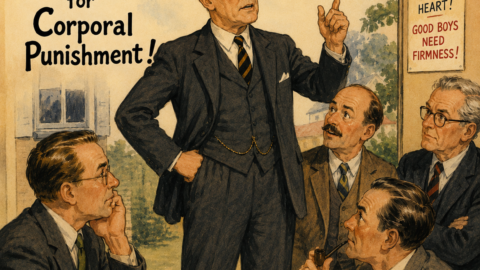
The curious and troubling saga of Wildman belongs unmistakably to that peculiar post-war British landscape in which morality, discipline, authority and social anxiety collided with remarkable force. In an age still haunted by wartime austerity and deeply fearful of juvenile delinquency, corporal punishment retained many passionate defenders. To modern eyes the controversy may appear extraordinary; yet in the Britain of the late 1940s and early 1950s, arguments over the cane, the birch and the strap were debated not merely in schoolmasters’ common rooms, but in Parliament, churches and drawing rooms across the nation.
Wildman emerged during what newspapers of the period called “the cosh wave” — a sudden rise in violent street robberies carried out by gangs of youths armed with crude bludgeons or “coshes.” Public alarm was intense. Respectable citizens feared that post-war Britain, wearied by rationing and social upheaval, was breeding a generation lacking discipline and restraint. It was in this atmosphere that Wildman found his audience.
His argument, endlessly repeated in pamphlets, lectures and correspondence, was starkly simple. Better, he insisted, that a boy receive a sharp but temporary punishment at home than later endure the lasting disgrace of the prison cell. The marks left by the rod faded in days; the stain of a criminal conviction might cling for life. To many anxious parents and conservatives of the era, this reasoning carried undeniable force. Even some former critics of corporal punishment softened their opposition amid fears of rising lawlessness.
Wildman preached that domestic discipline was not cruelty but prevention. In his view, the failures of the home produced the thug, the vandal and the street assailant. A moderate chastisement administered by a stern father, he argued, was infinitely preferable to the birching shed of the prison system — or worse still, the suffering inflicted upon innocent victims of violent crime.
Yet therein lay the beginning of his tragedy. What may once have begun as an eccentric but sincerely held crusade gradually drifted into darker territory. Increasingly, ethical considerations appeared to give way to obsession. Those who encountered Wildman during his later years often remarked upon his extraordinary conviction that he alone had been chosen to restore moral discipline to modern Britain. Admirers called him tireless; detractors called him dangerous. There was, unmistakably, something messianic in his bearing.
By the early 1950s the authorities had evidently begun paying close attention.
The storm finally broke in the winter of 1953. Acting upon information gathered from Wildman’s own publications, detectives arrived at his premises armed with a search warrant. What they discovered astonished even hardened officers.
Wildman operated from a cluster of cramped rooms overflowing with printed matter, correspondence and disciplinary implements. He employed several assistants — chiefly women — who managed orders and packaging. According to reports from the time, the police methodically emptied the premises over the course of three extraordinary hours. Four large vans were required to remove the confiscated material.
Nothing escaped seizure. Drawers were emptied, filing cabinets stripped bare and every pamphlet collected as evidence. The officers also removed what newspapers dramatically described as an “armoury”: canes, birches, straps, whips and other instruments stacked in cupboards, leaning against walls or displayed openly about the rooms.
Throughout the raid Wildman reportedly remained remarkably composed. Witnesses recalled him standing quietly amidst the chaos, murmuring only that his solicitors would deal with the matter.
The summons arrived shortly thereafter.
Charged with obscene libel, Wildman appeared before the court amid considerable public curiosity. Yet even then, faced with mounting legal peril, he displayed a recklessness bordering upon self-destruction. The trial was postponed twice, and during the interval — despite warnings from both police and counsel — he allegedly continued distributing the very material under investigation.
To observers, the irony was extraordinary. Wildman’s own literature frequently described the stubborn schoolboy who ignored repeated warnings and inevitably suffered punishment. Now the author himself appeared to be enacting precisely that moral drama.
When the trial finally commenced in May 1953, the prosecution painted a deeply unflattering portrait. They alleged that Wildman had long operated a business whose activities extended beyond moral advocacy into outright obscenity. Among the publications produced before the court were pamphlets bearing sensational titles such as A Girl’s Beating and Punishment Postures, some accompanied by illustrations that prosecutors argued removed any pretence of educational or disciplinary intent.
Particularly damaging was the evidence gathered by undercover police officers, who had posed as ordinary customers and successfully ordered material through the post. Even after formal charges had been laid, Wildman allegedly continued supplying them with pamphlets, demonstrating what the prosecution described as utter impenitence.
The defence faced an unenviable task.
Counsel attempted to portray Wildman not as a corrupter, but as a fanatic driven by damaged psychology and misguided religious fervour. Evidence was introduced suggesting he had suffered physical and emotional trauma which affected his judgement. Witnesses spoke of his genuine religious devotion: he taught Sunday School regularly and believed wholeheartedly that he was engaged in moral work sanctioned by God.
Perhaps most fascinating was the account of how his peculiar enterprise began. Demobilised after the Second World War, Wildman had initially attempted to establish a modest trade selling leather goods and razor strops. When business faltered, he conceived the idea of converting the same leather into punishment straps — a decision that would ultimately shape the course of his life.
The magistrate, however, remained unmoved.
Though declaring he had no desire to “crush the man out of existence,” the judge concluded that Wildman required what he ironically termed “a sharp lesson.” The phrase, echoing Wildman’s own rhetoric, reportedly drew murmurs throughout the courtroom.
“He must learn,” the magistrate declared sternly, “that he is not the world’s Messiah in this matter.”
An initial fine of one thousand pounds — a crushing sum for the period — was considered. Eventually the sentence was reduced to five hundred pounds payable within six months, with a year’s imprisonment as the alternative. Additional consequences followed swiftly. Wildman’s adopted daughter was removed from his care, while proceedings for the adoption of another child were halted immediately.
And with that, the strange public career of Wildman effectively came to an end.
Yet the memory of such figures lingers curiously in British social history, especially among those who grew up in the years when corporal punishment remained woven deeply into domestic and educational life.
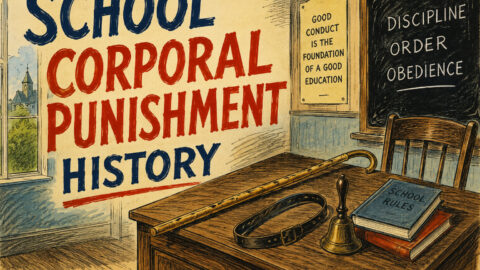
Many men of that generation can still vividly recall the dreaded arrival of the cane purchased through discreet mail-order catalogues from London suppliers. Such implements were not theatrical curiosities, but instruments of entirely ordinary household discipline. The crooked-handled school cane, polished smooth from use, possessed a fearsome reputation among schoolboys of the era.
For countless families, punishment of this kind was considered neither exceptional nor abusive, but simply part of respectable upbringing. Fathers who had themselves endured strict Edwardian or Victorian discipline often saw little reason to abandon practices they believed had produced resilience and obedience.
One former schoolboy of the 1950s later recalled that the canes in his household seemed almost indestructible — viciously flexible, hard-wearing and put to frequent use upon four unruly brothers. Underpants, he joked grimly, wore out long before the canes ever did.
Such recollections illuminate not merely the story of one obsessive campaigner, but an entire vanished world: a Britain of stern fathers, anxious morality, unquestioned authority and punishments accepted with a severity that now feels remote and unsettling. Wildman himself may have fallen into notoriety, but the culture from which he emerged was far broader, more complicated and far more widely accepted than later generations might comfortably imagine.