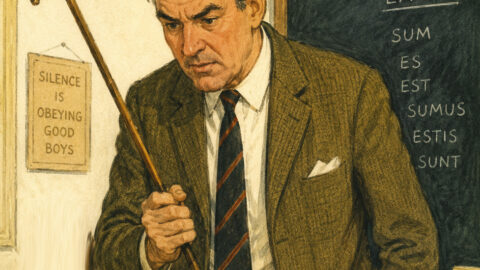
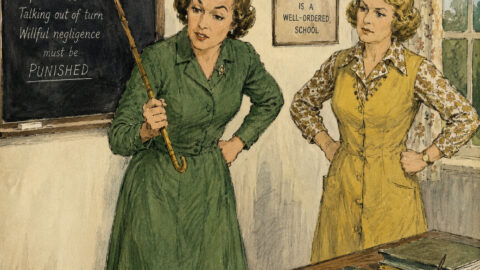
In those days, school discipline carried with it a sense of theatre as much as punishment. Every master seemed to possess his own preferred method of dealing with troublesome boys, and among the more memorable characters was our newly appointed Physical Education master, a stern fellow whose arrival brought with it an altogether unfamiliar instrument of correction.
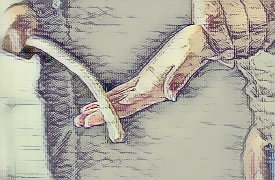
The implement itself was not a regulation cricket bat, at least not in the proper sporting sense. It was a miniature version, perhaps no more than two feet in length, though in the fearful imagination of a schoolboy it appeared considerably larger whenever it emerged from the games office. Smoothly polished and deceptively light in appearance, it resembled more the paddles reportedly used in American schools than anything associated with English cricket. None of us had encountered such a thing before, and naturally its novelty only added to its reputation.
My first experience of it remains vivid even after all these years. I was summoned forward and instructed to assume the customary position, bending over while the master delivered three sharp strokes across the seat of my trousers. The pain itself was intense but brief, a fierce stinging heat that spread rapidly until my backside felt as though it had been set ablaze. Afterwards, I remember my bottom being an extraordinarily deep shade of red, and sitting through the following lesson proved distinctly uncomfortable. Fortunately, as was often the case with these punishments, the worst of the discomfort faded within the hour, though the embarrassment lingered somewhat longer.
The PE master quickly established a reputation for severity. Three strokes seemed to be the standard tariff for ordinary offences, and over the course of my school years I received that punishment on three further occasions. Yet rumours circulated constantly around the corridors and changing rooms that certain unfortunate boys, guilty of more serious misdemeanours, had received the full six strokes. To us, such a sentence sounded almost unbearable, and one could only imagine the agony involved.
Not long ago, I happened upon an intriguing discussion on a local internet forum in which former pupils from another school were reminiscing about the eccentric disciplinary methods of one particular teacher. Curiously enough, this master also employed a miniature cricket bat when punishing errant boys. The astonishing difference, however, was that he supposedly delegated the actual administration of the punishment to a randomly selected girl from the mixed class.
I must confess that I found the story exceedingly difficult to believe. In the schools of my era, no master would ever have surrendered disciplinary authority to a female pupil, regardless of how amusing the spectacle might have appeared to the rest of the class. Although it would undoubtedly have provided unforgettable entertainment, I cannot imagine any of the girls in my own school wishing to participate in such proceedings. Watching was one thing; actively taking part would have been quite another matter entirely.
Indeed, for us boys, the humiliation of being punished in front of the girls was mortifying enough. Physical punishment in mixed classes often carried a curious element of public performance, and some masters seemed positively aware of the dramatic effect they created. A caning or whacking was rarely administered without ceremony. Boys might be ordered to touch their toes, bend over the back of a chair, or drape themselves awkwardly across the master’s desk. Particularly theatrical masters occasionally instructed a girl to rise from her desk so that the unfortunate culprit could bend across it before the assembled class. Commands such as “bend over further” or “keep those knees straight” were barked with an almost military precision, ostensibly to ensure the punishment landed effectively, though no doubt also to heighten the spectacle.
Looking back now, it is difficult not to recognise how much school discipline in those years relied upon ritual, embarrassment, and display as much as physical discomfort. The punishments themselves were usually short-lived; the sting faded quickly enough. What endured far longer in the memory was the ordeal of standing before one’s classmates, painfully aware of every suppressed laugh, every whisper, and every curious glance from the girls seated nearby.
Such scenes belong unmistakably to another age — an era when strict discipline was regarded not merely as acceptable, but essential, and when many schoolmasters considered a sound whacking as much a part of education as Latin verbs or algebra.