In retrospect, one of the more curious episodes connected with the school’s turbulent final years was the affair involving the eccentric disciplinarian known simply as Wildman. Whether the educational authorities themselves regarded the Headmaster’s practical joke with amusement, irritation, or quiet embarrassment remains uncertain. Yet there is perhaps one revealing clue. When, in due course, the school itself was dissolved for the reasons already outlined, no official mention whatsoever was made of the “Wildman Incident” — a silence that is difficult to ignore. Had the authorities wished to mount a broader condemnation of the school’s philosophy or methods, the affair would surely have provided irresistible ammunition.
The omission is therefore striking.
But who, precisely, was Wildman? And what, beyond the theatricality and controversy that surrounded him, did he imagine himself to be accomplishing?
The answer, on one level at least, is surprisingly straightforward. Wildman appears to have believed — and believed with extraordinary sincerity — that he had been called upon to preserve and spread the doctrine of corporal punishment at a moment when it was rapidly retreating from British life. To him, the cane, the strap, and the birch were not relics of a harsher age but instruments of moral order. In an era increasingly suspicious of physical discipline, he cast himself almost as a missionary figure, a lonely apostle standing against national decline.
There were, it should be noted, those who attributed some of his intensity to injuries sustained in a succession of accidents, injuries that may well have affected his mental balance. Yet even critics conceded that his convictions were genuine. Wildman insisted repeatedly that his campaign was ethical rather than punitive in spirit. He claimed among his correspondents and clients monasteries, convent schools, clergy, and church educators. Again and again he returned to what he regarded as the moral necessity of “judicious chastisement.”
To Wildman, modern permissiveness lay at the root of social disorder. He lamented what he described as the collapse of discipline throughout Britain and frequently pointed to phenomena such as the so-called “Coshing Wave” — outbreaks of youth violence that had disturbed public opinion during the period — as proof that earlier firmness in the home might have prevented later brutality in the streets. One may reject his conclusions entirely, yet it would be misleading to dismiss them as wholly isolated eccentricities. At the time, substantial sections of respectable opinion, including figures of considerable establishment authority, still accepted corporal punishment as a regrettable but sometimes necessary element of upbringing.
Where Wildman damaged his own cause was in the manner of its presentation.
For although he spoke endlessly of ethics and moderation, he possessed little instinct for restraint in publicity. He seemed irresistibly drawn toward sensationalism. He emphasised aspects of whipping and punishment that many otherwise sympathetic people preferred to leave discreetly unspoken. His lectures, pamphlets, and advertisements displayed a curious blend of moral earnestness and vulgar showmanship. He craved attention, and too often pursued it clumsily.
There was, too, a marked absence of proportion in much that he said and wrote. Critics who might initially have regarded him as merely old-fashioned began to suspect something more troubling. His inability to tolerate criticism, his extravagant denunciations of opponents, and his relentless insistence upon his own righteousness inevitably invited speculation about deeper motives. Whether those suspicions were fair is another matter altogether, and perhaps one for psychologists rather than historians.
Psychologists themselves, however, occupied a special place in Wildman’s gallery of enemies. He poured scorn upon psychoanalysis, progressive education, and virtually every modern theory of child development. In his eyes, these movements had done more than anything else to undermine British discipline and authority. Ironically, this uncompromising hostility cost him many potential allies. Plenty of moderate parents and teachers still believed in occasional physical punishment, yet recoiled from Wildman’s absolutism and theatrical moralising.
For most ordinary people who accepted the principle of an occasional smack or caning, no elaborate ideology was required. They saw such measures simply as one among many tools of discipline — unpleasant perhaps, but sometimes effective. Wildman, by contrast, surrounded the subject with an almost evangelical fervour that many found excessive and faintly alarming.
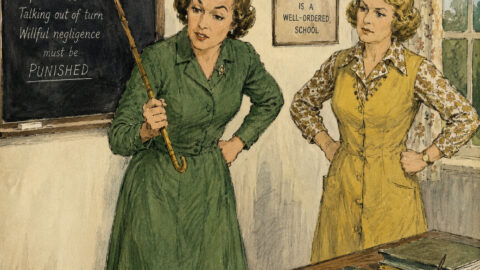
This tendency was especially evident in the elaborate apparatus associated with the Corpun Educational Organisation, the institution with which his name became inseparably linked. Wildman approached punishment with a systematising zeal that bordered on the obsessive. Children, in his literature, appeared to pass through successive “disciplinary ages”: the strapping age, the tawzing age, the caning age, and finally the birching age. Different instruments were recommended for different stages of development, each carefully graded according to severity and flexibility.
To many sensible parents, this must have seemed bizarre.
A mother might readily admit that young Jack deserved “a good whacking” for stealing apples or tormenting the neighbour’s dog, yet still recoil from catalogues describing specialised canes and straps in exhaustive detail. Wildman’s world was overstocked with paraphernalia. Punishment, which most households regarded as occasional and regrettable, became in his hands a strangely elaborate science.
One particularly unsettling anecdote he related with approval concerned a father who, upon the birth of his son, began assembling a collection of disciplinary instruments intended for use throughout the child’s upbringing — culminating in a specially selected “Wildman Smoky Malacca” cane reserved for the boy’s fourteenth birthday. To many readers, stories of this sort did little to strengthen Wildman’s public credibility.
Yet there is another side to the portrait, and fairness requires that it be acknowledged.
Contrary to the assumptions of some critics, Wildman consistently described himself as an opponent of cruelty. He was no advocate of savage flogging. Indeed, he expressed horror at the monstrous punishments once common in earlier centuries under notorious schoolmasters such as Busby and Keate, or within the brutal disciplinary systems of eighteenth- and nineteenth-century armies. He subscribed generously to organisations devoted to the protection of children and repeatedly stressed what he termed “moderation in chastisement.”
His idea of moderation may strike modern readers as unusual. If, for instance, a mother wrote to him confessing she had administered twenty-five strokes to a disobedient daughter, Wildman would gently suggest that twenty-one would probably have sufficed. Such distinctions were important to him. Significantly, he never advocated increasing punishments; his instinct, however peculiar the context, was always to reduce excess.
Another of his strongly held principles was what he regarded as fairness between the sexes. Wildman disliked what he saw as sentimental double standards in discipline and argued consistently that girls as well as boys should, where necessary, receive equal chastisement. This notion of disciplinary equality appeared repeatedly throughout his writings. Whether English parents and teachers ever embraced the idea to the extent he hoped is doubtful. Wildman himself admitted readily enough that boys, in practice, usually provided more frequent disciplinary cases than girls.
Even among those who broadly accepted corporal punishment, however, there remained one fundamental disagreement with Wildman. Most parents and masters believed punishment should remain flexible — that there were occasions when mercy, discretion, or simple understanding might serve a child better than any thrashing. Wildman seldom conceded this point. He seemed unable to imagine circumstances in which a boy plainly deserving punishment might nevertheless benefit from being spared it.
And it was perhaps here, more than anywhere else, that he revealed the central weakness in his philosophy. Discipline, in ordinary life, depends not merely upon rules or punishments but upon judgment, humanity, and proportion. Wildman possessed conviction in abundance; what he lacked was the ordinary commonsense that tempers conviction with sympathy.
Had he possessed more of that quality, he might have become a respected if controversial adviser on school discipline. Instead, he became something rather sadder and more peculiar: a man so consumed by his cause that he ultimately undermined it himself.