There are certain sounds that never truly leave a generation.
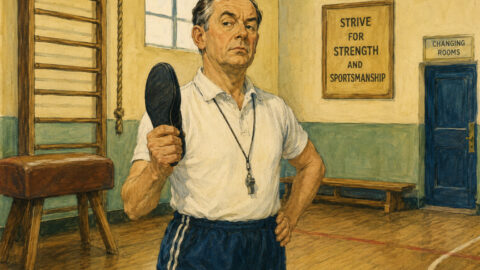
The squeak of plimsolls across polished wooden floors. The whistle hanging from a P.E. master’s neck. The smell of floor polish mixed with winter air drifting through high gymnasium windows. And, for many who passed through British secondary schools in the late 1960s and early 1970s, there was another sound too — the sharp crack of discipline echoing around the sports hall.
Last year, after forty-five years apart, I attended a pair of school reunions. Time, of course, had worked its inevitable magic upon us all. The boys who once sprinted reluctantly around muddy playing fields had become grey-haired grandfathers. The girls who once giggled in corridors beneath school blazers now arrived with reading glasses dangling from elegant chains. Faces had softened, hair had vanished, waistlines had expanded, yet somehow the old personalities returned within minutes of meeting again.
And then, to everyone’s delight, one of our old teachers appeared.
He arrived quietly alongside his wife — a former Physical Education master now well into his late eighties. Age had stooped him slightly, but he still possessed that unmistakable bearing that only schoolmasters of that era seemed to carry: upright, stern, quietly authoritative. Instantly, conversations around the room drifted back half a century.
For this was no ordinary teacher.
This was the man who had once lined us up in the gymnasium on icy winter mornings and barked out instructions in clipped military tones. The man whose discipline had become the stuff of school legend. And, most memorably of all, the man with the sawn-off cricket bat.
In a moment of mischievous affection, those organising the reunion had prepared a surprise. Presented to him that evening was a miniature replica of his infamous “instrument” — a tiny sawn-off cricket bat, lovingly recreated as a tongue-in-cheek tribute to those long-ago P.E. lessons.
The room erupted with laughter.
Someone called out about the dreaded warm-up routine:
“Remember those freezing mornings? Bend over and touch your toes!”
The old master smiled faintly, shaking his head with the innocence of a man either genuinely forgetful or wisely selective with his memories.
“Can’t remember doing that,” he replied.
The laughter only grew louder.
Yet what struck me most that evening was not resentment, but respect. Genuine respect. Here stood a man feared by generations of schoolboys, and yet surrounded by warmth, handshakes, and old pupils eager to speak with him once again. Time, it seemed, had softened not merely the man, but also the memories themselves.
I attended a co-educational secondary school during that curious transitional period between the fading austerity of post-war Britain and the freer, louder decade that followed. Discipline in schools was still accepted as part of everyday life, particularly in the gymnasium, where the rules seemed harsher and tempers shorter.
We had two P.E. masters, both legendary in their own distinctive ways.
Corporal punishment was administered with alarming regularity. Hardly a lesson seemed to pass without some unfortunate boy being summoned to the front of the gym to “touch his toes” or bend over the vaulting horse while the rest of the class stood in uneasy silence. Looking back now, it is astonishing how routine it all appeared at the time.
One master favoured the plimsoll.
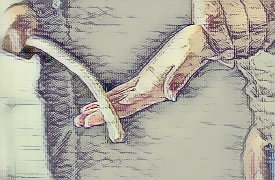
Used with expert precision and considerable force, it possessed a sting that few forgot. The other preferred something far more memorable: a small cricket bat unlike any standard piece of sporting equipment.
It looked almost toy-like, as though borrowed from a child’s cricket set. Yet there was nothing childish about its purpose. The bat had a distinctive red rubber grip extending all the way down the handle, giving it a curious appearance somewhere between sports equipment and disciplinary tool.
I remember one occasion vividly.
Another boy and I had been caught throwing a medicine ball at one another during class — horseplay that today might earn little more than a warning, but in those days was treated as serious misconduct. The P.E. master said very little. Instead, with chilling calmness, he ordered me to fetch the bat from the changing rooms.
Even now, decades later, I can still recall the peculiar feeling of walking down that corridor knowing precisely what awaited us.
When I returned, the vaulting horse had already been positioned in the centre of the gymnasium.
We were instructed to bend over, gripping the bars tightly. Three strokes each, delivered firmly across the seat of our shorts. I remember shutting my eyes moments before the first blow landed. The crack echoed around the vast gymnasium walls with startling force. The pain was immediate and fierce, radiating through the body with astonishing intensity. Somehow, through clenched teeth and youthful pride, I managed to hold back the tears.
Around us, the rest of the class stood in silence.
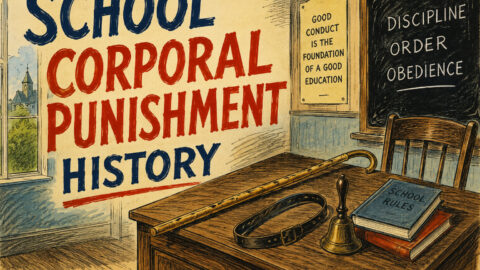
At our school, corporal punishment came in many forms. There was the cane, of course — dreaded throughout every corridor. There was the leather strap, feared particularly by the older boys. And there was the plimsoll, delivered with humiliating ceremony during games lessons. Yet somehow the cricket bat occupied a category all of its own. It felt more personal, more theatrical, perhaps because it seemed unique to that particular master.
And strange though it may sound now, none of us questioned it very much at the time. It belonged to the fabric of school life in that era, woven into the rituals and routines of British education before attitudes changed forever.
Today such scenes seem unimaginable, relics from another country entirely. Modern schools operate under vastly different values, and few would argue otherwise. Yet memory is rarely simple. The passage of time has a curious way of blending fear, humour, discomfort, and nostalgia into something far more complicated.
At that reunion, watching old classmates laugh together about those gymnasium punishments from nearly half a century earlier, I realised we were not celebrating the punishments themselves. Rather, we were remembering a vanished age — an era of strict teachers, polished gym floors, shouted instructions, and schooldays that shaped us in ways both harsh and enduring.
And somewhere in those memories still lingers the sharp echo of a cricket bat in a cold school gymnasium.