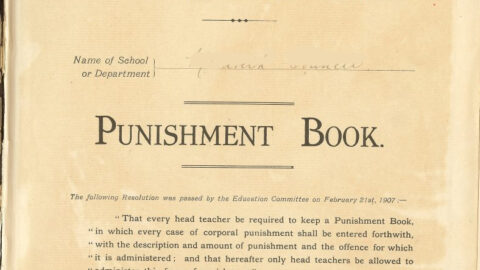
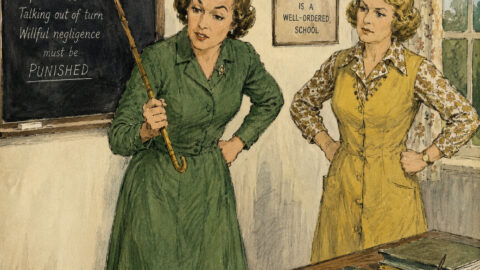
Corporal punishment in schools was experienced very differently depending on the era, the country, the school, and the individual teacher administering it. For many pupils, anticipation and ritual were often as significant as the physical punishment itself.
One former pupil recalled:
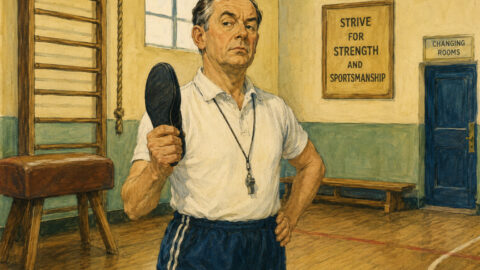
“He told me to put my hands on his desk. He squeezed around the desk — it was a small room — behind me and turned up my blazer at the back. There was a whirr and a dull thud and almost immediately a repeat of the same. It was uncomfortable rather than painful; I never saw his cane. In a way I think I was a bit disappointed — all this stuff about not being able to sit down for hours, leaping up with surprise and pain. By the time I’d walked down the corridor back to my class, any discomfort had gone. If anything, the application of the slipper to thin PE shorts was more painful.”
Experiences varied enormously. Much depended on the teacher, the type of cane or paddle used, what the pupil was wearing, and even the pupil’s own build and pain tolerance. The same punishment administered by different teachers could feel entirely different. Some teachers delivered quick, formal punishments with little ceremony; others created an atmosphere that heightened anxiety long before the first stroke landed.
The psychological effect was often considerable. The sight of the cane itself, being summoned from class, walking to the headmaster’s office, or hearing the swish of the cane through the air all contributed to a mounting sense of dread. One former student described it this way:
“Much of the effect was mental. The existing anxiety increased on seeing the cane and being guided into the required posture, causing turmoil in the stomach and an inability to speak lucidly, as my mind was preoccupied with the immediate ordeal. The uniquely sinister sound of the cane zipping through the air and connecting very loudly is alarming, and the initial sting does increase in seconds. The truth was that it hurt more than I thought I had remembered. That was always the same shock.”
Afterwards, reactions also differed widely. Some pupils were deeply embarrassed by being punished publicly or semi-publicly, while others seemed to accept it as simply another part of school discipline. The physical aftereffects could last from minutes to several days depending on severity.
“I left the room with stinging buttocks, but somehow feeling elated it was over. Walking or just standing still was a strange sensation, as if my bottom had been altered in some way, constantly aware of it, aside from the unusual warmth and smarting. I also wondered oddly if others could divine I had been caned. Someone mentioned sitting, but luckily our hard wooden benches were fairly narrow so I could ease back and overhang.
The irritation diminished over a few days as the tramlines likewise faded and the remaining red flecks disappeared, but I no longer remember how long that took.”
Many schools treated corporal punishment as a routine disciplinary measure rather than an extraordinary event. In Britain, caning and slippering remained common in many schools until the 1980s, while in parts of the United States paddling continued in some districts long afterward. In some American Southern states, corporal punishment remained officially sanctioned well into the 21st century.
One teacher reflecting on disciplinary practices in senior high school explained:
“In high school, especially senior high, in states such as both the one in which I teach and my home state, it is necessary to paddle both young men and women with considerable force if paddling is going to be an effective lesson. However, the reaction of some students is disproportionate to the pain inflicted, and to me can only be explained by the entire ritual of the paddling.”
The teacher went on to describe a disciplinary incident involving misuse of a mobile phone:
“For example, this week — and we are hardly back to school — I was asked to act as witness to a hallway paddling for misuse of a mobile phone. In my county we are one of the few that still allows hallway paddling. One of our more attractive seniors had been covertly texting in a social studies period taken by our coach Samantha.
Frankly, had it been a male teacher she might have got away with it, but not with Sam. That, plus a potty mouth, earned her three licks in the hallway. I was the next-door teacher, so was asked to witness the punishment. Sam used a good ash one-inch-thick paddle, and yes, she really blistered the girl’s butt. But the reaction was as if murder was being committed. Sam added two swats for the refusal to stay down during the punishment and for the excess fuss caused.”
Accounts such as these demonstrate how corporal punishment often relied as much on authority, humiliation, anticipation, and ceremony as on physical pain itself. The emotional memory frequently remained vivid decades later, even when the physical pain had long faded.
There were also pupils who seemed to receive corporal punishment repeatedly. These were often not malicious children, but energetic and impulsive boys who enjoyed testing boundaries.
“I too have thought about those who were repeatedly caned. Typically they were fairly high-spirited lads who enjoyed a prank — these days they might be described as ‘hyperactive’ — though I might prefer the word ‘mischievous’.
I don’t think they lacked intelligence, but they tended not to be the top students. Even so, their lively characters gave them some status in the class. I have to admit I sometimes wished I was more like them because they made friends easily and seemed to have a lot of fun.
However, they were not very good at reading the warning signs when liveliness crossed the line into unruliness and as a result often ended up in the headmaster’s study. For them it was one of the risks they were prepared to take. They didn’t enjoy being caned, but they didn’t fret about it. It was soon over and forgotten until the next time. They may have used some choice words about the headmaster, but rarely heard a word of real complaint.”
Today, opinions on corporal punishment remain deeply divided. Critics argue that it fostered fear, humiliation, and resentment, while defenders often claim it maintained discipline and order in difficult educational environments. Regardless of viewpoint, firsthand recollections reveal that the experience was rarely forgotten. For many former pupils, the memory of waiting outside the office, hearing the cane swish through the air, or returning quietly to class afterwards remains extraordinarily vivid decades later.