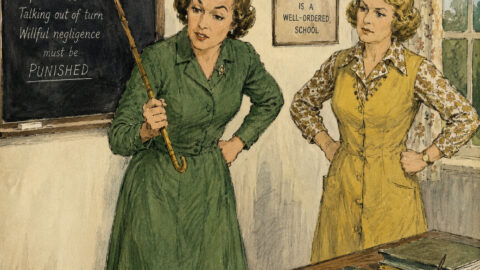
I think the majority of boys at my school were spanked, slippered, or caned at least once. Some experienced it more often, and a much smaller percentage seemed to receive punishment frequently. Had you asked me at the time, I would probably have said that certain boys were unfairly targeted by particular teachers, though with hindsight I suspect that was only partly true. I wonder how many others had the same impression during their school days.
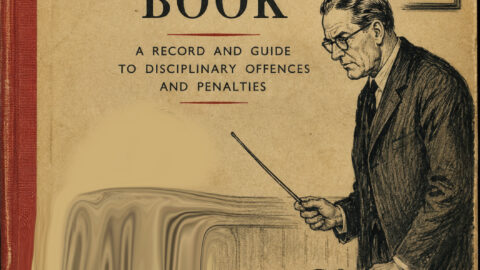
One class clown simply could not resist impersonating teachers, mimicking their voices and making ridiculous remarks from the back of the classroom. To the rest of us it was hilarious, but eventually the teachers stopped finding it amusing and he was sent to the headmaster for the cane. Incredibly, when he entered the office he still could not help himself. Seeing the punishment book and cane produced, he burst out laughing and continued joking. It was not a wise strategy. The caning quietened him for a while, though he remained something of a comedian throughout school. Ironically, he later became an eminent scientist, so it clearly did not hold him back in life.
Another student was also fond of wisecracks. One teacher, Mr Church, was among the most patient and mild-mannered men imaginable. I never once saw him lose his temper. On one occasion he was gently admonishing the class when a boy suddenly shouted, “Watch out lads, the Church Bells are ringing!” Mr Church was not amused. Calmly, he instructed the boy to accompany him to the gymnasium next door. We never discovered exactly what happened there, but the boy returned considerably quieter than when he left.
For some pupils, the rewards of misbehaviour outweighed the consequences. I do not believe pain, or even the fear of pain, is enough on its own to stop people doing things they genuinely enjoy or value. If it were, none of us would participate in sports or activities that involve discomfort or injury. Athletes push through pain to achieve personal bests, riders climb back into the saddle with barely healed ribs, and people persevere because the reward matters more than the suffering. In the same way, for certain pupils smoking, truancy, or clowning around in class mattered more than the threat of punishment. They carried on regardless because, to them, the social rewards, excitement, or sense of rebellion outweighed the consequences.
Some boys simply were not very good at recognising warning signs that they were pushing matters too far. Men, generally speaking, are often poor at recognising subtle signs of displeasure. That tendency does not magically appear in adulthood. I sometimes joke that this explains why I find myself ranting at a bewildered husband protesting that I never told him I was unhappy. In my mind, I have been making it obvious for days. I saw the same thing at school. Certain boys would fool around endlessly in class and then seem genuinely shocked when a teacher finally lost patience and sent them to the deputy head. They never seemed to develop the ability to read the atmosphere, and as a result they repeatedly found themselves in trouble.
Of course, some adults had short tempers and fragile egos. They could not tolerate being questioned, contradicted, or challenged in even the smallest way. A teacher with that sort of personality naturally had far less tolerance for lively or spirited pupils, especially those who lacked the ability to recognise when they had crossed a line. Such boys were far more likely to be punished than equally mischievous pupils fortunate enough to be taught by teachers with more robust and confident characters. Some pupils actively enjoyed winding certain teachers up precisely because they knew those teachers could not cope with it. For them it became a kind of sport. I must confess I occasionally joined in myself.
In communities where everybody knew one another, family reputation often mattered enormously. Certain families acquired a reputation for being troublesome, and their children were punished more harshly and more frequently than the rest of us, even when we had all committed exactly the same offence. Looking back with old school friends, we often remember those children as always being in trouble, yet in reality they were not necessarily worse behaved than the rest of us. The difference was that our misdemeanours were dismissed as normal childish behaviour, whereas theirs confirmed expectations adults already held about them.
I remember one troubled friend showing me two coffee cups hidden in her bag. She had been caned earlier that day and had slipped into the staff room afterwards to steal them. Her reasoning was simple: if she was going to be punished anyway, she might as well actually do something worth being punished for. That attitude says quite a lot about how some children viewed corporal punishment. Once labelled as a troublemaker, additional punishment often lost much of its deterrent power.
It was also difficult to escape the reputation of older siblings. I still remember a remark from my very first day at high school. A maths teacher heard one boy’s surname and immediately said, “I’ve struck your brother. At least I should have struck him.” Before the poor boy had done anything wrong himself, he had already inherited a reputation.
Many pupils also seemed convinced they would never actually be caught. The smokers, in particular, always appeared astonished when they were rounded up yet again behind the sheds or toilets. Years later I asked someone, now settled down with a partner, whether he thought he might finally stay out of prison. His response was, “Depends if I get caught again.” I suspect he was only half joking.
If the cane or slipper was applied simply to inflict pain, then yes, it undoubtedly achieved its purpose every single time. But if the aim was genuinely to change behaviour, then in many cases it failed rather badly. Personally, I do not think I know anyone who was caned only once. Those administering punishment often seemed trapped in a repetitive cycle where the same boys returned again and again. In that sense, they were merely peeing into the wind.
It is interesting to wonder whether those unable to read a teacher’s warning signs at school later became adults less sensitive to the moods of others. Society certainly tends to encourage girls from a young age to be more attentive to emotions and relationships, while boys are often socialised differently. That is obviously a broad generalisation, and both personality and upbringing play important roles, but there may be some truth in it.
As for mood, I would suggest that much of the corporal punishment I witnessed, both at school and at home, depended more on the emotional state of the adult than on the actual seriousness of the child’s behaviour. Children who were poor at recognising those moods often misjudged situations badly and misbehaved at exactly the wrong moment.
Looking back now, I think corporal punishment often functioned less as a genuine tool for reform and more as a ritual assertion of authority. It demonstrated who held power rather than encouraging meaningful behavioural change. Some children feared it, some resented it, and some almost wore it as a badge of honour. A few appeared entirely unaffected by it. Whatever adults intended it to achieve, its actual effects were far more complicated than simply stopping bad behaviour.
I generally agree that corporal punishment was rarely effective in producing lasting behavioural change. At best, it achieved short-term compliance. In many cases it simply reinforced resentment, encouraged defiance, or confirmed a child’s reputation as a troublemaker. I do not even think reform was always the true objective. Very often it seemed to be about maintaining discipline at a superficial level, preserving authority, and satisfying adults’ belief that something had to be done.