At no school I attended did I ever witness a boy being punished with the slipper after leaving the showers, nor did I hear of such an occurrence. Punishments of this kind were, however, administered with some regularity before boys entered the showers, generally for misconduct or poor behaviour during physical education lessons. These punishments were always carried out over the boy’s shorts.
In practical terms, the shorts offered little protection, as the material commonly worn at the time was extremely thin. I myself received the slipper on several occasions, ranging from one to six strokes, and I can attest that our physical education master administered the punishment with considerable force.
Whenever a boy was instructed to remain behind after a lesson, it was generally understood that punishment was forthcoming. As the remainder of us proceeded to the showers, it was not uncommon to hear the cries of the unfortunate recipient from the changing room.
Punishments administered in the changing room were generally less severe than those carried out in the gymnasium. In the changing room, the boy was required to bend forward and touch his toes, while the master allowed him to straighten briefly after each stroke before resuming position. Gymnasium punishments, by contrast, were administered with the boy bent over the vaulting horse, usually receiving six rapid strokes in succession. These were notably more painful, a fact I can confirm from personal experience.
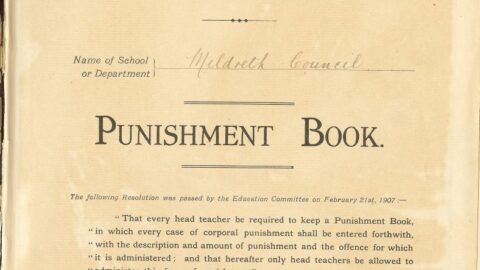
Corporal punishment was accepted as part of school life during that period, though naturally it was seldom welcomed by those subjected to it.
There were certainly no punishments administered on the bare body at the schools I attended. It was, however, not unusual for boys in the changing rooms after physical education lessons to display the marks left by the slipper, and I believe I did so myself on one occasion.
A slippering was generally not regarded as the gravest form of school punishment and, once the initial discomfort had subsided, it was often dismissed with humour among the boys. I distinctly recall being surprised by the severity of my first experience, and I was later told that my face had become extremely flushed afterwards. The thin athletic shorts worn at the time became even tighter when bent over, which naturally increased the effect of the punishment.
This was during the late 1960s, a period when boys’ physical education clothing had changed considerably from earlier years. Previous generations had worn heavier and looser-fitting shorts, whereas by then the fashion had shifted to lighter and more tightly fitted garments.
School uniforms of the era also reflected contemporary fashions. Boys commonly wore narrow black trousers, while girls’ skirts had become notably shorter than in previous decades. Such styles, fashionable at the end of the 1960s, would almost certainly not have been permitted in schools today.
Although corporal punishment for girls undoubtedly occurred in some schools, I never witnessed a girl being punished with the slipper before a class. If such incidents did take place, they were evidently conducted in private.