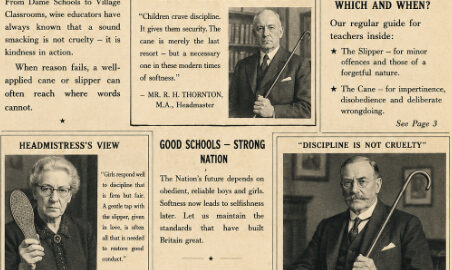
In schools across Britain during the 1950s, 1960s and 1970s, corporal punishment remained a firmly established part of school discipline. Former pupils from a number of secondary schools have recalled experiences of receiving the cane, the slipper, or other forms of punishment from teachers and headmasters whose authority was rarely questioned at the time.
At Broadgate School in Nottingham, several former pupils remembered repeated punishments administered by a senior master referred to as “Mr O”. One former pupil recalled being caned on three separate occasions and also receiving the slipper twice. Another remembered being punished for forgetting a tennis racket, while others described being caned collectively for misconduct ranging from breaking school rules to inappropriate behaviour in cloakrooms.
One former prefect recalled that in 1986 a group of prefects were given the cane rather than being stripped of their badges after disciplinary offences. Another former pupil remembered being punished for kissing in the cloakroom, while several described the atmosphere in which punishments were carried out, with masters appearing in traditional academic dress and using the cane ceremonially before administering the strokes.
At Brookfield Comprehensive School in Merseyside, former pupils remembered a strict disciplinary environment during the early 1960s. One woman recalled that pupils “would not dare misbehave” for fear of the cane, while another remembered a teacher known for striking pupils on the backs of their legs with a ruler.
At Brownhills High School in Stoke-on-Trent, one former pupil recalled receiving the cane frequently from the deputy headmaster.
Former pupils of Burrington Secondary Modern School in Plymouth also remembered corporal punishment as commonplace. One recalled being caned by the domestic science teacher, while others spoke of a feared teacher known as “Granny Williams”, who administered the cane regularly. A former pupil remembered waiting anxiously in her office alongside other girls before receiving punishment.
At Bury Grammar School, one former pupil recalled being caned by a teacher named Mrs Stoddard.
At Caldicot School in Monmouthshire, a former pupil described being sent to the headmaster after striking a boy and causing his nose to bleed. She recalled it as the only occasion in her school life on which she received the cane.
Memories from Carbrook School in Sheffield dated back even further. One former pupil recalled receiving the cane in 1954 and remarked that the memory “still stings”. Another remembered a teacher carrying a stick referred to as “Excalibur”, which was used to strike pupils.
At Cardinal Newman School in Wigan, former pupils described strict enforcement of school rules. One woman recalled being caned for smoking in the lavatories, while another remembered being punished simply for leaving a few pennies in her coat pocket in the cloakroom. She recalled being made to queue in the corridor with other pupils awaiting punishment.
At Cardinal Wiseman School in Birmingham, a former pupil from the 1970s remembered receiving the cane from a teacher named Mrs Bolan.
Memories from Carleton High School in Pontefract included accounts of teachers throwing chalk at pupils and physically reprimanding them in class.
At Carmountside Junior High School in Stoke-on-Trent, former pupils remembered repeated use of the cane by staff, with one recalling that another pupil was punished on more than one occasion.
At Castlefield School in High Wycombe, one former pupil remembered both the cane and the slipper being used at different schools by the same teacher. She recalled receiving the slipper after injuring a guinea pig at primary school.
Former pupils of Cathedral High School in Salford described public punishments carried out in classrooms. One woman remembered being sent to a music teacher to receive the cane in front of an entire class, while another recalled a science teacher whose attempt at punishment “did not hurt very much”.
At Central High School for Girls in Manchester, one former pupil remembered being caned by Mrs Wilde. She recalled the teacher appearing distressed after administering the punishment, although the pupil herself was left with welts across her fingers.
At Central School for Girls in Stalybridge, former pupils remembered teachers who were regarded as especially severe with the cane, particularly Mrs Nightingale, whose punishments were described as painful and memorable.
At Chadwell Heath High School in Romford, one former pupil described a teacher who appeared to take satisfaction in administering corporal punishment with either the cane or the slipper.
At Charlton School in Telford, former pupils recalled strict uniform regulations, with boys receiving the cane and girls punished with the slipper.
At Chelmsford Comprehensive School, one former pupil remembered receiving the cane for bringing mice to school in a pencil case.
Former pupils of Chesterton Community High School in Staffordshire recalled a headmaster who kept a single cane displayed prominently in a wardrobe in his office. Another remembered repeatedly being sent to him for punishment by a science teacher.
At Chiltern Edge School near Reading, one former pupil remembered receiving the slipper after being caught engaging in lunchtime mischief in the art room.
At Christ the King School in Southport, former pupils described a rigorous disciplinary system in which girls could be strapped for failing to bring physical education equipment or for neglecting uniform requirements. Others remembered receiving the strap for incomplete homework or untidy books.
Taken together, the recollections paint a vivid picture of a period in British education when corporal punishment was accepted as a normal disciplinary measure. Although many former pupils now recount the incidents with humour or nostalgia, others remember the fear, humiliation and pain associated with punishments that would later disappear from British schools altogether.