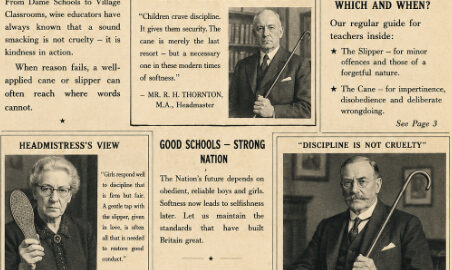
Accounts from former pupils across Britain provide a revealing picture of school life during past decades, when corporal punishment formed an accepted part of discipline in many classrooms.
Former pupils from schools throughout England, Scotland and Wales recall teachers whose names remain vivid many years after leaving school, often less for their lessons than for their use of the slipper or cane.
At Mornington High School in Wigan, one former pupil, who left in 1985, remembered receiving the slipper from a teacher who had assured her that the punishment would not be severe because it was her first offence. The experience, however, proved rather more painful than expected.
A former pupil from Mortimer Comprehensive School in South Shields recalled meeting a former teacher several years after leaving school and introducing herself, only to remember that this particular teacher had been responsible for administering the cane during her school years.
At Mossley Hollins High School in Manchester, one recollection concerned a classroom prank involving an unpleasant-smelling device during a sewing lesson, which resulted in punishment from a member of staff.
Former pupils from Moulton John Harrox School in Spalding remembered certain teachers with affection while also recalling the routine use of disciplinary measures. One teacher was remembered particularly for the frequent use of a slipper fashioned from a green-and-white training shoe.
At Mountain Ash Comprehensive School in South Wales, one former pupil described a difficult relationship with an accounts teacher, which eventually resulted in disciplinary action after a confrontation between teacher and pupil.
Elsewhere, memories from Netherhall School in Cambridge included recollections of receiving the slipper from the head teacher, while pupils from Netherstowe High School in Lichfield remembered teachers whose habit of confusing pupils’ names caused equal measures of amusement and distress.
At Norfolk School in Sheffield, one former pupil remembered being caned in 1973 following an argument with dining hall staff and refusing to go outdoors during heavy rain.
Former pupils from schools in Scunthorpe recalled several teachers associated with strict discipline. One remembered being sent for punishment merely for laughing in class, while another described receiving corporal punishment for failing to pay attention during an art lesson. One particularly feared cane had acquired a name of its own among pupils.
At Hill Top High School in West Bromwich, former pupils simply recalled particular teachers as being closely associated with the cane.
Memories from Holmwood Secondary School in Slough included recollections of repeated appearances before staff responsible for rural studies and discipline, while former pupils from Honley High School in Kirklees remembered a period when even incorrect school socks might attract punishment.
Former pupils from Horley Comprehensive School remembered the frequent use of the slipper, while memories from the Hundred of Hoo Comprehensive School in Kent included recollections of physical education staff administering punishment that pupils still remembered decades later.
At Hurn Court School in Christchurch, one former pupil recalled being punished after leaving a dormitory during the night.
Former pupils of Huyton with Roby Secondary School in Liverpool remembered an educational culture in which teachers commanded unquestioned authority. One music teacher was remembered particularly for maintaining a collection of canes of varying thicknesses and allowing pupils to select which would be used.
Memories from Icknield High School in Luton centred upon several formidable female teachers who left lasting impressions through both discipline and strict classroom management.
Former pupils of Joseph Eastham High School in Manchester remembered one teacher whose reputation for administering punishment remained widely known many years later.
At Joseph Whitaker School in Mansfield, memories included instances of collective punishment, with entire classes disciplined when no individual accepted responsibility for misdemeanours. Some former pupils also recalled being punished for offences they insisted they had not committed.
Finally, recollections from Kelvin High School in Belfast suggest that strict disciplinary traditions extended throughout the United Kingdom. Former pupils remembered particular teachers whose reputations alone were sufficient to maintain order, with canes displayed prominently in classrooms as a visible reminder of school discipline.
Taken together, these recollections provide an insight into a period of British education in which corporal punishment was not exceptional but commonplace, shaping memories that many former pupils still recall decades later.