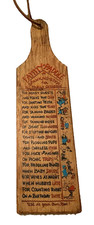
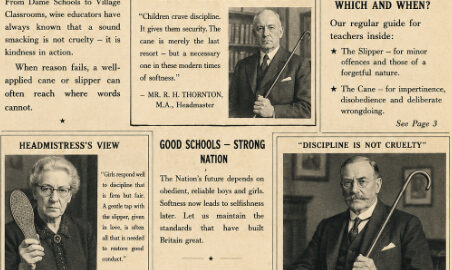
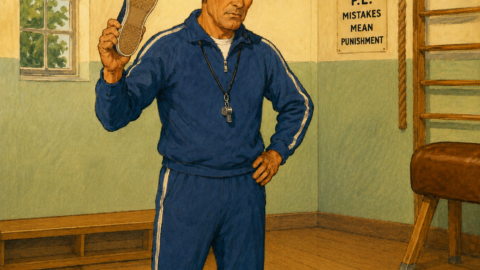
The use of the slipper as a form of school punishment has often been described as comparatively mild, scarcely severe enough to merit classification as corporal punishment. I have always found this view somewhat puzzling, for a number of the punishments administered at my school were extremely painful. Whether the slipper caused as much pain as the cane is open to debate and doubtless depended greatly upon the individual carrying out the punishment. One may also argue over the wider question of whether the deliberate infliction of pain upon misbehaving pupils was justified. Contemporary opinion is now largely opposed to such practices.
In the 1960s, however, corporal punishment in schools was generally accepted without question. Anyone who objected on moral grounds to striking schoolboys repeatedly with a gym shoe hard enough to reduce them to tears would likely have been regarded as eccentric or excessively idealistic. Even many who disliked the practice in principle considered it an unfortunate necessity. More contentious perhaps was the use of the slipper as an incentive to encourage academic effort among pupils. At the time, however, few of us regarded the practice as fundamentally improper.
Naturally, we feared it. I vividly recall the sinking feeling during examinations when it became apparent that I had revised inadequately and stood little chance of achieving the required pass mark. I also remember the atmosphere of tension in the classroom as results were announced. Certain masters favoured the practice of reading out the names of unsuccessful boys in reverse order, beginning with those who had narrowly failed and ending with those whose marks were particularly poor.
The boys concerned would then be summoned to the front of the class and lined up to receive punishment in the same sequence. If one’s name had not been called at an early stage, anxiety steadily mounted as the possibilities diminished. Would there be no punishment at all, or would one receive ten or even twelve strokes? The uncertainty itself was often deeply unsettling. What may be said in favour of the system is that it undoubtedly encouraged diligence. Most boys revised conscientiously for examinations, particularly when the master in question was known to administer punishment with considerable force.
The maximum penalty of twelve strokes applied to all age groups, though younger boys rarely received the full number. During my first year at school I witnessed only one instance of a boy receiving twelve strokes. A physical education master had caught him urinating in the showers. The boy was instructed to dry himself and dress, after which he was made to bend over in the changing room and was given the full punishment. In the second year another boy received twelve strokes for writing obscenities on the blackboard during the break period. It was believed that he had intended to erase them but had forgotten. A further case involved a boy who achieved an exceptionally poor mark in a History examination, scoring only a handful of marks out of fifty.
My own first experience of receiving twelve strokes occurred at the beginning of the second term in my third year. Following a heavy snowfall, another boy and I had been behaving foolishly with snow and pushed some down the collar of a fellow pupil. We were caught by a master unknown to me, who took us into his classroom and punished us before the assembled class. During the first three years it was more usual to receive three, four, or six strokes, with higher numbers being comparatively rare. By the fourth and fifth years, however, the more severe punishments became increasingly common.
At the end of each term there were typically several instances of boys receiving twelve strokes for poor examination results. The examinations had become more demanding, and in some cases the required pass mark was raised. There was also a general tendency for older boys to receive harsher punishments. On one occasion another pupil and I were given twelve strokes by the Latin master for copying homework, an offence he referred to as “collusion”. I had been taught by the same master in my second year, when two boys guilty of the same offence had received only six strokes.
Some masters undoubtedly struck harder when dealing with older boys, and at least one employed a larger and heavier slipper. More commonly, however, severity was increased simply by raising the number of strokes administered.
I believe that six strokes of the cane represented the maximum punishment that form masters were permitted to administer. I do not know whether any formal limit applied to the headmaster, though I never heard of anyone receiving more than eight strokes from him. To be sent before the headmaster generally required an act of particularly serious foolishness. I myself appeared before him on only two occasions.
I cannot recall actually witnessing a boy receive twelve strokes in consecutive lessons, though such an occurrence was certainly possible in theory. The closest I came to this myself occurred during the examinations at the end of the third term in my fourth year. I received twelve strokes for failing Geography with a particularly poor mark and, in the following lesson, a further five strokes for failing German. My backside was still sore when I bent over to receive the second punishment, which made the experience especially painful.
The examinations usually took place during the final week of term and were spread over three days, from Monday to Wednesday. Depending upon how quickly the papers were marked, results might be returned at any point between Tuesday and Friday. Most punishments therefore occurred on Wednesday, Thursday, and Friday. Whether one received two punishments in close succession was largely a matter of chance if one had performed badly in more than one subject. With examinations in seven or eight different subjects, boys often found themselves calculating not merely how much revision to undertake, but also which masters were reputed to punish most severely.