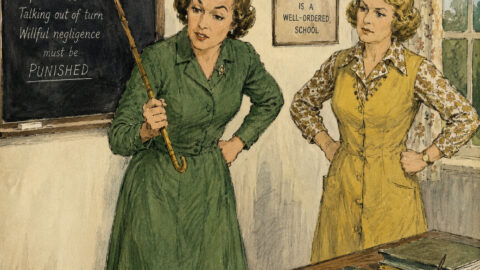
The three-day period during which examination results were returned must have been an exceedingly anxious time for the boys concerned. To receive twelve strokes of the slipper was, in itself, a severe punishment, leaving the offender in considerable discomfort. The prospect of having to submit once again to such chastisement undoubtedly demanded a notable degree of fortitude, if not outright courage. One can readily imagine the apprehension of a boy sitting an English Literature examination, failing to recognise the passage quoted on the paper, and realising that insufficient preparation would, within a matter of days, result in a painful punishment.
The public reading of marks, conducted in a manner reminiscent of a musical competition, must have created a highly tense atmosphere, particularly for the boy who suspected his name would be announced last. To walk to the front of the classroom, observing one’s classmates receive their punishments while knowing that one’s own turn would shortly follow, can only have been deeply distressing. If the same boy then proceeded to his next lesson aware that further punishment was a distinct possibility, concentration upon his studies must have been exceedingly difficult.
Parents whose sons had succeeded in gaining entrance to such schools would no doubt have taken considerable pride in their achievement and would likewise have expected standards of discipline to be rigorous. At the time, the regular use of corporal punishment was widely regarded as an accepted and necessary aspect of education.
It must be admitted that the regime described appears, by modern standards, remarkably severe, and one can only speculate upon the discouragement experienced by boys whose academic abilities fell somewhat below those of their contemporaries. During the fourth and fifth years in particular, many pupils must have endured repeated punishments, though considerations of equity were not always foremost in institutions of this character.
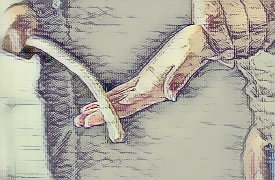
To receive “twelve of the best”, as the expression then had it, was undeniably painful. The strokes were delivered with force and intended to cause genuine discomfort. The slipper produced an acute stinging sensation which intensified as the punishment continued, owing to the repeated blows falling upon the same area. The pain mounted steadily until it became almost intolerable by the conclusion of the punishment. Fortunately, the sharpest effects subsided comparatively quickly, with the worst discomfort diminishing within less than a minute. By the end of the lesson, however, a lingering warmth and soreness remained. To be punished again at the beginning of the following lesson was unpleasant enough, though some former pupils recalled that a second punishment administered several hours later could prove worse still, once deeper bruising and tenderness had developed.
The tension while examination results were being announced was considerable, especially when the marks were revealed gradually and one suspected that one had performed poorly. Indeed, some boys later remarked that there was almost a sense of relief in hearing one’s name called early, thereby discovering that only a comparatively light punishment awaited.
Watching others receive punishment while anticipating one’s own sentence of twelve strokes must likewise have been a difficult experience. Although some former pupils hesitated to describe it as traumatic, few would have considered it anything other than deeply unpleasant.
There appears to have been no formal policy of setting lower pass marks for boys of lesser academic ability, although certain masters were said to mark more leniently when dealing with pupils who struggled in a particular subject. One former teacher later recalled that he and some colleagues would first examine a selection of papers in order to determine how strictly or generously they might mark the remainder.
This practice, it was said, arose partly from practical considerations, as an excessive number of failures would inevitably lead to a correspondingly large number of punishments. One master reportedly considered it manageable if five or six boys in a class of thirty were liable to punishment. Given that a teacher might instruct seven or eight classes, this still represented a considerable number of punishments to administer within the course of several days. When questioned years later about the system, the same teacher expressed the opinion that a limited degree of corporal punishment had been necessary in order to maintain the school’s exceptional academic standards.
On the matter of fairness, it is perhaps surprising to modern readers that many former pupils did not, at the time, regard the regime as unjust. Corporal punishment was accepted as an ordinary feature of school life. Although boys naturally disliked receiving it, they did not generally view it as catastrophic or arbitrary. Punishments were administered for specific failings rather than capriciously. Debate may continue regarding the morality and educational value of corporal punishment as a means of motivation; nevertheless, those subjected to it often recalled that it fostered a highly competitive atmosphere in which fear of punishment served as a powerful incentive to diligent study. Many believed that, provided one worked conscientiously and made proper preparation for examinations, it was usually possible to achieve the required standard.