I have endeavoured to imagine myself, at the age of fourteen, in the circumstances you describe so vividly. I was caned with the gym shoe on several occasions at school by members of the physical education staff, and the punishment was extremely painful. As a result, I made every effort to avoid incurring it.
Had I attended King’s School during the period of which you write, I am uncertain how I should have managed. For me, there would undoubtedly have been a combination of anxiety and despondency. Had I known that I was due to receive a severe punishment with the slipper, I believe I should have found it difficult to sleep on the preceding night, particularly if the sentence exceeded six strokes.
I should have been overcome with apprehension while watching another boy being punished, knowing that my own turn would follow. I imagine there must have been a certain sense of relief once the punishment had concluded, but to sit through lessons afterwards with lingering pain, while aware that further punishment might yet occur later in the day, must have been most distressing.
I admire the composed manner in which you and your contemporaries appear to have accepted what were, by any standard, severe punishments, though I cannot deny that I am grateful not to have experienced such treatment on a regular basis myself.
I referred earlier to the first occasion on which I witnessed a boy receiving twelve strokes of the slipper. His offence had been misconduct in the showers following physical education. The following day, by unfortunate coincidence, he was punished again in the classroom. He and another boy each received two strokes for talking during a French lesson.
I remember clearly how profoundly unhappy he appeared as he awaited his turn to bend over for punishment. Each stroke caused him visibly to recoil, and he wept far more than one might ordinarily expect after receiving only two strokes. I have little doubt that the experience was especially painful because he was still suffering from the effects of the previous day’s punishment. Whenever I myself had received a particularly severe slippering, I took great care to avoid further trouble for several days afterwards.
Most boys, surprisingly enough, appeared to endure such discipline reasonably well, though naturally some managed better than others. For certain boys the experience was unquestionably a severe ordeal. Some became extremely anxious if they knew they were facing a particularly heavy punishment.
During my first year at school, we attended weekly recorder lessons in music. The master adopted a rather unusual method of encouraging boys to remember their instruments. Any boy who forgot his recorder received one stroke of the slipper during the first week, two strokes in the second week, three in the third, and so forth. In the first week approximately half a dozen boys were punished. By the second week only a few remained forgetful, and by the fourth week no boy neglected to bring his recorder.
Then, during the final week of term, one unfortunate boy forgot his instrument. I recall speaking with him during the luncheon interval. He was terrified at the prospect of receiving twelve strokes. He was already in tears as he walked to the front of the classroom. In the event, the master exercised a measure of leniency and reduced the punishment to six strokes. Even so, this proved extremely distressing for such a sensitive boy, and he bore it poorly. Naturally, some boys displayed greater fortitude than others. Certain boys endured severe punishment without tears, whereas others became highly emotional. A number were already crying before the punishment commenced. Nevertheless, most accepted these experiences with a degree of resignation.
If a boy was informed that he was to be punished with the slipper, he generally accepted the matter with little protest, although there were occasional attempts to offer explanations or excuses. A boy might claim, for instance, that circumstances beyond his control had prevented him from completing preparation work. Others, plainly frightened, sometimes pleaded with the master to reconsider.
Among their peers, such behaviour was not necessarily regarded as cowardly. More often there was simply relief among the other boys that they themselves were not to be punished. However, any determined attempt to evade a punishment could occasionally irritate the master concerned and result in the sentence being increased.
At my own Roman Catholic secondary school for boys, the slipper was the principal form of corporal punishment. Any misconduct in class or elsewhere about the school led to the completion of a disciplinary report by a master or prefect. This was forwarded to the boy’s housemaster, to whom he was required to report at the conclusion of the school day in order to receive six strokes of the slipper.
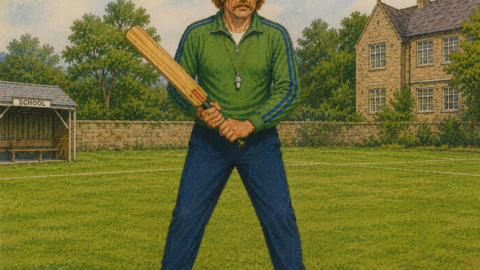
The physical education and games staff also administered punishment. Any breach of discipline during games or physical education generally resulted in the offender remaining behind afterwards, where he would be instructed to bend over against the wall bars and grasp one of the lower rungs while receiving six strokes with a gym shoe.
I myself was punished in this manner several times each term throughout most of my secondary education, and once again during the sixth form. As others have observed, such discipline was regarded as entirely normal at the time and accepted as part of everyday school life. There was little point in complaining to one’s parents, as many fathers maintained similar standards of discipline at home.
For the most part boys simply accepted their punishment. They bent over when instructed and remained in position until told to rise. I have tried to recall instances in which boys attempted to persuade a master to reconsider, and such occasions were