In the years when Britain still argued fiercely over the virtues of discipline, authority, and the moral fibre of youth, few figures inspired such noisy controversy as the curious and indefatigable Wildman. To his admirers he was a crusader for order, a lone prophet railing against the collapse of standards in the nation’s schools. To his detractors he was a relic of an earlier age, marching stubbornly forward with a bundle of canes beneath his arm and Victorian certainties ringing in his ears.
The letters pages of provincial newspapers became his battlefield. Week after week, from Cornwall to Caernarvon, readers encountered his unmistakable prose: stern declarations on discipline, impassioned defences of corporal punishment, and dark warnings of what would become of a generation raised without fear of chastisement. Others answered him with equal vigour. Schoolmasters, clergymen, psychologists, reformers and ordinary parents all took sides in the debate, and not a few predicted that history—and perhaps the courts—would eventually judge the self-appointed “apostle” rather harshly indeed.
Yet opposition only seemed to strengthen his resolve. Wildman possessed that peculiar confidence found in certain public campaigners: the absolute conviction that ridicule merely proved the righteousness of his cause. Invitations to speak began arriving from societies, debating halls and educational circles. He accepted them all with missionary enthusiasm, never suspecting that not every invitation was extended in good faith.
One engagement in particular, now passed into local legend, would provide the dramatic turning point in his public career.
The setting was a remote school tucked away in a Midland valley, an institution proudly committed to what were then called “progressive” educational methods. The school rejected rigid hierarchy, favoured freedom over punishment, and regarded corporal discipline as both archaic and harmful. In short, it represented everything Wildman despised. Ironically, the establishment’s own lack of structure would later attract the attention of the Authorities, who eventually closed it amid criticism concerning discipline, standards and general conduct. But at the time of Wildman’s visit, it remained a flourishing experiment in modern education.
The Headmaster, outwardly courteous and scholarly, formally invited Wildman to address the assembled pupils and staff. The proposed lecture was broad in scope: discipline, manliness, authority, moral instruction, and the practical application of corporal punishment in schools. Wildman, delighted by the opportunity, accepted at once.
He travelled northward by train carrying what one observer later described as “an alarming collection of punitive apparatus.” His leather case reportedly contained canes of varying lengths and flexibility, together with straps, tawses and other instruments designed, in his opinion, for the correction of youthful misconduct. Upon arrival he was received with impeccable politeness. Masters shook his hand warmly, boys sat in orderly rows, and members of the local community filled the rear benches of the assembly hall. Most notable of all, however, was the conspicuous presence of reporters and photographers from the regional Press, all apparently eager to witness the celebrated disciplinarian in action.
Wildman took the attention as admiration.
The lecture commenced smoothly enough. For nearly an hour he discoursed solemnly upon the decline of standards in modern Britain, lamenting what he saw as the collapse of respect for authority. The boys, to their credit, listened with remarkable restraint, though many had been educated under systems in which physical punishment was entirely unknown. To them, his language of “firm correction” and “healthy fear” must have sounded like echoes from another century.
Then came the moment that would immortalise the occasion.
Holding aloft one of his prized canes before the audience, Wildman declared with evident pride:
“This is a fine cane for six of the best; all my canes, moreover, are antiseptic.”
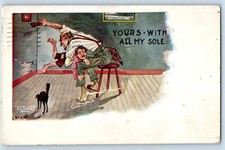
No sooner had the words left his lips than the atmosphere in the hall changed with astonishing speed. As if responding to some unseen signal, several of the larger boys sprang from their seats. Before the astonished lecturer could react, they seized him, bent him over a nearby table and held him firmly pinned.
What followed was executed with alarming efficiency.
A tall Indian student—described by one newspaper as “athletically built and wholly unhesitating”—stepped forward, took Wildman’s own cane from the lectern, and administered a brisk and thoroughly energetic demonstration upon the unfortunate lecturer himself. Contemporary reports differed on the exact number of strokes delivered, but all agreed that the blows were neither symbolic nor gentle.
When at last the bewildered disciplinarian was released, the hall erupted into uproarious laughter. Masters struggled to maintain composure, boys cheered openly, and several journalists reportedly abandoned all pretence of neutrality while scribbling furiously into their notebooks.
The humiliated visitor, red-faced and spluttering with indignation, demanded an explanation. The Headmaster, still maintaining perfect civility, calmly pressed two pounds into his hand for travelling expenses.
Wildman stormed from the premises in outrage.
His next destination was the local hospital, where the duty Matron was confronted by a most extraordinary scene. Bursting into the ward office, the aggrieved lecturer reportedly lowered his trousers and exclaimed in tones of moral catastrophe:
“I’ve been beaten by boys!”
Unfortunately for Wildman, the Matron proved no more sympathetic than his audience. Overcome by the absurdity of the spectacle, she is said to have laughed outright. Deeply offended, he departed once more in fury, threatening legal action against the school and all concerned. Cooler heads, however, apparently persuaded him that a public trial might produce consequences even more embarrassing than the original incident.
The affair marked the effective end of Wildman’s career as a public lecturer. Thereafter he became considerably more cautious of enthusiastic invitations from educational establishments, especially those describing themselves as “experimental” or “progressive.” Though he continued to write letters and pamphlets defending corporal punishment, he never again addressed a public school audience.
Meanwhile the story spread across Britain with extraordinary speed. Local newspapers revelled in the delicious irony of the episode, while Fleet Street quickly transformed it into national comic material. Headlines flourished with merciless creativity:
“Caning Man Caned”
“Discipline Expert Gets Taste of Own Medicine”
“School Crusader Receives Six of the Best”
For weeks afterwards the incident was recounted in pubs, staff rooms and railway compartments across the country. To many, it symbolised more than a practical joke. It represented a clash between two visions of Britain itself: one clinging stubbornly to hierarchy and punishment, the other mocking such traditions as absurd remnants of a fading age.
And at the centre of it all stood Wildman: outraged, ridiculed, unrepentant—and, for a brief moment at least, one of the most talked-about men in the kingdom.