Growing up on a council estate in Scotland in the early 1970s was like living in a world built from concrete, coal smoke, and the constant hum of neighbours’ voices. (short pause) The blocks of flats loomed over us, their grey faces streaked with rain, while the air always seemed tinged with the scent of damp laundry and the distant tang of frying onions drifting from open kitchen windows. (pause) Every stairwell echoed with the slap of trainers and the shouts of kids, and every adult seemed to know exactly what you were up to, even before you did.
The estate was its own universe—tight-knit, sometimes suffocating, but always alive. (pause) We kids darted between parked cars and battered prams, our laughter bouncing off the walls, but there was an unspoken code: everyone looked out for each other, and everyone’s business was everyone’s business. (short pause) My mum and the other mothers would gather outside, arms folded, sharing stories and gossip as they watched us play, their voices a steady background to our games.
It was in this world that I made a mistake I’d regret for years. (pause) I got caught bullying my neighbour’s daughter—a girl who, as people said back then, was “educationally subnormal.” (pause) She was quiet, always trailing behind the rest of us, and I suppose I thought picking on her would make me look tough. (short pause) But the guilt started to gnaw at me the moment I saw her mother’s face, tight with anger and disappointment.
Trouble was, her mum and my mum were close—thick as thieves, really. (pause) Their friendship was the kind that meant cups of tea in each other’s kitchens, secrets shared over the whirr of the washing machine, and a fierce loyalty that didn’t waver. (short pause) So when her mum caught me, she didn’t hesitate. She stormed straight home, picked up the heavy black rotary phone, and dialed our number with shaking hands.
I remember standing in our cramped hallway, the patterned wallpaper closing in around me, as my mum’s voice came sharp and cold through the receiver. (pause) She didn’t shout, but her words cut deeper than any yell. She told me, in no uncertain terms, that as soon as she got home from her shift, I was in for a leathering. (short pause) My stomach twisted with dread, and the minutes crawled by, each tick of the clock echoing in my chest.
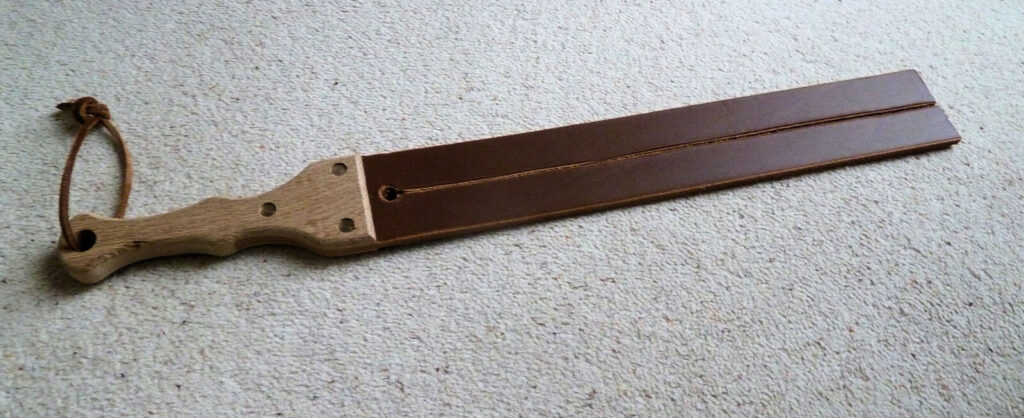
Back then, a leathering wasn’t just a threat—it was a promise. (pause) The belt hung on a hook in her bedroom, a silent warning we all understood. (short pause) My mum was strict, but she was fair, and she never made empty threats. (pause) I could almost feel the sting before it happened, my mind racing with fear and shame.
When she finally came home, the flat seemed to shrink around me. (pause) The front door banged shut, and her footsteps echoed down the narrow corridor. (short pause) She grabbed me by the ear—her grip firm but not cruel—and marched me past my sister, who sat frozen on the stairs, eyes wide with worry. (pause) The hallway felt endless, the air thick with tension and the faint smell of her perfume mixed with the day’s sweat.
In my bedroom, the world narrowed to the faded bedspread beneath my face and the sound of my own shaky breathing. (pause) My mum’s hands were steady as she unbuckled her belt—the same one she wore to work every day, worn smooth at the edges. (short pause) She gave me a dozen hard strokes, each one a lesson I’d never forget. I was sobbing before she finished, the pain sharp but the shame sharper.
Downstairs, my sister listened through the thin walls, every sound carrying. (pause) She told me later she wanted to run up and stop it, but she knew better—she’d felt the belt herself, and understood the rules of our world. (short pause) There was no teasing, just a quiet understanding between us, a bond forged in shared experience.
That night, I couldn’t sit at the dinner table, shifting uncomfortably on the hard chair as my mum served up mince and tatties. (pause) The food tasted of salt and regret, and the silence at the table was heavy. (short pause) I was grounded for two weeks, but the real punishment came the next day, when my mum marched me to our neighbour’s door.
Standing there, cheeks burning, I stammered out an apology while my mum explained exactly what had happened. (pause) The neighbour’s eyes softened, and for a moment, I saw the pain I’d caused—not just to her daughter, but to the whole fragile web of trust that held our estate together.
As dusk fell and the streetlights flickered on, I sat by the window, watching the estate settle into quiet. (pause) The world outside looked the same, but I felt different—smaller, maybe, but also wiser. (short pause) That day left a mark on me deeper than any bruise, a memory that’s never faded, no matter how many years have passed.