I attended a school in north London during the early 1970s, a time when the city’s air was thick with the scent of coal smoke and the distant rumble of double-decker buses. The school itself was a squat, grey building, its corridors echoing with the clatter of shoes and the nervous laughter of children. The cane was still very much in use then—a thin, menacing rod that seemed to hang over us all like a shadow. I was, regrettably, no stranger to its sting, having been sent for a whacking more times than I care to admit.
(short pause) The ritual of punishment was as much a part of the school day as the ringing of the final bell. The cane was always administered at the end of the day, when the sun slanted through the high windows and cast long, anxious shadows across the tiled floors. There would be a line of boys—sometimes a girl, too—standing outside the headmaster’s study, each of us shifting from foot to foot, our faces pale and drawn. The air was thick with the smell of chalk dust and fear. We all knew why we were there, and we all knew we’d be going home with a sore bottom. Sometimes, in hushed voices, we’d mutter about what had landed us there, but mostly we kept silent, too embarrassed to speak, especially if a girl was among us.
(pause) The worst part, I always thought, was the waiting. Standing outside that heavy wooden door, you could hear everything—the muffled voices, the scrape of a chair, and then, inevitably, the sharp, unmistakable crack of the cane. My heart would pound so loudly I was sure everyone could hear it. The headmaster, Mr Taylor, was a tall, severe man with a voice like gravel. He’d appear at the door, cane in hand, and call out the next name. The door would close behind you, and for a moment there’d be a tense silence—just the two of you, the cane, and the knowledge of what was coming. Sometimes he’d lecture you about your misdeeds, his words heavy with disappointment, before instructing you to bend over. Then came the stroke: a searing line of pain that made your eyes water. Most of us tried to take it bravely, but you could always hear someone cry out, and the younger boys—well, they’d sometimes sob as if it was their first smacked bottom from their mum.
(short pause) I’m ashamed to admit that, even knowing my own turn was coming, I’d sometimes listen to those cries with a strange mix of dread and relief—relief that, for a moment, it wasn’t me.
(pause) In truth, the cane hurt—of course it did—but it was over quickly. There was a strange mercy in its swiftness. We only ever got it through our trousers, or for the girls, the seat of their skirts. The marks would linger for a day or two, faint red lines that throbbed when you sat down, a private reminder of your mischief.
(pause) But for me, the real ordeal began after school. The worst part wasn’t the sting of the cane, but the letter home—a folded slip of paper, stamped with the school’s crest, that had to be signed by a parent and returned the next day. In our house, discipline was Mother’s domain. The ‘Notice of Punishment’ was a guarantee of another smacked bottom, this time delivered with her slipper. I’d trudge home, the letter burning a hole in my pocket, dreading the moment I’d have to hand it over.
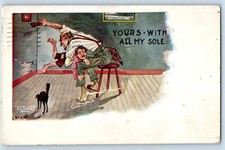
(pause) At home, Mother would retrieve her slipper from the dressing table drawer—a faded, floral thing that seemed harmless until it was in her hand. No matter how old I got, she’d pull me across her knee, my face burning with shame. The sting of the slipper was sharp, but it was the humiliation that lingered. I felt like a little boy again, helpless and exposed.
(pause) The worst part of these home punishments wasn’t even the smacking itself, but what came after. Unlike at school, where the cane was given and then forgotten, Mother would talk about my naughtiness for days—sometimes even in front of visitors or relatives. She’d recount the story, shaking her head, while I sat there, cheeks burning, wishing I could disappear. That was the real pain—the shame that clung to you long after the marks had faded, a reminder that childhood in those days was as much about learning to endure embarrassment as it was about learning your lessons.