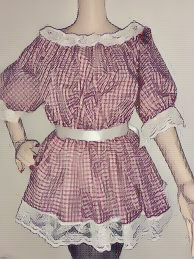
On Monday morning, William boarded the school minibus and told Andrew all about his deeply embarrassing Sunday.
“It wouldn’t have been so bad if we hadn’t gone to my grandparents.” he moaned.
“And mum spent half the morning shaving my legs.” he said.
“Your mum shaved your legs?” Andrew gasped.
William gulped and nodded and said it was weird wearing a dress without a pair of tights on.
Instead, he wore a pair of white ankle socks and his school shoes. “
What did your grandparents say?” Andrew asked.
“Well, Nana kept saying how nice I looked and my granddad kept teasing me until Nana told him off.” William replied.
“I was glad when we finally left and came home.”
“And you could finally take it off.”
“Nah… I had to wear it all day.”
It was big deal to William but not to any other boys on the minibus.
They’re more than accustomed to their regular ‘Sunday’ dresses.
Monday began with a big school assembly.
The headteacher addressed the school, a few pupils were awarded commendations.
One read a self-penned poem aloud.
The entire school sang a hymn and after the lord’s prayer, they went to their classes.
Starting at 8.00am and finishing at 4.00 pm is a much longer day than both William and Andrew were used to, but their various classes are ordered, engaging, involved, and informative… time flew and they were seldom bored.
There was no getting out of the playground activities but Andrew preferred playing hopscotch to skipping and William mastered the rope much quicker than his friend had.
Other activities included elastics, duck-duck-goose, tiggy, and leapfrog… but these would be permitted only after they’d learned to hop, skip, jump and most importantly, play nicely with the others.
After lunch, they had their second dance class which meant donning their pink tights, burgundy leotards, see-through mini-skirts, ballet shoes and having their hair scraped back into a tight bun.
As before, it began with the basic positions over and over again, followed by some simple steps at the barre, and ended with dancing to some modern pop records;
this time it was ABBA’s SOS followed by Mud’s The Cat Crept In.
Afterward, Andrew was mesmerized as he watched William put his hair into two perfect French braids.
“Is it easy doing that?” Andrew asked.
“Not as easy as bunches,” William replied.
“Mum got sick of doing them for me so showed me how to do it myself,” he said.
On the way home in the minibus, Andrew moaned about how boring the dance class is but William surprised his friend by admitting that he enjoyed it; especially the ‘freestyle’ dancing at the end.
“Yeah but it’s the boring ballet stuff I hate.” Andrew replied.
Wayne said it felt silly at first but after a while he ‘got into it’.
“You won’t tell anyone will you?”
“What… that you enjoy ballet?” Andrew snorted.
“Well we have to do it… may as well try to enjoy it.” William retorted.
“We’re only here for one more week remember.” Andrew said.
“All I’m doing is keeping my head down, doing as I’m told so I can get back to normality sooner rather than later.”
“Yeah I know.” William agreed.
Andrew was dropped off outside his home and trotted up the path toward his front door.
It opened as the minibus departed. “Oh!” his mother said. “You’ve got plaits.”
“Er yeah… Winifred did them.” Andrew replied.
“I mean… William.” he corrected.
“I hope I don’t make that mistake when we go back to Cromwell Road.”
His mother grinned and asked if they always use each other’s girl names.
“Only at school,” Andrew replied.
“Can I keep them in for a bit?” he asked.
“Course… they look nice,” she said.
After completing his homework, Andrew asked if he could change and his mother said he could.
“I’ve put something out for you.” she added as he headed to his room.
On his bed lay a beige drop waist pinafore dress, a mustard yellow blouse with long pointed collars and bishop-style sleeves, and a pair of mustard yellow tights.
He sighed at the ensemble and mumbled “one more week” before donning it.
Meanwhile, William is packing up his homework and his mother tells him to change out of his school uniform.
“In a bit.” William replied. “Can I watch some telly first?”
“If you want.” his mother replied, before telling him to make sure he’s changed before supper time.
Wayne caught the last few minutes of Blue Peter, followed by Newsround, Inch High Private Eye and The Wombles… then he changed out of his school uniform and into his own clothes.
He spared a thought for his friend Andrew and wondered what he’d be wearing this evening.
He opened his wardrobe and hung his school pinafore and blouse away, putting it next the the ‘Sunday’ dress he’d worn yesterday.
He cast his mind back to last Monday when he and Andrew skipped school and ended up in Mrs Vaughn’s garden, knocking down the old gazebo, sweeping leaves, and clearing the debris from her stagnant pond.
Neither had any idea that she was in fact a truant officer, nor did they have any idea of the consequences.
Compared to Andrew, William’s got it easy and he can’t help but feel more than a little guilty.
When William boarded the minibus on Tuesday morning, he was in for a huge surprise since there, sat next to Andrew is Roland Hamilton… a notorious thug from Cromwell Road and said to be the hardest boy in the year.
“Well well well… William Dowson.” Roland said.
“Don’t you look nice.”
“Quiet Roland.” the teacher who drove the minibus said.
“Ignore him Winifred,” she added as Wayne sheepishly found a vacant seat.
Roland sniggered. “Just wait ’til I tell the guys about this!” he blurted.
Andrew frowned.
It was a tense and silent journey to school.
A group of five prefects and two teachers awaited the minibus and surrounded Roland as he alighted, before escorting him inside.
The next time he was seen was during morning break.
Roland’s head hung low.
The cocky bravado he displayed in the minibus is nowhere to be seen.
Wearing the St Urshalla’s uniform,
Roland is sent to join the skipping group where the prefects introduce him as Roberta.
William asked how he’d ended up at St Urshalla’s.
Roland said he’d attacked one of the teachers who’d intervened in a fight that had broken out.
“How long you here for?” Wayne asked.
“As little time as possible,” Roland growled.
“This place is full of faggots!” he spat.
“Language Roberta!” Angela, his chaperone snapped.
“Additional days are easy to earn and you’re going the right way about getting them.”
“My name’s not Roberta!” Roland barked. “It’s Roland!”
“Well is says Roberta on your handbag, and it’s Roberta in the register… so for as long as you’re here, your name’s Roberta,” Angela stated.
“Isn’t that right Winifred?”
William gulped and said “Yes.”
Roland was put into the class as William.
Throughout the day he refused to answer to Roberta and refused to curtsey.
He initially refused to take part in his playground activity at lunchtime, but he was no match for the dominant prefects, and eventually and reluctantly, he skipped.
Roland was one of the first to be dropped off from the minibus after school.
“I can’t believe he’s been sent to St Urshalla’s.” William gasped as the minibus departed.
“By the look on his face, he can’t believe it either,” Andrew replied.
Some of the other boys asked who he was and both William and Andrew described his various misdemeanors at Cromwell Road; fighting, bullying, misconduct, vandalism, etc.
“He sounds as bad as you were Emily,” Jonathan said.
“Well, you were hardly a goodie-two-shoes before you came Jennifer!” Lee retorted.
“Stop bickering boys.” the driver said.
“I’m sure Roberta will learn the error of his ways, just as you did.”