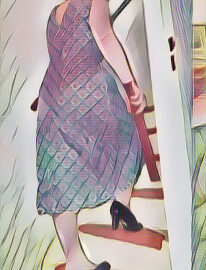
My mother was a formidable woman, sturdy and unadorned, with a plain cotton dress and apron, sensible shoes always on her feet, and her hair pulled back in a no-nonsense bun. She moved through our modest Yorkshire cottage with a purposeful grace, her presence filling every room with a quiet authority. Her hands, roughened by years of scrubbing and mending, were always busy—polishing the brass, kneading dough, or folding laundry with a precision that brooked no sloppiness. Her eyes, sharp and unwavering, missed nothing, and her voice, though rarely raised, carried the weight of absolute command. (short pause)
Her only ambition for me, her only son, was that I should never become like the other urchins who roamed our neighborhood—those rough-and-tumble boys with muddy knees and unruly manners, their laughter echoing down the cobbled streets as they darted between parked Morris Minors and Austins. Because of this, she rarely allowed me out to play, and if I did venture beyond our garden gate, it was always under her watchful supervision, her silhouette framed in the window, arms folded, eyes narrowed in vigilance. (short pause)
She was a devout Christian, and every Sunday, rain or shine, she would march me to church, my shoes polished to a mirror shine, my hair slicked down with a dab of Brylcreem. The church bells would ring out across the village, mingling with the distant whistle of the steam train, and I would walk beside her, my small hand swallowed in her firm grip. She believed that discipline and morality were the twin pillars upon which a boy’s character must be built, and she was determined that I should never stray from the straight and narrow. (short pause)
My earliest memories are a patchwork of Yorkshire and Paris, the scents and sounds of two worlds blending in my mind. I spent the first years of my life in Paris, where my father’s work had taken us. I remember once attending a diplomats’ party—a grand affair in a chandelier-lit salon, the air thick with the scent of polished wood and expensive perfume. There was a table at the center, draped in crisp linen, laden with delicate pastries and bowls of sugared almonds. Across from me sat a little girl, her hair tied with a blue ribbon, her eyes wide and uncertain.
For reasons I can no longer fully recall, the other diplomats’ children decided to bully this little girl—myself included, I’m ashamed to say. We crawled beneath the table, the world above us muffled and distant, and began to pelt her legs with crackers, giggling at her discomfort. I remember the thrill of mischief, the sense of belonging to a secret band of conspirators. I was really quite good at it, I must admit—the crackers arced through the air and landed with satisfying precision. The little girl’s face crumpled, and soon she was sobbing, peering under the table with tear-filled eyes as we continued our childish assault.
Then, suddenly, the tablecloth lifted, and my mother’s face appeared, her expression thunderous. The other children scattered like startled birds, but I was not so lucky—her hand closed around my arm with unyielding strength, and she plucked the plate from my grasp. Without a word, she marched me through the crowded room, the eyes of diplomats and their wives following us, their conversations faltering as we passed. The kitchen door swung shut behind us, and the world narrowed to just the two of us, the clatter of pots and the hiss of the kettle filling the silence.
“Ignacio, what on earth do you think you’re doing?” she demanded, her voice stern and steady as a church bell. I stood there, cheeks burning, unable to meet her gaze. My heart pounded in my chest, and I felt the weight of my foolishness settle over me like a heavy blanket. I had not meant to be cruel, but the shame of being caught was sharp and immediate.
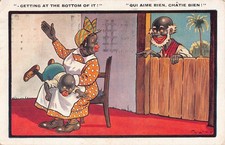
My mother, in the manner of mothers from the old storybooks, believed that a lesson learned in the heart must sometimes be taught to the seat of the trousers. She sat herself down on a sturdy wooden chair, smoothing her apron with deliberate care. The kitchen was warm and close, the scent of baking bread mingling with the faint tang of coal smoke. With a gentle but unyielding hand, she guided me across her lap, my hands clasped tightly in front of me, my toes barely brushing the cool tiles.
There was a certain ritual to it, as if she were following a script handed down through generations. She adjusted my position, ensuring my bottom was squarely presented, and then, with a measured firmness, she delivered a series of brisk, stinging smacks to the seat of my corduroy trousers. Each one landed with a sound like a small clap of thunder, sharp but never cruel, and always accompanied by a steadying hand on my back. The pain was real, but it was the solemnity of the moment—the sense that this was a necessary correction—that made it unforgettable.
The spanking itself was not severe—just enough to make me wriggle and to impress upon me the seriousness of my mischief. But it was the gravity in her voice, the unwavering steadiness of her hand, that truly chastened me. She did not scold or shout as she administered the punishment; instead, she spoke in a low, even tone, explaining that kindness and decency were the marks of a true gentleman, and that thoughtless cruelty, however small, would never be tolerated in her house. Her words painted vivid pictures in my mind—of the little girl’s tears, of the pain I had caused, of the kind of man she hoped I would become.
When the spanking was done, she sat me upright on her lap, her arms encircling me, her voice gentle but unwavering. She described the little girl’s distress in careful detail, her voice softening as she spoke of empathy and the importance of seeing the world through another’s eyes. The words, more than the smacks, brought a hot rush of shame to my cheeks, and I found myself sobbing in remorse, my tears soaking the rough cotton of her apron.
Mother dried my eyes with the corner of her apron, then fixed me with a look that brooked no nonsense. “Now, Ignacio, you are going to tell me who those other children were under the table who were being unkind.” Her tone left no room for argument, but I was torn—caught between the instinct to obey and the unspoken code of childhood silence. I shook my head, unable to betray my companions, my lips pressed together in stubborn defiance.
My mother’s lips pressed into a thin line. She lifted me gently, but firmly, and once again I found myself across her lap. This time, the smacks were sharper, the lesson sterner, and I bit my lip to keep from crying out. The ritual was the same—measured, controlled, never angry, but always purposeful. The kitchen seemed to shrink around us, the ticking of the clock loud in my ears, the world reduced to the rhythm of her hand and the ache of my conscience.
When it was over, I was set on my feet, my bottom tingling, my pride wounded, but my heart strangely lighter. My mother knelt to my level, her hands on my shoulders, and told me that true courage was not in keeping secrets, but in owning up to one’s mistakes and making amends. Her eyes searched mine, and for a moment, I saw not just sternness, but a deep, abiding love—a fierce desire to see me grow into a man of integrity.
I returned to the party, my steps slow and uncertain, intending to apologise to the little girl, but she had already gone. The laughter and music seemed distant, the room suddenly too bright, too loud. The lesson, however, lingered long after—the memory of my mother’s firm hand, her unwavering standards, and the love that shaped every act of discipline. I carried it with me, tucked away like a secret talisman, a reminder that kindness and decency were not just words, but the foundation of a life well-lived.