In the heart of Bradford, where the rows of red-brick houses pressed close together and the air always seemed to carry the faint, persistent hum of distant textile mills, my childhood unfolded with all the colour and drama of a well-thumbed storybook—though not always a gentle one. The streets were narrow and cobbled, echoing with the laughter of children and the clatter of marbles, while the sky above was often a patchwork of grey clouds and drifting chimney smoke.
(short pause) My mother was the undisputed ruler of our little kingdom. She wore her knitted cardigan and floral apron like a suit of armour, her hair always pinned back, her eyes sharp as tacks. The living room was her domain, adorned with crocheted doilies, a gas fire that hissed and glowed, and furniture so sturdy and well-worn it seemed to have absorbed the very spirit of our family.
(pause) My father, a quiet man with hands roughened by years at the mill, was gone from dawn until the last whistle blew. It was Mother who kept the household in perfect check, her rules as unyielding as the cobblestones outside our door. She was not unkind, but she brooked no nonsense. For every misdeed, there was a consequence, and for every consequence, a lesson to be learned—etched not only in memory, but sometimes in flesh.
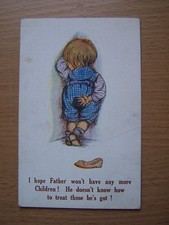
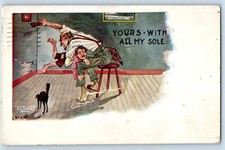
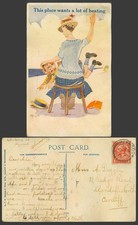
(pause) The slipper—oh, that dreadful tartan slipper!—was always close at hand, resting on her bedside table like a coiled snake, ready to strike. Its battered sole bore the marks of years of use, and its mere presence was enough to make my heart thump with dread. If I dared to answer back, or if my sister and I were caught giggling behind the ginnel wall when we ought to be inside, Mother would summon me to the front room. “Bend over,” she would command, her voice as cold and sharp as the Yorkshire wind that rattled the windowpanes.
(pause) The ritual was always the same. I would shuffle forward, cheeks burning, trousers stretched tight, and wait for the inevitable. Three sharp smacks would follow, each one landing with a resounding crack upon the seat of my trousers. The first sting would make me gasp, the second would bring tears to my eyes, and the third would leave a burning memory that lingered long after the punishment was done. The pain was real, but it was the anticipation—the dreadful waiting—that made my stomach twist into knots.
(pause) Lying was a graver offence, and Mother’s eyes would narrow to slits if she suspected a fib. “Five smacks, and not a single one less,” she would declare, her voice ringing with the certainty of a judge passing sentence. I would bend over, trembling, as the slipper descended—one, two, three, four, five—each blow sharper than the last, each one a fiery stripe across my bottom. The pain was fierce, but it was the shame that truly smarted. I would bite my lip, determined not to cry, but the tears would come anyway, hot and stinging, blurring the world into a watery haze.
(pause) If my brother and I quarreled, the punishment was even more severe. Six stinging smacks, trousers down, so the lesson would not be forgotten. The slipper would whistle through the air, and each smack would land with a thunderous clap, leaving a patchwork of red welts that throbbed for hours. We would squirm and sniffle, promising never to fight again—at least, not until the marks had faded and the memory had softened into something almost funny.
(pause) On days when our schoolwork was poor, Mother would reach for the cane instead. For every mark missed on a spelling test, there was a stroke across the palm. I would stand before her, hands outstretched, trying not to flinch as the cane sliced through the air. The sting was sharp and immediate, a thin red line blooming across my skin. If I dared to pull my hand away, the stroke would be repeated, harder and more biting than before. The pain was real, but it was the humiliation that lingered, the knowledge that I had disappointed her, that I had failed to live up to her expectations.
(pause) The aftermath was always the same. My brother and I would rub our sore hands or bottoms, sniffling quietly, vowing to do better next time. Sometimes, the marks would last for days—red stripes on our palms, or a patchwork of welts on our bottoms. Changing for physical education at school was the worst, as friends would point and whisper, and even the teachers would shake their heads knowingly. But at home, the lesson was clear: misbehaviour brought swift, certain consequences.
(pause) We tried, of course, to hide the slipper or the cane, but Mother always had a spare. Once, she locked them in a wooden case with a combination lock, so we could not get at them. There was no escape from justice in our house. The slipper seemed to have a life of its own, appearing at the most inopportune moments, dangling from Mother’s hand as she chatted with neighbours by the garden gate, or peeking out from her handbag as we giggled behind the privet hedge.
(pause) Yet, for all the harshness, there was love—a fierce, unyielding love that wrapped around us like a woolen blanket on a cold night. On evenings when the punishment had been especially severe, Mother would come to our room, sit on the edge of the bed, and pull us close. “It hurts me more than it hurts you,” she would whisper, smoothing our hair and kissing our foreheads. And in those moments, we knew she meant it. Her hands, so quick to punish, were just as quick to comfort, to hold us tight and chase away the lingering ache.
(pause) Sometimes, as I lay in bed, the ache in my hands or bottom throbbing in the darkness, I would listen to the sounds of the house—the creak of the stairs, the distant tick of the wind-up alarm clock, the soft murmur of my parents’ voices. I would think about the lessons I had learned, about right and wrong, about the weight of consequences and the power of forgiveness. I would wonder if other children’s mothers were as strict, if their slippers were as fearsome, if their love was as fierce.
(pause) Looking back now, through the haze of years and the softening lens of memory, I see that the discipline was strict—sometimes too strict—but the lessons endured. In that little Bradford house, with its red bricks and narrow ginnels, we learned that every action had a consequence, and that love could be as fierce as it was gentle. The slipper, the cane, the stern voice and the gentle hand—they were all part of the same story, a story of growing up, of learning, of becoming who we were meant to be.
(long pause) And so, when I walk those old streets now, the scent of coal smoke and distant chip shops still lingering in the air, I remember not just the pain, but the laughter, the warmth, and the unbreakable bond of family. For in the end, it was love—unyielding, imperfect, but true—that shaped us, and taught us how to face the world.