(gap: 2s) In the gentle, golden days of the 1950s, when the world seemed to move at a slower, kinder pace, there nestled a quiet Scottish village, its stone cottages huddled together beneath the watchful gaze of rolling green hills. Here, the air was often scented with peat smoke and wildflowers, and the laughter of children echoed down winding lanes lined with dry stone walls. In those days, the lessons of life were taught not only in the classroom, but in the home, where mothers and fathers—firm yet loving—believed that a child’s character was shaped by both kindness and correction. My own dear Mother, a woman of unwavering resolve and deep affection, held fast to the belief that a well-smacked bottom, delivered with purpose and care, could teach a lesson that words alone might fail to impress. In our household, the word “spanking” was never uttered; instead, we spoke of being “smacked” or “skelped,” always with the intention of guiding us toward honesty, respect, and goodness.
The story I am about to share unfolded toward the close of that gentle decade, on a day that dawned bright and full of promise. The sun, warm and golden, spilled across the rooftops as my friend Richard and I hopped off the school bus at half past three, our battered satchels bouncing against our knees, our hearts light with the anticipation of an afternoon’s adventure. The village was alive with the familiar sights and sounds: the distant whistle of a steam train, the clatter of milk bottles, and the cheerful greetings of neighbors exchanging news by their garden gates.
As Richard and I strolled up the lane toward my house, we spied my sister’s beau’s motorcar—a gleaming, navy-blue Austin—parked just outside our gate. My sister, seven years my senior and already on the cusp of adulthood, was the object of much admiration, and her young man, a year older still, was regarded with a mixture of awe and curiosity by us younger boys. That afternoon, mischief twinkled in our eyes. With the reckless confidence of youth, Richard and I decided to play a prank: each of us crouched beside a tyre and, stifling our giggles, let the air out—one apiece—imagining ourselves clever and daring, never pausing to consider the consequences of our actions.
Our deed done, we dashed away, our laughter ringing down the lane like the peal of church bells on a Sunday morning. The world seemed wide and full of possibility, and for a time, we forgot all about the motorcar and its deflated tyres. At half past four, as the shadows lengthened and the scent of baking drifted from open windows, I made my way to my grandmother’s cottage for supper. Her kitchen, always warm and inviting, was filled with the comforting aroma of stewing vegetables and the gentle hiss of the kettle on the Aga.
As I waited, perched on a wooden stool, the back gate creaked open and in stepped Mrs. Rhona, the kindly lollipop lady from across the road. Her cheeks were rosy from the wind, and her eyes twinkled with a mixture of amusement and reproach. She had witnessed our prank from her post and, with the brisk efficiency of one accustomed to keeping children in line, wasted no time in recounting the tale to my grandmother. “Naughty little monkeys,” she declared, shaking her head, her voice both stern and fond. After she departed, my grandmother delivered a rare and solemn scolding, her words measured and grave. Supper was eaten in silence, the weight of my mischief pressing upon me like a heavy woolen blanket.
When the meal was finished, I mustered the courage to ask if I might go out to play once more. To my surprise, Grandmother agreed, her eyes softening as she handed me my cap. Soon I found Richard again, and together we kicked a ball about on the patch of worn grass near the swings, our earlier laughter now subdued, our hearts uneasy with the knowledge that we had crossed a line.
An hour slipped by, the sky turning a gentle shade of lavender as dusk approached. Then, from around the corner, I saw my Mother striding purposefully, her figure framed by the golden light of the setting sun. She was a picture of quiet strength—her plain cotton dress and sensible shoes a testament to her no-nonsense ways, her hair pulled back in a neat bun. She entered Grandmother’s house, where she was promptly informed of my wrongdoing. With a voice as clear and unwavering as the church bells, she summoned Richard and me, her eyes leaving no doubt that we were in grave trouble indeed.
Without delay, Mother marched us to Richard’s house, her grip firm but not unkind. She explained our mischief to his own Mother, a woman equally formidable in her sense of right and wrong. A flash of anger crossed her face, and Richard was taken inside for his own reckoning, the door closing softly behind him—a sound that seemed to echo with the promise of consequences.
My Mother then turned to me, her gaze steady and full of meaning. “Just you wait!” she declared, her voice firm as granite. “Up the road with you, now!” I followed her home, my gaze fixed upon the pavement, the sound of her sensible shoes echoing with each step, each one a reminder that the time for laughter had passed.
We entered by the back door, the familiar scents of tea and coal mingling in the air. I stood trembling in my school uniform, my hands twisting nervously at my sides. “Shoes off, this instant!” Mother commanded, her tone brooking no argument. I obeyed, my fingers fumbling with the laces, my heart pounding in my chest.
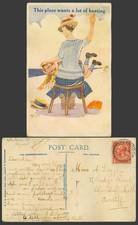
Mother drew a sturdy kitchen chair into the centre of the room, its legs scraping across the linoleum with a sound that seemed to fill the whole house. The clock on the mantelpiece ticked loudly, marking the seconds until my reckoning. With practiced care, Mother took my wrist and guided me over her knee, my school trousers and underpants lowered with brisk efficiency. I felt the rough wool of her skirt against my cheek, the kitchen bathed in the soft glow of the evening light.
Then, with a steady hand, Mother delivered the first smack—sharp and stinging, a lesson written in the language of consequence. I gasped, and before I could recover, four more smacks followed in quick succession, each one landing firmly, making a total of five. The sound of her hand meeting my skin echoed in the small kitchen, mingling with my cries and the relentless ticking of the clock. My legs kicked, but Mother held me securely, ensuring I could not escape my just punishment. In that moment, I understood that love sometimes wears a stern face, and that discipline, though painful, is a gift given by those who care most deeply.
Tears streamed down my cheeks, hot and unbidden, and I sobbed openly, feeling both the sting of the smacks and the deeper ache of shame for my misdeed. Mother’s voice rang out, clear and unwavering: “Do not ever, ever behave so again, you naughty boy!” With each word, she delivered another smack, bringing the total to twelve. The lesson was being firmly impressed upon me, both in body and in spirit. In that small kitchen, beneath the watchful eyes of generations past whose photographs lined the walls, I learned that actions have consequences, and that respect for others is a cornerstone of a good life.
At last, Mother ceased. She rested her hand gently on my back for a moment, allowing me to catch my breath. The pain was sharp, but the lesson was sharper still: one must always respect the property of others and remember that every action, no matter how small, leaves its mark upon the world. In that quiet pause, I felt the weight of her love—a love that sought not to break my spirit, but to shape it, to guide me toward becoming a better person.