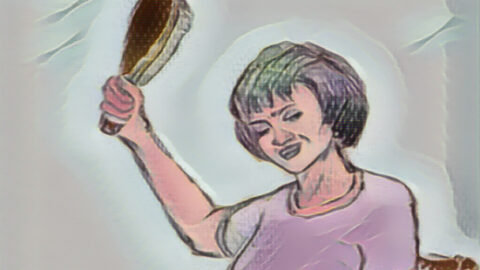
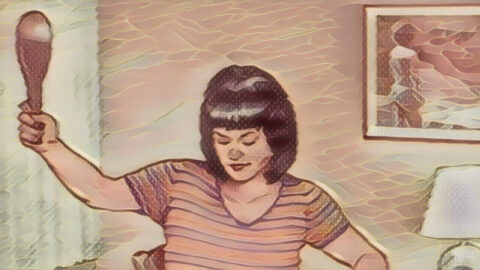
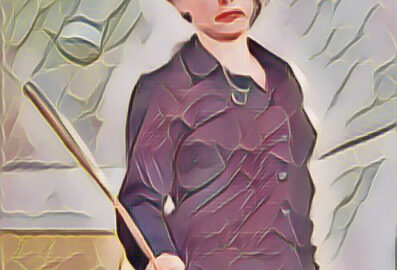
My grandmother’s Christian faith was the foundation of her life, guiding her every action with unwavering resolve. She believed, with the certainty of a headmistress, that discipline was a sacred duty, not merely a matter of correcting mischief. She would often recite, in her crisp, clear voice, the words from Proverbs: ‘He who spares the rod hates his son, but he who loves him is careful to discipline him.’ For Grandmother, discipline was an act of love, a moral lesson to shape my character. Whenever I transgressed, she would fetch the cane from its high cupboard, her face solemn and determined. The ritual was always the same: a stern lecture, followed by six sharp smacks delivered with precision across my bare legs. Each stroke stung fiercely, and I was expected to count them aloud, my voice trembling with each number. Afterwards, Grandmother would explain, in her calm and unwavering tone, that these punishments were not given in anger, but to ensure I grew into a good Christian boy, rather than a wayward pagan. She insisted that every spanking was a lesson, a necessary step on the path to righteousness. Her faith taught her that every action had consequences, and it was her duty to see that I understood the importance of obedience, respect, and humility. She prayed daily for guidance, asking for strength to uphold her values, even when it was difficult. Her discipline was always measured and purposeful, never given in haste, but as a lesson meant to guide me towards a righteous path.
There were times when Grandmother’s discipline became so frequent that I could scarcely recall what mischief had earned me her stern attention. The ritual never varied: a solemn lecture, the dreaded cane fetched from its high perch, and six sharp smacks delivered with unwavering resolve. Sometimes, the punishments came so often—sometimes for the smallest infractions, such as muddy shoes or a forgotten chore—that I would stand, red-faced and sniffling, struggling to remember what rule I had broken this time. The anticipation was often worse than the punishment itself, for I knew that even the slightest slip could bring about another session with the cane. Over time, the reasons blurred together, and I learned to accept her discipline as an ever-present part of my childhood, a lesson in obedience that lingered long after the marks had faded.
Our days followed a gentle rhythm. Mornings began with the clatter of pots and pans as my grandmother prepared porridge, the aroma of fresh bread filling the air. After breakfast, she would walk me to school, her gloved hand holding mine tightly as we passed the cobbled streets and bustling shops of our neighbourhood. In the afternoons, we would visit the local market, where she exchanged pleasantries with the greengrocer and selected the ripest apples for our supper. The evenings were my favourite, when we would sit together by the fire, and she would read aloud from her favourite books, her voice weaving magic into every tale. Life in the 1960s was simple, but there was a sense of order and respect that governed every household, and my grandmother made sure our home was no exception.
When I erred, there was only one kind of punishment: a sound spanking on my bottom. Grandmother, ever the devout Christian, believed in the Biblical instruction to use ‘the rod’ for child discipline. She would instruct me to bend over, and then she would deliver six firm smacks with the cane, each one a sharp reminder of the lesson to be learned. The pain was real, and so was the lesson: obedience and respect were not optional.
I can remember the worst experience with that cane, though I do not recall now what offence had earned it. After my caning—six stinging smacks, each one echoing in the quiet room—Grandmother made me stand in the corner to reflect upon my behaviour and its consequences. I stood there, my bottom smarting, the lesson of the cane imprinted upon me as surely as any moral from a storybook.
So there I was, with a stinging bottom, when the doorbell rang. My grandmother opened the door, and there stood two women from the Jehovah’s Witnesses, their faces composed and polite.
To my absolute horror, my grandmother invited the two women in. As they entered the hallway, I overheard her confide that I had just been punished, adding that they could leave if they felt uncomfortable. However, the women raised no objection and all came into the room where I was standing, my cheeks burning with embarrassment.
I heard one of the women say to Grandmother, ‘Well, it certainly appears he deserved his punishment. His bottom must be sore, but that is precisely what the rod is for, of course.’
My grandmother invited the women to stay for coffee, during which they discussed, in the most matter-of-fact way, the best methods for disciplining children. The two women described, in detail, how they spanked their own offspring when they were naughty, and Grandmother was not shy about recounting my own catalogue of misdemeanours and the six smacks I received for each.
It was an extremely humiliating experience at the time, but of course, looking back, I can see that each spanking was intended as a moral lesson, a step towards making me a better person.