(gap: 2s) On the edge of a Berkshire estate, where the air always seemed tinged with the scent of cut grass and coal smoke, I spent my boyhood in a squat, pebble-dashed house that looked just like all the others in the row. The houses stood shoulder to shoulder, their windows glinting in the pale English sun, while children’s laughter and the thud of footballs echoed along the tarmac paths. (pause)
Inside our little house, the world felt safe and small. My adoptive mother and I lived alone, just the two of us, since my father had slipped away into memory before I could even picture his face. Our home was always neat, the kitchen scrubbed until it shone, the garden trimmed with military precision. My mother was a careful woman, her hair always pinned, her hands always busy—knitting, polishing, or folding laundry with a kind of anxious energy. (pause)
She loved me fiercely, with a devotion that was both comforting and, at times, suffocating. We shared everything: our meals of boiled potatoes and stewed mince, our whispered secrets after dark, and our laughter, which seemed to bubble up even on the rainiest days. Yet, beneath her gentle exterior, there was a steely resolve—a belief that a child must be shaped, like a sapling, with a firm hand and a clear sense of right and wrong. (pause)
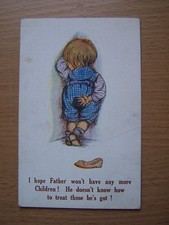
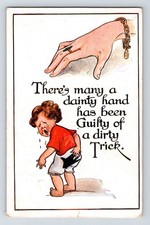
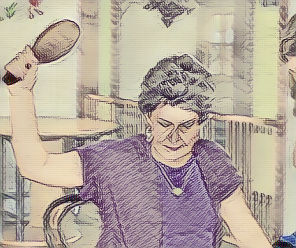
I was not always the angel she hoped for. There were days when mischief got the better of me—muddy footprints tracked across her spotless linoleum, a cheeky retort at the dinner table, or a fib told to escape chores. My mother, like many of her generation, believed in the old ways. She kept her discipline close at hand, in the form of a faded blue slipper, its rubber sole worn smooth by years of use. (pause)
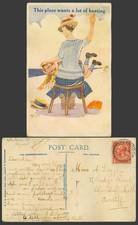
The ritual was always the same, as predictable as the ticking of the kitchen clock. “Come here, boy,” she would say, her voice never raised, but carrying a weight that made my heart flutter with dread. I would shuffle forward, cheeks burning, the world narrowing to the kitchen’s yellow light and the scent of her lavender soap. She would sit on her sturdy chair, take my arm with gentle firmness, and guide me across her lap. (pause)
The slipper would rest for a moment against my skin, cool and slightly rough, and I would feel the hush in the room—the pause before the storm. Then, with a swift, practiced motion, she would bring it down. Smack! The sound was sharp, echoing off the Formica table and the chipped mugs. Six times, always six, each blow stinging more than the last, delivered with unwavering precision. (pause)
“One for muddy shoes,” she would intone, “two for cheekiness, three for not listening, four for fibbing, five for dawdling, and six for forgetting your manners.” Each word was a stone dropped into the stillness, each smack a lesson written in fire across my skin. By the end, my bottom would be ablaze, my eyes prickling with tears I dared not shed. Outside, the shouts of children seemed impossibly distant, as if the world had shrunk to the four walls of our kitchen. (pause)
Yet, even in the midst of punishment, there was a strange tenderness. My mother’s hand, though firm, never lingered in anger. After the sixth smack, she would set the slipper aside, gather me into her arms, and hold me close. “There, my boy,” she would whisper, her voice soft as a lullaby, “all is forgiven. Let us have some tea.” (pause)
We would sit together at the kitchen table, the sting in my bottom slowly fading, the warmth of her embrace lingering. She would pour strong tea into mismatched mugs, the steam curling between us like a peace offering. I would sip in silence, chastened but cherished, the lesson settling deep inside me like a stone in a pond. (pause)
On our estate, such scenes were as common as rain. The air was alive with the sounds of children at play, but every child knew the sting of a slipper or the swish of a cane. It was the way of things, a harshness that seemed woven into the fabric of our lives, yet never entirely cruel. We accepted it, even found comfort in its predictability, for it meant we were cared for, watched over, loved enough to be corrected. (pause)
Sometimes, after the tears had dried and the tea had been drunk, I would feel a peculiar sense of belonging. The slipperings, though harsh, were a sign that I mattered—that my mother would not let me drift into badness or neglect. The six smacks, the gentle embrace, the whispered forgiveness: these were the rhythms of my childhood, as familiar as the chiming of the church bells on Sunday morning. (pause)
Years later, when I was nearly grown and the estate seemed smaller than before, I spoke to my mother about those days. We remembered the slipperings, the lessons, the laughter that always returned. She confessed, with a sigh, that she had never enjoyed giving punishment, but believed it was her duty. “A lesson learned with a smarting bottom,” she said, “is a lesson remembered for life.” (pause)
Now, looking back, I wonder how many other boys in those rows of pebble-dashed houses received their own six smacks for muddy shoes or forgotten manners. Did they, too, learn the lessons my mother taught me—lessons of order, kindness, and love, delivered with a firm hand and a heart that never stopped caring? The memory of those days lingers, bittersweet and bright, like the last rays of sunlight on a Sunday afternoon.