(gap: 2s) In the little English village of Little Elms, where the hedgerows grew thick and wild, and the air was always sweet with the scent of primroses and damp earth, there lived a boy named George. The village itself seemed to slumber beneath a patchwork sky, its slate-roofed houses huddled together as if sharing secrets. On Sunday mornings, the church bells would ring out across the green, and the whole world felt gentle and safe.
George was a lively child, with a mop of unruly hair and eyes that sparkled with curiosity. He was forever dashing about the village green, his scuffed shoes kicking up dust, his patched trousers flapping as he ran. His jumper, always a size too big, had belonged to his older brother before him, and bore the marks of many adventures—snags from brambles, a stubborn grass stain, a button replaced with a mismatched one by his mother’s careful hand.
The village was a world unto itself. There were the mothers, gathered by the white picket fences, their voices rising and falling in gentle gossip as they watched their children play. There was the corner shop, with its bell that jingled whenever someone entered, and the old men who sat on the bench outside, pipes in hand, watching the world go by. The air was filled with the distant laughter of children, the clatter of bicycle wheels, and the occasional bark of a dog chasing after a stick.
George’s days were a tapestry of small adventures—climbing the ancient oak tree at the edge of the green, chasing butterflies through the tall grass, and sometimes, just sometimes, forgetting the time altogether. He was, as the grown-ups liked to say, “a handful.” His mother, a kind but firm woman in a house dress and imitation pearls, would call him in with a voice that brooked no nonsense, her words carrying across the garden like a bell.
In those days, children were expected to mind their manners and obey their elders. The rules were as much a part of life as the changing seasons. If a boy like George forgot himself, there were consequences. The slipper, the belt, and even the cane were not strangers in the homes and schools of Little Elms. These were the tools by which lessons were learned, and bottoms were made sore. Yet, there was a certain order and comfort in knowing where the boundaries lay.
One Sunday afternoon, the sun hung low and golden, and George, utterly enchanted by a flutter of moths, wandered far from home. The world beyond the hedgerows was a place of wonder—fields dotted with cows, a brook that sang over smooth stones, and the distant call of a cuckoo. George lost all sense of time, his heart light and his mind adrift in the magic of the countryside.
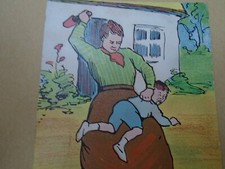
When at last a policeman found him, George’s heart thudded in his chest. The constable was a large man with a bristling moustache and boots that shone like black mirrors. George tried to explain, his words tumbling over each other, but the constable was a man of action, not words. He sat George upon his sturdy knee and delivered a sound spanking—ten sharp smacks that made George’s eyes water and his bottom sting. The world seemed to shrink, and George felt very small indeed.
The walk home was a solemn one, the constable’s grip firm on George’s ear. The village seemed quieter than usual, the shadows longer. At the door, George’s father awaited, belt in hand, his face grave. Without a word, George was led to his small bedroom, where the wallpaper peeled at the corners and a faded “See England!” poster hung above his bed. He lay face down, bracing himself, the familiar scent of soap and old linen filling his nose. The belt sang through the air, landing with a crack across his backside—once, twice, thrice, and more. Each stroke was a lesson: “A boy must obey, and a boy must be home on time.”
That night, George cried into his pillow, the pain sharp and the shame sharper still. He thought of the moths, the brook, and the freedom of the fields, and wondered if it had been worth it. Yet, beneath the sting, there was a quiet understanding—a sense that he had crossed a line, and that the world, though sometimes harsh, was also just.
The next morning, George shifted uncomfortably at the breakfast table, his porridge lumpy and his bottom sore. The kitchen was filled with the comforting smells of toast and tea, the clink of china, and the gentle hum of his mother’s voice. As he rubbed the seat of his trousers, he knew in his heart that he had done wrong. His mother poured him a cup of tea and gave him a gentle pat on the shoulder. “We punish because we love, George,” she said softly. “A good boy learns from his mistakes.” Her words, though simple, wrapped around him like a warm blanket.
At school, the rules were just as strict. The headmaster, a tall man with silver hair and a voice like thunder, kept a slipper behind his desk, and the cane hung on the wall like a silent warning. George, bright but easily distracted, often found himself called to the front of the class. The walk from his desk to the headmaster’s was the longest journey in the world. A few quick smacks with the slipper—sometimes just two, sometimes as many as eight—reminded him to pay attention. The sting faded, but the lesson lingered, echoing in the hush of the classroom.
The cane was reserved for the gravest offences. George received his first caning on a cold, grey morning, and the memory of those fiery stripes across his bottom stayed with him for days. The pain was sharp, but it was the shame that truly smarted. He kept his head down, avoiding the eyes of his classmates, and resolved to do better. Yet, in the world of Little Elms, every child knew that discipline was part of growing up, and that forgiveness was never far behind.
Sometimes, George would sit on the stairs, listening to the grown-ups talk in low voices about the importance of good behaviour. He would think about the slipper, the belt, and the cane, and resolve to do better. But boys will be boys, and mischief was never far away. There were always new adventures to be had, new rules to test, and new lessons to learn.
There were tears, of course—tears into his pillow, tears as he apologised to neighbours for his pranks, his cheeks burning with embarrassment. But there was also forgiveness, and the chance to try again. The mothers of Little Elms, in their sensible coats and headscarves, believed that a firm hand and a loving heart would set a child straight. They would share knowing glances and gentle smiles, their eyes soft with understanding.
As the years passed, George grew wiser. He learned that every spanking, every scolding, was meant to teach him right from wrong. The world was not always kind, but it was fair, and a boy who learned his lessons would one day become a good man. He remembered the sting of discipline, but also the warmth of his mother’s embrace, the pride in his father’s eyes when he did well, and the laughter that filled their little parlour on winter evenings.
Sometimes, on quiet afternoons, George would wander the village lanes, the memories of childhood swirling around him like autumn leaves. He would pause by the old oak tree, run his fingers over the rough bark, and remember the boy he had been—the boy who chased butterflies, who tested boundaries, and who learned, slowly and surely, what it meant to be loved.
And so, in the gentle glow of the parlour fire, with the sounds of the village drifting in through the window, George would remember the sting of the slipper and the warmth of his mother’s embrace. For in Little Elms, as in all good stories, a boy’s mischief was always met with love—and a lesson well learned. And as the years rolled on, George carried those lessons with him, a quiet strength in his heart, and a fondness for the village that had shaped him.