During the late 1950s and early 1960s, the term “lower school” at my grammar school referred to the first and second years following entry from junior school. The transition proved something of a shock. At junior school, corporal punishment was employed occasionally. Boys might be punished in class by being required to bend over a teacher’s desk, with the severity depending largely upon the individual master. Some administered only a few strokes with a ruler, while others were considerably firmer. At that time many children also received physical punishment at home, and consequently a few strokes administered at school were generally regarded as unremarkable. Although girls occasionally witnessed such punishments, it was uncommon for them to be disciplined in this way. I do not recall any girl receiving corporal punishment in class; rather, they were usually referred to the senior mistress, though even this occurred infrequently.
The move to grammar school introduced a far stricter regime, including regular homework, detentions, and a compulsory uniform complete with school cap. Whereas junior school pupils generally remained in one classroom, grammar school life involved moving between different rooms for separate subjects. Many lower-school masters kept a plimsoll shoe or ruler at hand, and some made frequent use of them. A whispered conversation during a lesson could easily result in two strokes administered before the class. The severity varied widely from teacher to teacher: some struck with considerable force, while others delivered little more than formal taps. Given the number of lessons and masters encountered in a single day, a boy might find himself punished several times before the final bell. Canings, however, remained comparatively rare in most lower schools unless a particularly serious offence had occurred.
Discussion of Poundswick High School in the 1970s recalls the case of a girl named Alison, who was reportedly slippered before the assembled lower school. It is interesting to note that some modern schools with sixth forms now define the “lower school” as Years 7 to 11, encompassing all pupils prior to entry into the sixth form.
One cannot help but sympathise with Alison. Poundswick High School, apparently formed through the amalgamation of a grammar school and a secondary modern school, appears to have been both mixed and comparatively large in size. If, as accounts suggest, the punishment was administered across the buttocks, the experience must have been deeply humiliating. To be punished publicly before not only one’s own classmates but also pupils from numerous other forms and members of staff would undoubtedly have been a distressing ordeal.
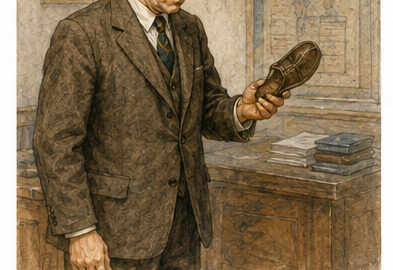
At my own secondary school there was no formally designated lower school. Nevertheless, classroom corporal punishment was largely confined to the second and third forms. There was no first form as such, since that year corresponded to the final stage of the associated preparatory school. Owing to the timing of my birthday, I remained an additional year in junior school before taking the eleven-plus examination and therefore entered secondary school in the third form. My form master was the formidable Mr H, a man of imposing stature who habitually carried a large leather-soled sandal.
This instrument was sufficiently severe to reduce even robust twelve-year-old boys to tears. One pupil alone remained unimpressed, having previously attended a preparatory school where he had experienced caning upon the bare skin; by comparison, he declared the sandal insignificant. On the sole occasion when I found myself awaiting punishment from Mr H, he unexpectedly changed his mind at the final moment, though I never discovered the precise reason. Beyond the third form, apart from the gymnasium masters—who enjoyed a fearsome reputation—the risk of classroom punishment diminished considerably. More serious disciplinary matters, however, could still bring pupils before the prefects or, in exceptional cases, before the headmaster himself.
For much of my school career I lived in apprehension of punishment at the hands of the prefects, who exercised substantial authority over routine discipline. This anxiety ended only with my entry into the sixth form and my subsequent appointment as a “privileged sixth former”, a position akin to that of a junior prefect. I appeared before the prefects’ court only once, early in my school career.
At junior school I had previously received punishment with a plimsoll before the class and had not found it especially painful. Yet the sight of the full-sized school cane laid upon the prefects’ table suggested that matters would have been altogether different had it been vigorously applied by a senior rugby player. Fortunately, I received only lines to copy, and that proved my final appearance before the prefects’ tribunal.
It seems accurate to suggest that pupils aged approximately eleven to thirteen formed the principal recipients of school corporal punishment. Nevertheless, some junior school boys and girls also experienced the ruler or slipper, and a few boys were caned. At my junior school the cane was reserved for persistently disruptive boys and usually consisted of one or two strokes across the hands. On one occasion my class teacher struck me twice with a blackboard T-square. It stung sharply, though no lasting harm resulted. Such practices must be understood within the social context of the period, when physical punishment by parents remained commonplace.
During the early years of secondary school, however, punishments with the cane or slipper were often administered more firmly. In my first year I experienced both the plimsoll and the ruler. At the age of thirteen, a foolish prank led to my appearance before the headmaster alongside two other boys. Since my school was boys-only, my recollections naturally concern male pupils. By the end of the third form, classroom punishments had become unusual, though caning for serious offences continued into the upper years and occasionally even involved lower sixth-form pupils. I was approximately sixteen when I discovered how painful a full “six of the best” could be.
Although some maintain that corporal punishment should still have a place in schools, I do not share that view. Society and educational attitudes have altered profoundly, and young people today mature under very different circumstances from those of previous generations.
St James’ School in Bolton provides another example frequently discussed. One former pupil, Vivien, stated that she had received caning across the buttocks from a mistress for repeated lateness. Accounts suggest that groups of girls were also caned across the hands. St James’, a mixed Church of England secondary school, appears to have originated as a secondary modern before becoming comprehensive in the early 1970s.
Practices regarding corporal punishment varied greatly from school to school. In some mixed schools only boys were punished physically, while in others both boys and girls were liable to such discipline. Frequently girls were punished across the hands rather than the buttocks, particularly where male staff were involved. In many schools it was considered improper for male teachers to administer corporal punishment to girls, though there appear to have been exceptions. Some grammar schools reportedly imposed identical punishments upon boys and girls alike, generally across the hands.
Local Education Authorities occasionally issued guidance concerning corporal punishment, but many schools retained broad discretion. At the time, physical discipline was widely regarded as legitimate provided it was not excessive. One common rule prohibited punishment upon the bare skin in state schools, though private institutions sometimes operated differently.
It should also be remembered that during the 1950s and 1960s many parents continued to employ physical punishment at home. Standards and methods varied, but most parents considered such discipline part of ordinary child-rearing. By the 1970s these practices were already beginning to decline, reflecting broader social change.
For those seeking to understand the historical character of particular schools, including whether they were mixed or single-sex institutions, a brief search of public records is often illuminating. Many schools underwent mergers, name changes, and alterations in status during the post-war decades, particularly within local authority systems.
Evidence from schools in the North-West of England suggests that there were occasional instances of male teachers administering corporal punishment to female pupils, though the details are often unclear. In many historical accounts the precise manner or location of punishment is left unspecified, making firm conclusions difficult. It is also worth noting that student teachers were often discouraged, or even forbidden, from administering corporal punishment until they had gained several years’ experience as fully qualified members of staff.