Once, in the heart of a bustling Surrey estate, there lived a boy named Peter. Peter was a cheerful lad, always eager for adventure, and he had been saving his pocket money for what felt like an eternity. At last, the day arrived when he could buy a brand new football—a splendid black and white one, with the names of famous footballers written on its panels. Though it was not real leather, it gleamed with promise, and Peter carried it home with pride, his heart brimming with joy.
(short pause) After changing into his football kit, Peter set out to find his friends, eager to show off his prized possession. But as he stepped into the alley behind his house, he encountered a group of older boys. They were mischievous, as older boys often are, and they snatched Peter’s new ball, tossing it over his head and laughing. Peter knew they meant no real harm, and he waited patiently for them to finish their game.
(pause) At last, one of the boys kicked the ball high into the air. It bounced off a kerb and sailed over the neighbour’s hedge. There was a splash, a startled shout, and soon the neighbour appeared, dripping wet and cross as a bear disturbed from his nap.
(short pause) The neighbour, his temper as soggy as his trousers, seized Peter by the arm and marched him into the garden. There, floating in the pond, was Peter’s precious football. The neighbour’s wife, equally displeased, handed her husband a screwdriver. Before Peter could utter a word, the man punctured the ball, and it sagged sadly in Peter’s hands. Peter’s heart broke, and tears welled in his eyes.
(pause) Peter tried to explain, but the neighbour would not listen. The neighbour’s wife hurried round to Peter’s house to complain, her voice rising with every step.
(short pause) Peter’s mother opened the door and received a stern lecture about the damage to the pond, the frightened fish, and the soaked husband. Peter’s mother listened gravely, her lips pressed in a thin line.
(pause) When Peter’s mother found him in the garden, clutching his ruined football and weeping, she was not pleased. The neighbour glared over the fence, and Peter’s mother, her patience worn thin, ordered him inside. She took the deflated ball and threw it in the dustbin. Peter was sent to his room, his heart heavy with sorrow.
(short pause) Alone in his room, Peter wept bitterly. He had not meant to cause trouble, but now he feared the consequences. In those days, children were expected to behave, and when they did not, they faced the consequences bravely.
(pause) Peter knew what was coming. In his family, mischief was met with firm discipline. For small offences, he might be kept indoors for a day or two, with no time for play. But this, he feared, was a greater misdeed.
(short pause) Downstairs, Peter heard voices—his mother speaking to someone, her tone sharp. Then, suddenly, she called his name, her voice ringing through the house. Peter’s heart thudded in his chest as he made his way to the kitchen.
(pause) His mother stood waiting, her face stern. Without waiting for Peter’s explanation, she delivered her verdict. She had spoken to Peter’s father, who was very disappointed. Peter was to be punished, and if he complained, his father would deal with him more severely when he returned.
(short pause) Peter had never been spanked before, and the thought filled him with dread. But he knew, as all children did in those days, that discipline was part of growing up. It was how one learned right from wrong, and how respect for elders was instilled.
(pause) A chair had been placed in the centre of the room, with an extra cushion on the seat. Peter’s mother sat down and beckoned him forward. “Across my knee, young man,” she said firmly. “This has been coming for some time.”
(short pause) With trembling hands, Peter obeyed. He placed his hand on his mother’s knee, and she guided him gently but firmly across her lap. He felt her arm secure him, and he braced himself, not knowing quite what to expect.
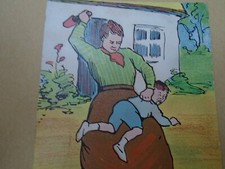
(pause) Then, with a swift motion, his mother began to spank him. The pain was sharp and stinging, and Peter gasped in surprise. It was not her hand, but a wooden spoon, hidden beneath the cushion, that delivered the lesson. Peter tried to wriggle away, but his mother held him fast, determined that he should learn from his mistake.
(short pause) As the spanking continued, Peter pleaded his innocence, but his mother was resolute. She knew that sometimes, a firm hand was needed to teach a child the difference between right and wrong. Peter’s cries grew louder, but his mother did not relent until she was sure the lesson had been learned.
(pause) At last, the spanking was over. Peter’s mother released him, and he stumbled upstairs, his bottom sore and his pride wounded. She gave him a final smack and told him to stay in his room and think about what he had done.
(short pause) Peter lay on his bed, tears streaming down his cheeks. He was shocked by how much a spanking could hurt, but deep down, he knew it was meant to teach him a valuable lesson. He thought about his actions, and how they had led to trouble for himself and others.
(pause) Later, Peter realised that his mother had used the wooden spoon, cleverly hidden under the cushion. It was a tool many mothers of the time kept handy, not out of cruelty, but out of a sense of duty to raise their children well.
(short pause) Eventually, Peter drifted off to sleep. When he awoke, his father was sitting beside him. Peter, still frightened, begged not to be punished again. But his father, with a gentle smile, assured him that the matter was settled. He invited Peter to come down for supper, but Peter, still sore and ashamed, chose to stay in bed.
(pause) It took several days for Peter to recover, both in body and spirit. His bottom was tender, and his heart was heavy, but he knew he had learned a lesson he would never forget.
(short pause) Peter never spoke to the neighbours again, and he never told the older boys what had happened. In time, he explained his side of the story to his mother, but she did not apologise. In those days, parents believed that discipline was for the child’s own good, and apologies were rare.
(pause) That spanking remained the only one Peter ever received as a child. It was a memory that stayed with him, a reminder of the importance of honesty, respect, and obedience.
(short pause) Years later, when Peter was grown, he spoke to his father about that day. His father explained that the threat of a harsher punishment had been meant to encourage Peter to accept his discipline bravely. He also confided that he and Peter’s mother had disagreed about the severity of the spanking, but it was all in the past.
(pause) Peter never mentioned the incident to his mother again. He understood that, though the lesson had been painful, it had been given with love and a desire to help him grow into a good and responsible man.
(short pause) And so, Peter learned that mistakes, though painful, are opportunities to grow. He learned to respect his elders, to take responsibility for his actions, and to cherish the lessons of childhood. For in every tear and every trial, there is a seed of wisdom, waiting to blossom in the heart of a child.
(pause) The days that followed were filled with a quiet reflection. Peter’s mother, though stern, showed her love in small, tender ways. She would leave a biscuit on his bedside table, or ruffle his hair as she passed by. Peter, in turn, tried to be more mindful of his actions, understanding now the weight of his choices.
(short pause) The estate, with its familiar sights and sounds, became a backdrop to Peter’s growing awareness. The laughter of children, the clatter of the milkthe fact that I had not kicked the ball or even got to show my mates the new football of which I was so proud!