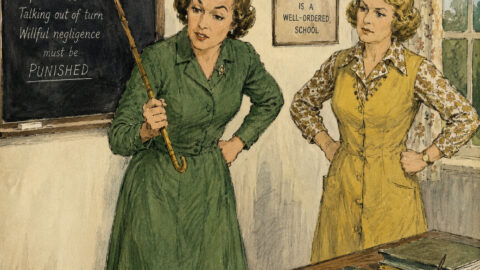
In the grey, drizzly days of the 1960s, when the sky above Hull seemed permanently hung with clouds and the air always carried the tang of coal smoke and wet concrete, I trudged each morning to a council-run school perched on the city’s far edge. The building itself was a squat, grim affair, its brickwork streaked with damp and its windows forever fogged with condensation. The playground was a patchwork of puddles and cracked tarmac, where children in threadbare jumpers and scuffed shoes splashed and skidded, their laughter echoing off the pebble-dashed walls. Inside, the corridors smelled of boiled cabbage and disinfectant, and the classrooms were lit by the weak, flickering glow of strip lights that buzzed like angry wasps.
The teachers, too, seemed worn down by the endless drizzle and the relentless tide of children. Their faces were pale and pinched, their shoulders stooped beneath the weight of a hundred small miseries. They moved through the halls like ghosts, clutching battered registers and muttering to themselves about lost pencils and missing dinner money. Lessons dragged on, each minute stretching into eternity, and the children—myself included—grew restless and wild, our minds wandering far beyond the arithmetic and spelling on the blackboard.
Whenever a supply teacher appeared, we regarded them with a mixture of curiosity and glee, for everyone knew they would never keep order. They were lambs sent to the slaughter, and we, the unruly flock, wasted no time in testing their patience. Paper aeroplanes soared, ink pellets flew, and the air was thick with whispered jokes and stifled giggles.
One particularly dreary afternoon, as the rain lashed against the windows and the radiators clanked and hissed, I found myself seized by a sudden, irresistible urge for mischief. I tore a page from the back of my battered mathematics book—already dog-eared and covered in doodles—and folded it into a perfect paper aeroplane. With a furtive glance at the teacher, I launched it across the classroom. It soared in a graceful arc, gliding above the heads of my classmates, and for a brief, glorious moment, I felt like a hero.
But before the aeroplane could complete its maiden flight, I felt a sudden, sharp tug on my ear—a sensation as shocking as plunging your hand into a bucket of icy water. I yelped and twisted round to find Mrs. Hargreaves, my old first-year teacher, standing behind me. She had swept in from the next room, her eyes blazing with righteous fury, her lips pressed into a thin, determined line. She had heard the commotion and come to restore order, as she always did.
Without a word, she marched me to the front of the class, her grip on my ear unyielding. The room fell silent at once, every eye fixed on me. “Every one of you shall be silent this instant—unless you wish to receive a sore bottom like Thomas here!” she declared, her voice ringing out like a church bell. The hush that followed was so complete you could hear the rain tapping on the windowpanes and the distant rumble of a lorry passing by.
Mrs. Hargreaves twisted my ear once more and led me out, her shoes clicking ominously on the linoleum. As we crossed the corridor, she announced, “I never imagined I would be forced to spank a second-year boy today.” Her words hung in the air, heavy with disappointment and resolve.
She brought me to her own classroom, a cold, echoing space at the end of the corridor. The walls were lined with faded maps and curling posters of the solar system, and the air smelled faintly of chalk dust and boiled cabbage. At the back of the room stood a battered wooden desk, its surface scarred by generations of restless hands. My knees trembled as she opened the supply cupboard, the hinges squealing in protest. I had not been spanked by Mrs. Hargreaves since I was in the infants, and the memory of it still made my stomach twist.
Mrs. Hargreaves rummaged in her handbag, her movements brisk and businesslike. Then came the unmistakable sound of a slipper being slapped against her palm—a sharp, rubbery thwack that made my heart thump like a drum. My mouth went dry, and I stared at the floor, unable to meet her gaze. She fixed me with a look that was both stern and sorrowful, as if she regretted what she was about to do but saw no other choice.
“Six with the slipper,” she said sternly, “and you will count each one aloud.” My hands shook as I bent over the battered desk, the wood cold and splintery beneath my fingers. My breath came in short, shallow bursts, and I could see the scuffed toes of her shoes as she took her position behind me.
The first smack landed with a crack that echoed around the empty room. The pain was immediate—a hot, stinging jolt that seemed to set my whole backside ablaze. “One,” I gasped, my voice trembling. The second blow came swiftly, harder than the first, and I bit my lip to keep from crying out. “Two.” My eyes began to water, and I squeezed them shut, bracing myself for what was to come.
The third smack was the worst yet, landing squarely on the same spot as the others. The pain built upon itself, sharp and insistent, and I felt my knees buckle. “Three,” I choked out, my voice barely more than a whisper. The fourth and fifth followed in quick succession, each one a fiery explosion that left me sobbing openly. “Four… five…” My hands gripped the desk so tightly my knuckles turned white, and I could hear the faint ticking of the classroom clock, each second stretching out like an eternity.
The sixth and final blow was the hardest of all. It landed with a resounding slap that seemed to reverberate through my bones. “Six!” I cried, tears streaming down my cheeks, my whole body shaking with the effort of holding myself together. For a moment, there was only the sound of my own ragged breathing and the faint echo of children’s voices from the playground, muffled by the thick glass.
Mrs. Hargreaves pulled me upright, her face grave but not unkind. She scribbled a note, folded it crisply, and placed it in my trembling hand. “Give this to your mother and return it, signed, tomorrow morning,” she said, her voice softer now, almost gentle. I nodded, unable to speak, and clutched the note as if it were a lifeline.
She marched me back to my own classroom, still holding my ear, and pointed to the corner. “You shall remain there until playtime,” she commanded. My bottom throbbed with every heartbeat, and all I could think of was the dreadful note in my pocket—and what would happen when my mother read it. The minutes crawled by, each one marked by the slow, relentless ticking of the clock and the muffled sounds of lessons continuing around me.
When the bell finally rang, I gathered my things and trudged home through the drizzle, my shoes squelching with every step. The estate was quiet, the only sounds the distant ring of the rag-and-bone man’s bell and the soft clatter of milk bottles on doorsteps. I passed mothers in curlers and housecoats, gossiping by battered prams, and children playing football on the patchy green, their shouts echoing in the damp air.
When I arrived home, I handed the note to my mother at once, hoping to get the ordeal over with. She read it in silence, her brow furrowing, and then sighed deeply—a long, weary sound that seemed to carry the weight of a thousand disappointments. “Fetch the slipper from my bedroom,” she said at last, her voice tired but resolute.
I trudged upstairs, my legs heavy as lead, and retrieved the dreaded slipper from beneath her bed. It was old and worn, the sole cracked and the edges frayed, but I knew from experience that it could sting like a wasp. I returned, clutching it in both hands, my heart pounding in my chest, and handed it to her without a word.
My mother announced, “You shall receive six smacks for your mischief.” Her voice was weary but determined, and I knew there would be no arguing. She made me bend over the arm of the sagging sofa, the fabric rough against my cheek. I could hear the kettle rattling on the hob and the faint strains of pop music from the radio in the kitchen, the ordinary sounds of home made strange by the tension in the air.
The first smack landed with a dull, heavy thud, sending a jolt of pain through my already sore backside. “One,” I whimpered, my voice muffled by the sofa. The second was sharper, catching me just below the first, and I yelped despite myself. “Two.” The third was a glancing blow, but it stung all the same, and I felt hot tears prick at my eyes. “Three.”
The fourth smack was delivered with grim determination, and I kicked my legs involuntarily, the pain radiating down to my toes. “Four.” The fifth was the hardest yet, and I howled, my face wet with tears. “Five.” The sixth and final blow seemed to last forever, a burning, searing pain that left me breathless. “Six!” I sobbed, my whole body shaking.
Afterwards, my mother sent me to stand in the corner, without any tea, and told me to remain there until bedtime. My bottom throbbed with every movement, and I could feel the heat radiating through my thin trousers. The room was quiet except for the ticking of the clock and the distant hum of traffic outside. I stared at the faded wallpaper, tracing the patterns with my eyes, and tried not to think about the day’s events.
That day, I learned a lesson as sharp as any slipper’s sting: never again did I make, or throw, a paper aeroplane in class. For in our