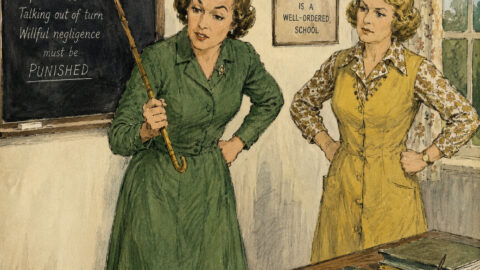
(gap: 1s) My earliest school days unfolded in a world that now feels impossibly distant—an era of pebble-dashed council houses, the air tinged with the scent of cut grass and coal smoke, and the constant background hum of a community bound by routine and resilience. I attended a boys-only junior school from the ages of eight to eleven, a place where discipline was as much a part of the curriculum as arithmetic or handwriting. The staff was almost entirely male, save for two women: one, gentle and motherly, and the other—a figure who loomed large in our collective memory—was strict, sharp-tongued, and seemed to carry a permanent cloud of disapproval about her. She was the sort of teacher whose footsteps in the corridor could silence a classroom in an instant.
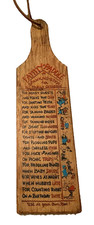
(short pause) Officially, the only corporal punishment allowed was the headmaster’s cane—a thin, whippy rod that hung on the wall of his office like a warning. But the reality was more complicated. One afternoon, after a muddy games lesson, I lingered in the changing room, the air thick with the smell of damp socks and liniment. It was there, from the shadowy far corner, that I witnessed something that would etch itself into my memory: the strict mistress, her face set in a mask of stern resolve, ordering a boy to touch his toes. The slap of her hand against his shorts echoed off the tiled walls. It wasn’t a brutal punishment, but the humiliation was palpable—the boy’s cheeks flushed, his eyes fixed on the floor. I remember feeling a strange mix of fear and fascination, knowing that if she’d spotted me, I might have been next. Even now, decades later, I can recall the tension in that room, the sense that childhood was a fragile thing, easily bruised by adult authority.
(pause) My secondary school years brought a change of scenery but not of gender—another boys’ school, this one surrounded by genteel girls’ academies, their manicured lawns and neat uniforms visible just over the crumbling brick wall that marked the edge of our world. Our own grounds were less refined: a sprawling yard bordered by the single-storey rifle range and the CCF Orderly Office, places that smelled of gun oil and old paper, where boys in ill-fitting uniforms marched and shouted under the watchful eyes of ex-military staff. After I left, I heard that, on sunny days, physical training was sometimes moved outdoors, the yard echoing with the thud of footballs and the shouts of boys released from the confines of the gym.
(short pause) There was an unspoken ritual whenever a ball sailed over the wall into the forbidden territory of the girls’ school. The PE teacher, a man with a whistle always dangling from his neck, would single out the unlucky culprit—usually a boy in nothing but shorts and plimsolls, his knees still muddy from the game. With a mixture of dread and excitement, the chosen one would clamber onto the rifle range roof, then drop down into the unknown. Looking back, I suspect there was some tacit agreement between the schools, a silent understanding that boys would occasionally trespass in pursuit of lost property. Still, the stories that filtered back were always tinged with bravado and embarrassment: tales of near-capture by giggling girls, of red faces and hurried escapes, of the strange, electric thrill of crossing boundaries—both literal and otherwise.
(pause) These memories, vivid and oddly tender, remind me how childhood is shaped by the rules we break, the authority we fear, and the small rebellions that mark our growing up. Even now, I can close my eyes and hear the distant rattle of a pram, the hum of a Ford Anglia, and the echo of laughter—half anxious, half triumphant—on the other side of the wall.