(gap: 2s) It is true that one of the lady’s many talents is that of Animatrice—a word that, in the French tradition, means far more than just “animator.” It conjures up images of a vibrant leader, a creative educator, a spark at the heart of children’s television and youth culture. In France, the Animatrice is a cherished figure, guiding generations through laughter, song, and gentle lessons. Yet, while she specializes in nurturing young minds, I can assure you she is not involved in the sort of training and education that involves SCP—school corporal punishment. (short pause) The only consolation, perhaps, is that if she were, she would likely wield a martinet, that infamous French implement of discipline. Seldom described in English circles, and even less often discussed, the martinet was traditionally reserved for boys, delivered with the recipient bent over and, as the stories go, on the bare. It would have made a splendid tale for this estimable Forum!
(pause) She is, in fact, a French actress, singer, and animatrice—born Frédérique Hoschedé, but known to millions as Dorothée. Her career is a tapestry woven through the fabric of French popular culture. Dorothée’s rise began in the late 1970s, but it was in the 1980s that she became a household name, hosting beloved children’s programs like “Récré A2” and “Club Dorothée.” Her warmth, wit, and boundless energy made her a surrogate big sister to a generation. The image you see here is from December 1985, when she was, according to the caption, 25 years old—though, as we’ll see, the numbers don’t quite add up. The photograph, published on the French celebrity site ‘Purepeople,’ captures her at the height of her fame, surrounded by the glittering world of Parisian showbiz.
(short pause) Most of the original article has vanished into the ether, but once, there was a series of photographs from that same event—Dorothée mingling with French celebrities, her laughter echoing through the room. Now, only this orphaned image remains, captioned ‘dorothee-a-l-age-de-25-ans.’ From the fragments of other captions, we can deduce the event took place in 1985, a year when French pop culture was in full bloom and Dorothée was its radiant centerpiece.
(pause) Now, one should never comment on a lady’s age—especially a French lady, for whom age is but a number, and style is eternal. Yet, there is a charming discontinuity between the date of the photograph and the age given. Dorothée was born in July 1953, so if the photograph was indeed taken in December 1985, she would have been 32, not 25. Be that as it may, she was certainly not old enough to wield a punitive implement when I was at school. But in 1985, at the time of the picture, she was the queen of children’s television, a figure of gentle authority and boundless creativity.
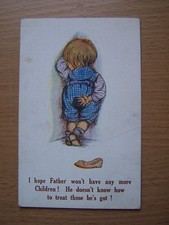
(pause) The martinet—a word that sends a shiver down the spine of many a French child of the past. This very French implement for juvenile corporal punishment was once as common in French households as the wooden spoon or slipper in Britain. I remember, vividly, holidaying in the Loire Valley—Saumur, I think, around 1970. In a small general store, there was a stack of about a dozen martinets on a shelf, unwrapped, their purpose unspoken but universally understood. The martinet is a short whip: a wooden handle, about 25 centimeters long, with a spray of leather thongs—ten or so—dangling from the end, each one like a bootlace, ready to sting. French parents, especially mothers, would keep one handy for moments of disobedience, and the ritual was always the same: the child, over the knee, bare bottom exposed, the martinet flicking through the air with a sound that promised swift justice. (short pause) It is a curious thing—while the martinet was a fixture in French homes, I have never heard of it being used in French schools. French SCP, as it were, remains a mystery to me.
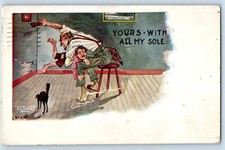
(pause) In England, there was no direct equivalent. School punishment canes could be purchased from educational suppliers, but for family discipline, the tools were more improvised: slippers, plimsolls, table tennis bats, wooden spoons, and the ever-present trouser belt. None of these were sold explicitly for corporal punishment, and none carried the same cultural weight as the martinet. The very name “martinet” comes from Jean Martinet, an 18th-century French Lieutenant Colonel renowned for his strict military discipline—a man whose legacy, for better or worse, lives on in the collective memory of French childhood.
(pause) And then there is the Scottish Tawse—a subject I know little of, though I understand variants were used in the North of England, notably in Manchester and the Midlands town of Walsall. The Tawse, with its split leather tongues, was a fearsome implement in its own right, and stories of its use are woven into the folklore of British education. Should anyone here have more knowledge—or indeed, experience—of the French Tawse, I for one would be delighted to learn more.
(pause) As for Dorothée, I fear I may have revealed too much, too soon—conflating the stern Miss Brown, hard-caning headmistress, with Dorothée, the elegantly long-skirted French actress, singer, and animatrice, who, I suspect, never wielded a martinet or a cane. But once the scent of a story is in the air, the thrill of the chase is irresistible. It is not unlike the old days, trying to unravel the mysteries of a computer crash—was it the users, the operators, or the engineers who had caused the chaos and cost the company thousands? Never the system programmers, of course—perish the thought! (short pause) And so, the slipper, the martinet, and the legends of childhood discipline remain, woven into our memories, half-remembered and half-myth, as vivid as the faded photographs on a mantelpiece, or the distant echo of a mother’s voice calling us in from the garden at dusk.