(gap: 2s) The story I’m about to share takes us back to the heart of 1970s Huddersfield, to the corridors of Greenhead High School—a place caught between eras, tradition and change. My wife attended Greenhead during a pivotal moment: she was part of the penultimate all-girls intake, just before the school transformed into a mixed sixth form college in 1973. The early seventies were a time of transition, not just for the school, but for the entire country. The old ways were fading, but not yet gone.
(short pause) In 1971, the long-serving female headmistress retired, and for a brief period, the school was led by an interim male headmaster. This was unusual for an all-girls school, and it marked the beginning of a gradual shift. By 1973, a permanent male headmaster had taken charge, and each year, the number of girls in the lower school dwindled as the institution moved toward coeducation. For about four years, girls who found themselves in serious trouble—those rare, rebellious few—were sent to the headmaster’s office, where the ultimate sanction awaited: the cane.
(pause) But let’s be clear—Greenhead was considered a “posh” girls’ school, and the cane was reserved for only the most defiant. My wife recalls that being sent to the headmaster was a dreaded, almost mythical event, whispered about in corridors but rarely witnessed. The threat of the cane hung in the air, but it was shame, humiliation, and the fear of letting the school down that kept most girls in line. The culture was one of high standards and quiet discipline, enforced more by reputation than by physical punishment.
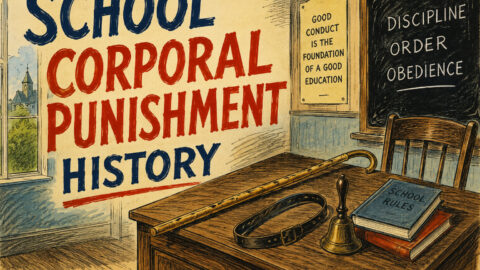
(pause) This all came up one evening as we chatted with a friend about the changing standards in schools. My wife mentioned her own brush with authority—being “sent to the headmaster”—and the conversation turned to the broader history of corporal punishment in British schools. Based on countless stories shared in historical forums and old school groups, it seems that while caning girls was never strictly forbidden, it was far less common than with boys. In many mixed schools, the cane was a first resort for boys, but for girls, it was a last, reluctant measure.
(pause) In fact, in most all-girls schools, especially those with a female head, corporal punishment was often delegated to a senior mistress, if it was used at all. The presence of a male headmaster at Greenhead was an anomaly, a product of the school’s transition. In mixed schools, the headmaster might sometimes delegate the task, but the responsibility—and the discomfort—often remained with him.
(pause) I remember a story from a good friend of mine, a senior mistress at a Liverpool school. She found herself in the uncomfortable position of having to cane a boy on the hand—a reversal of the usual roles. She confided that she never made a habit of it; the experience left her uneasy, a reminder of how discipline could weigh heavily on those who enforced it as well as those who received it.
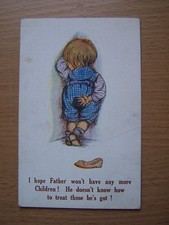
(pause) There are, of course, many accounts of girls being caned, but in my experience, these were usually in mixed schools or before the mid-1950s. In London’s girls-only grammar schools, the cane had all but disappeared by the late fifties. Yet, the slipper—a battered, familiar object in many households—remained in use, especially for younger girls in gym class. A couple of taps with the slipper was seen as a corrective, almost domestic gesture, rather than the formal severity of the cane.
(pause) Some schools, like Hay Currie in East London, had a reputation for strict discipline. In 1958, Hay Currie banned the caning of girls by anyone except the headmaster, and even then, it became a rarity—perhaps vanishing altogether. By the 1970s, most mixed schools in Essex had banned the caning of girls entirely, reflecting a broader shift in attitudes toward discipline and gender.
(pause) Of course, there were exceptions—names like Miss Dimes crop up in old staff lists, and stories from my wife and her friends suggest that the rules were sometimes bent. But by the mid-1960s, the use of the cane in all-girls schools was vanishingly rare. I’m always open to being proved wrong, and I know that every school had its own unwritten rules and legends.
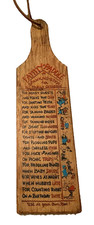
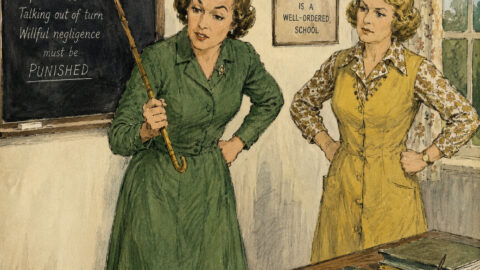
(pause) Recently, I stumbled upon a memoir from that era, complete with a faded photograph. It made me wonder: would the stern lady in the picture have passed muster as a disciplinarian in the eyes of the school’s most esteemed staff? Would she have wielded the cane, or relied on the power of her presence alone? These are the questions that linger, as the echoes of those days fade into memory, leaving behind only stories, and the quiet authority of a slipper resting on a dresser.