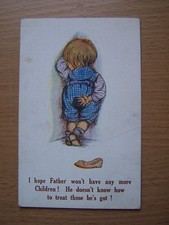
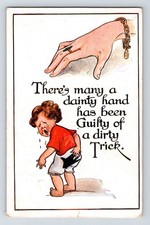
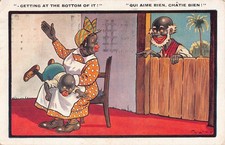
The recollections of childhood games and informal punishments described above reflect a curious aspect of post-war British childhood, when children were often granted a degree of freedom and independence scarcely imaginable today. During the 1950s and 1960s, long summer afternoons were spent largely unsupervised in gardens, parks, vacant lots and improvised playrooms fashioned from tents, sheds and tree houses. Within these private worlds, children frequently imitated the customs and authority structures they observed in adult life, particularly those associated with school and family discipline.
At that time corporal punishment was not merely tolerated but widely regarded as an ordinary feature of upbringing and education. In many schools the cane or slipper remained symbols of authority, while at home a smack or spanking was commonly accepted as a corrective measure. Children, naturally inclined to imitate the society around them, absorbed these practices into their games. Thus “playing schools” or “playing families” often involved mock punishments administered in imitation of teachers or parents.
What is striking in many such recollections is not cruelty, but rather the seriousness with which children approached these imaginary roles. The tree house became a schoolroom complete with rules and penalties; the tent became a courtroom or domestic setting in miniature. The punishments themselves, though occasionally painful, were usually treated as part of the ritual of the game. Participants accepted them much as they accepted the imaginary lessons, quarrels or ceremonies that accompanied childhood play.
The atmosphere of these games was often shaped by hierarchy within the group. Older children naturally assumed positions of authority, while younger ones were expected to submit to rules established by their seniors. Such arrangements mirrored broader social attitudes of the era, in which deference to age and authority was strongly emphasised. The youngest members of a neighbourhood circle were frequently assigned subordinate roles, whether as pupils, babies or “offenders,” and mock punishments became part of that structure.
Yet memory has a curious way of softening such experiences. Incidents that may once have caused embarrassment or discomfort are often recalled later with nostalgia, coloured by the innocence and companionship of childhood itself. The tents, tree houses and improvised playgrounds become symbols not of hardship but of freedom, imagination and belonging. The punishments, while memorable, formed only a small part of a larger world of adventure and companionship shared among neighbourhood children.
It is equally important to recognise how profoundly attitudes have changed. Practices once considered harmless imitations of adult discipline would now be viewed with far greater concern, both by parents and by society at large. Modern childhood is more carefully supervised, and corporal punishment itself has largely disappeared from schools and public life. Consequently, accounts such as these now appear not merely personal recollections but social documents, offering a glimpse into the customs, assumptions and freedoms of an earlier generation.
As I was a well-behaved child, I was never subjected to corporal punishment at school, where such measures were, in any case, uncommon.
Nevertheless, as the youngest among the children in our street, I often found myself the subject of playful chastisements during our games. These incidents have remained vivid in my memory, and I suspect many others of my generation may recall similar experiences.
Whenever I think of the disciplinary games of childhood, I am reminded of tents. A tent, even when erected in the corner of a neighbour’s garden, seemed to provide a world of our own in which we established our own rules and customs. One Sunday afternoon in July, we held a quiz inside such a tent. Judy answered four questions incorrectly, whereupon the others proposed that she should receive a spanking. In turn, she lay across the knees of each of the three of us while we administered a dozen smacks apiece. Elizabeth, who was considered the boldest among us, lifted Judy’s skirt slightly and delivered the punishment upon her undergarments. Judy appeared entirely untroubled by the affair and remarked afterwards that it had caused her little discomfort. We were all approximately ten years of age.
A year later, I myself was caned during another game in a tent by the girl next door, and I have scarcely entered one since. Even now, however, the memory of those childhood games returns to me with surprising clarity.
If tents hold such associations for some, tree houses hold them for me.
I received my first genuine spanking from the eldest boy in our group on a warm August afternoon. Though painful at the time, the incident impressed itself deeply upon my memory and has remained one of the most vivid recollections of my youth for nearly thirty years.
The tree house did not belong to my family, but to Graham’s. Their garden was long and spacious, and the structure itself was little more than a garden shed raised upon a sturdy platform in an old oak tree. For several years it served as our imaginary schoolroom, where many games involving mock punishments took place.
We frequently played at “Schools.” I invariably assumed the role of teacher and posed impossibly difficult questions such as multiplying vast numbers together or identifying the composer of Beethoven’s Seventh Symphony. Those who answered incorrectly were offered a choice of punishments, and most selected six strokes from my hand upon their underclothes.
It should be remembered that we were all children of primary school age, and these activities were understood entirely as part of childish make-believe.
Another popular pastime was “Mothers and Fathers.” The youngest child in the group would usually be assigned the role of the baby and was often subjected to mock punishments. I particularly recall one elaborate variation in which I played the mother, administering a spanking to the “child” for misbehaviour, only to be reprimanded and punished in turn by the “father,” who declared that it was wrong to chastise the baby.
In retrospect, it seems remarkable that Debbie and the eldest boy in her group behaved as they did: she in accepting genuine pain at so young an age, and he in risking severe consequences had she informed her parents that an older boy had punished her so harshly on that summer afternoon.