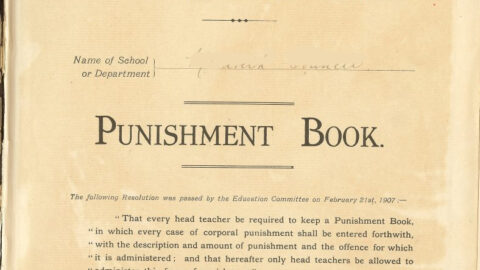
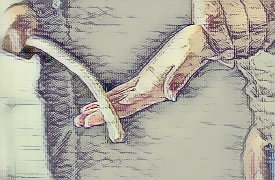
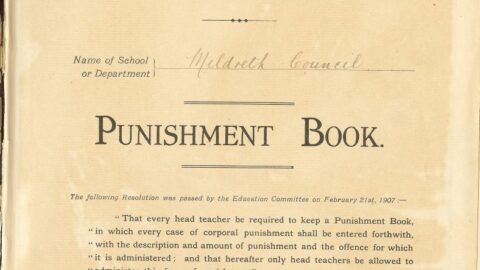
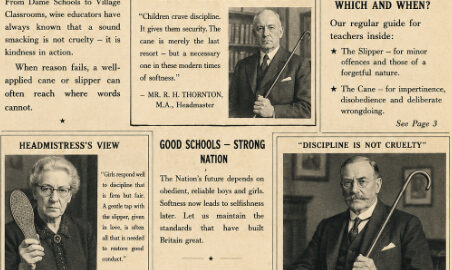
During a discussion of historical school disciplinary records, attention was drawn to an earlier observation that, in addition to the size 14 Dunlop slipper specified on the cover of the punishment book as the standard instrument of corporal punishment, the cane also appears to have been employed on occasion. One example may be found in the second entry on page 5 of the punishment register, where a pupil, possibly Stephen Harrison, is recorded as having received “1 cane” for a repeated offence similar to that for which another pupil, possibly Richard Lewin, received “2 slipper” in the preceding entry.
As both entries were made by the same member of staff, it would appear that a clear distinction existed between punishment by slipper and punishment by cane. Taken at face value, the records suggest that caning was regarded as the more severe penalty.
Several further apparent references to caning may be found between pages 5 and 8 of the register, all administered by the same teacher, with the maximum punishment recorded being two strokes. Although the teacher’s name also appears in earlier records on pages 1 to 4, it seems that the use of both cane and slipper did not begin until approximately early 1982.
The often untidy handwriting found in punishment books may perhaps be explained by changing conventions in penmanship over time. During my own schooldays, I frequently considered the handwriting of older generations difficult to decipher because they had been taught styles no longer in common use. Such changes in fashion have no doubt occurred repeatedly over the decades.
Teachers themselves would naturally have adopted clearer and more legible styles when writing on blackboards or preparing teaching materials, since they would have wished to avoid ridicule from pupils. When completing punishment books, however, they may not have expected the entries to be widely read, particularly by children. In many schools such records were treated as confidential documents and kept away from inquisitive eyes. Consequently, staff may have felt at liberty to write in their ordinary hand.
Naturally, one cannot know precisely what motivated teachers of earlier generations. It would nevertheless be interesting to hear from those with direct experience of administering school discipline.
The reference to the size 14 Dunlop slipper specified on the cover of the punishment book is particularly noteworthy. One wonders whether this was the standard form of slipper employed in schools generally. Although I myself received the slipper on several occasions, I cannot now recall either the make or the size.
At my own schools, the slippers used for punishment always appeared considerably larger than those the masters themselves might ordinarily have worn. They were also rather worn and shabby, suggesting that they had long ceased to serve any practical purpose other than disciplinary use.
The plimsolls used during my secondary school years, by contrast, seemed entirely ordinary. The strokes themselves were certainly painful, though the discomfort faded more quickly than that caused by a caning. In those days, slippering was administered far more frequently than caning. Very few boys escaped the slipper altogether, whereas many completed their schooling without ever experiencing the cane.
I first encountered the slipper shortly after entering senior school. Our French master regularly conducted vocabulary examinations. We were expected to learn twenty French words for homework, and a test was held the following morning. The pass mark was fifteen; for every incorrect answer below that mark, one stroke with the slipper was administered.
In my first test I scored only eleven, thereby earning four strokes with the plimsoll. Having previously experienced slipper punishment at home, I did not initially regard the school version with particular apprehension. I was instructed to bend over the front of my desk, whereupon the punishment proved markedly more painful than anything I had encountered domestically.
Punishment books, moreover, were not necessarily records that were merely completed and then forgotten. In many schools, local authority regulations or independent school rules required that such books be produced for inspection at meetings of boards of governors, which in some cases convened as frequently as once a month. I also recall examples of punishment books containing instructions specifying that they should periodically be submitted to the headmaster for review.
It is, of course, possible that these inspection requirements were not always observed rigorously, and that when inspections did occur they were often cursory in nature. Some years ago there was correspondence from an individual who served as a school governor and who occasionally used his position to inspect archived punishment books. Unfortunately, he ceased contributing in early 2020, and I do not recall whether he ever commented upon the extent to which such records were formally reviewed at governors’ meetings.
The ultimate fate of punishment books appears to have varied considerably. Some were removed by former staff or pupils and later sold privately or retained in personal collections. Others were simply abandoned in cupboards, only to re-emerge many years later when school buildings were demolished. In certain cases, however, regulations requiring long-term archival storage inaccessible to the public were strictly enforced, with the intention that the records should remain closed until those named within them were either deceased or of such advanced age as to render the matter irrelevant. Between these extremes, many different outcomes were possible.
Many years ago I made enquiries regarding the likely whereabouts of punishment books from the senior school associated with my former junior school. It appears probable that they are now held within the archives of the local Church of England diocese, although precisely where, for how long, and under what conditions they may be accessed remains uncertain.
Much though I might wish to discover the circumstances surrounding the severe caning received by a young woman known to my family during her time at that senior school — an incident frequently cited to me in childhood as a warning against misconduct — it is unlikely that I shall ever devote the considerable time and effort that such an investigation would undoubtedly require.