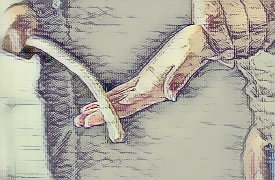
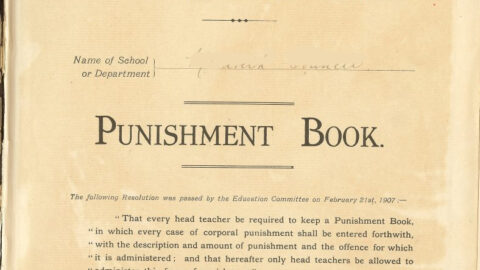
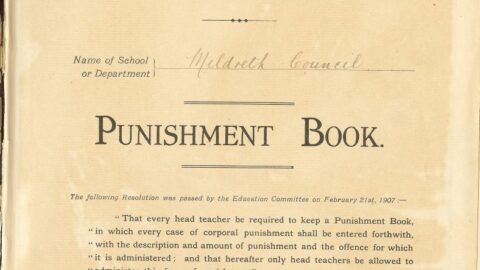
Debate concerning disciplinary practices in Scottish state schools during the mid-twentieth century has often centred upon several distinctive features of the system. Firstly, the tawse was the sole officially sanctioned instrument of corporal punishment. Secondly, its use was restricted to striking the outstretched hand rather than the buttocks. Thirdly, ordinary classroom teachers were generally authorised to administer punishment themselves, meaning that referral to the headmaster was comparatively uncommon. As a consequence, the tawse was employed with considerable frequency. Although boys were more often punished than girls, it appears that the incidence of girls receiving corporal punishment in Scotland was significantly higher than in England or Wales. The practice was not regarded as gender-specific; male teachers punished girls and female teachers punished boys according to circumstance and behaviour.
For this reason, it is not difficult to find Scottish women who recall having been subjected to the tawse during their school years. Public recollections of the implement were once sufficiently widespread that, when an old tawse appeared on a television antiques programme, many women in the audience immediately recognised it from personal experience.
At the same time, strong denunciations of the practice as excessively cruel appear comparatively uncommon among former pupils. Many who experienced it have tended to describe it as an accepted feature of school life in that era. Expressions such as “it did me no harm” and occasional calls for the return of stricter discipline have frequently accompanied such recollections. While some undoubtedly regarded the punishment as harsh, others have argued that its widespread and routine use within schools does not necessarily imply malicious or sadistic intent on the part of teachers.
Others with experience of Scottish schools have maintained that the tawse rarely caused lasting injury. They contend that pain and marks generally faded quickly and did not persist beyond the same day. By contrast, some former pupils have claimed that implements such as the cane or paddle, more commonly associated with schools elsewhere, could leave bruising and discomfort for several days. Nevertheless, the cane was also used in certain Scottish state schools, particularly during the 1940s and 1950s, and more frequently in remote districts. It remains uncertain whether some teachers preferred the cane to the tawse or whether different punishments were selected according to the nature of the offence.
Critics of corporal punishment, however, have strongly challenged attempts to minimise its severity. They argue that nostalgia and selective memory have sometimes distorted public recollection of school discipline. Historians and psychologists alike have long noted that attitudes toward punishment may soften with age, particularly when individuals compare past hardships with contemporary social concerns. Such critics further maintain that the infliction of physical punishment inevitably involved an abuse of authority in at least some cases, regardless of whether it was officially sanctioned.
Particular criticism has been directed at the inconsistency with which punishments could be administered. The same tawse or cane might be used lightly by one teacher yet far more severely by another. Opponents of corporal punishment have argued that this variability made the system open to excess and intimidation. They further contend that official demonstrations of “moderate” punishment often failed to reflect the reality experienced by some pupils.
Studies conducted during the later twentieth century into the use of corporal punishment in Scottish schools reportedly revealed its widespread nature. Educational observers and official investigators alike frequently expressed alarm at the scale upon which such disciplinary measures were employed. Comparisons have occasionally been drawn with disciplinary systems in certain schools abroad, where corporal punishment remained common and where similar arguments were advanced in its defence: namely, that it preserved order and discipline within overcrowded classrooms.
The debate over corporal punishment in Scottish schools therefore remains deeply divided. To some former pupils it represented a stern but accepted aspect of education in an earlier age; to others it symbolised an excessive and often harmful exercise of institutional authority.