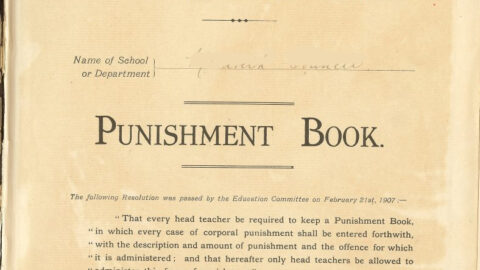
The question of corporal punishment in British schools remains a subject of considerable debate. While it is difficult to predict the future, it appears reasonable to assert that corporal punishment is unlikely to return to British educational institutions. However, for the sake of discussion, let us suppose that such measures were to be reintroduced. In what circumstances should they be employed? Should they be reserved solely for serious offences, or might they be applied to minor infractions as well? Who ought to be entrusted with the authority to administer such punishment? Should this responsibility rest exclusively with the headmaster, or perhaps only with a person of the same sex as the pupil? Is it ever appropriate for a child to be punished on the buttocks, or, in exceptional cases, on the bare buttocks? Should such measures be reserved for boys alone? These are questions worthy of public consideration.
It is pertinent to inquire as to the reasons for the prevailing belief that corporal punishment will not return to British schools. From my perspective, it is not inconceivable that such practices may one day be reinstated, though I acknowledge that those closer to the matter may possess greater insight.
My belief that corporal punishment may eventually return is informed by certain observable trends in education. Firstly, there is a growing demand among parents to participate actively in decisions regarding their children’s education. Secondly, there is an increasing recognition within the educational community that instruction must be tailored to the individual needs of pupils. A variety of methods is required to address the diversity of children in our schools.
Attitudes inevitably evolve over time. The movement to abolish corporal punishment reached its zenith as more child psychologists and paediatricians condemned physical discipline, with numerous publications asserting that such measures were universally harmful and ineffective. However, recent literature has adopted a more measured tone. Most professionals in the field now accept that the occasional use of corporal punishment is unlikely to cause lasting harm and, in certain cases, may indeed be effective. The body of published evidence supporting this view is likely to grow, not necessarily because it is entirely accurate, but because publishers are now more willing to consider articles in favour of physical discipline, some of which were previously withheld from publication.
There is also a widespread perception that juvenile delinquency and behavioural problems in schools are on the rise. Whether or not this is objectively true, it is a commonly held belief and one that is likely to persist. In due course, it is probable that serious efforts will be made to restore corporal punishment as a means of addressing these perceived issues. Coupled with the increasing view that parents, rather than the state, should have the primary say in their children’s upbringing, and the recognition that a range of disciplinary methods is necessary, it seems likely that corporal punishment will eventually return as an option in private schools in many countries. The situation in state-run schools is less certain.
It must be acknowledged that international bodies and courts complicate the matter, as changes in national law are not the sole consideration. Nevertheless, as the composition of these bodies evolves and as the published evidence on corporal punishment becomes more nuanced, their influence may also shift.
These are, of course, personal observations.
Let us now address the hypothetical questions posed.
In what circumstances should corporal punishment be employed? Should it be reserved for serious offences or also for minor misdemeanours?
It is my considered opinion that corporal punishment ought to be regarded as a medium-level sanction. It should not be used for trivial matters, yet I do not subscribe to the view that it must be a last resort. The notion of reserving it solely for the most severe cases was, in my view, an attempt to deflect criticism, but ultimately provided further grounds for abolitionists to argue that its severity was excessive.
I believe corporal punishment should be an available option in cases of deliberate disobedience, particularly where there is clear evidence of premeditation. It should also be considered in instances where a pattern of similar behaviour has developed and other methods have proven ineffective. This may include relatively minor infractions, such as repeated failure to complete homework, provided there is a discernible pattern and lesser sanctions have been attempted.
It is important to note that I advocate for corporal punishment to be an option, not a necessity, in such cases. The decision to administer it should take into account the individual personality of the child. Some children should not be subjected to corporal punishment under any circumstances, while for others it may be appropriate only as a last resort. There are also those for whom it would have no beneficial effect. Teachers must possess sufficient understanding of their pupils to make such judgements, a task that is by no means simple.
The preceding paragraphs outline my ideal scenario. However, I would be willing to accept certain compromises. If the following conditions were met, I would be reasonably satisfied.
With regard to bullying, I am firmly of the view that corporal punishment should be an available option. It should not be the sole or primary response in most cases, but it ought to be considered. My own school has achieved notable success in addressing bullying through a comprehensive programme that includes counselling, peer mediation, teacher-assisted mediation, and support for both victims and perpetrators. These measures are effective in many cases, but there remain some individuals for whom only a sufficiently onerous penalty will serve as a deterrent. Without the option of corporal punishment, I would likely be compelled to expel several pupils each year in order to protect their peers. As it stands, expulsions are rare. Furthermore, the use of corporal punishment in such cases can have a positive effect on victims, who are reassured that efforts are being made to protect them, and on perpetrators, who may feel they have atoned for their actions.
In summary, I believe corporal punishment should be available in a broad range of circumstances, though I would be content with more limited application.
Who should be permitted to administer corporal punishment? Should this responsibility be limited to the headmaster?
Ideally, most teachers should be entrusted with this authority, except those who are inexperienced or have demonstrated an inability to handle such matters appropriately.
In practice, I would not object to restricting this responsibility to a smaller group, depending on the size and structure of the school. This might include the headmaster, deputies, or year-level coordinators. The frequency with which corporal punishment is administered should also be considered, as excessive use may risk fostering undesirable attitudes among staff. It is not a pleasant duty, nor should it be, and there are limits to how much any teacher should be expected to undertake.
Should corporal punishment be administered only by a person of the same sex as the pupil?
This is a complex issue. Personally, I believe that male teachers ought not to administer corporal punishment to female pupils, though I recognise this is influenced by my own experiences and may not be universally applicable. I have no objection to female teachers disciplining boys; indeed, in an all-boys school, it would be unjust to deny female staff the same authority as their male counterparts. Ideally, teachers should be permitted to decide for themselves whether it is appropriate to discipline a pupil of the opposite sex, with the option to delegate if they feel uncomfortable.
In reality, however, it may be necessary in co-educational settings to restrict corporal punishment to teachers of the same sex as the pupil, as not all staff can be relied upon to exercise appropriate judgement. In single-sex schools, the situation differs, and it would be inequitable to restrict one group of teachers from administering punishment that another group is permitted to administer. In such cases, either the responsibility should be limited to a small group, or teachers should be trusted to act appropriately.
It should be noted that these considerations pertain primarily to secondary school pupils. In primary schools, class teachers should be permitted to discipline any child in their class, regardless of gender.
Should a child ever be punished on the buttocks?
In my opinion, this is the safest location for the administration of corporal punishment. While I am aware that punishment on the hands carries relatively low risks, it is prudent to minimise potential harm as much as possible.
Should corporal punishment ever be administered to the bare buttocks in exceptional circumstances?
In the current educational climate, this would be entirely inappropriate due to the considerable risks involved. Should attitudes change significantly, this position might be reconsidered, but substantial change would be required.
Should corporal punishment be reserved for boys alone?
Certainly not. Girls are capable of committing the same offences as boys and should expect to receive the same penalties. While individual circumstances may result in girls being punished less frequently, such decisions should be based on personality and other relevant factors, not gender.
I am grateful for the opportunity to reflect upon these important questions. In contemporary Britain, both proponents and opponents of corporal punishment would likely agree that this discussion is, at present, largely theoretical.
It is pertinent to inquire as to the reasons for the prevailing belief that corporal punishment will not return to British schools. From my perspective, it is not inconceivable that such practices may one day be reinstated, though I acknowledge that those closer to the matter may possess greater insight.