Even the most dramatic events—like the tragic Victorian train disaster that once shook the nation, or the comforting drone of the world’s longest-running radio soap—rarely stir up conversation about a topic that, for many, is both deeply personal and quietly haunting: school corporal punishment, or SCP. (short pause)
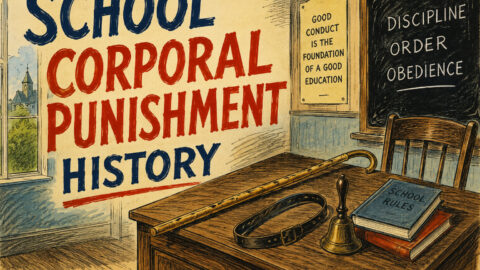
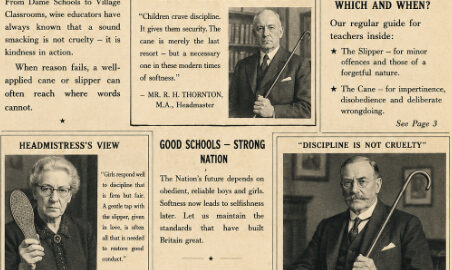
It’s almost unimaginable for today’s young people in the UK, but for those of us who grew up in the decades before 1987, the threat of the cane or slipper was a shadow that lingered in every corridor and classroom. Since that year, SCP has been banned in all UK state schools, with only a handful of private institutions clinging to the old ways. For anyone under 50, the idea of being physically punished at school is as distant as ration books or outside toilets. (pause)
Schools have changed, and mostly for the better. The air is lighter now, the fear less palpable. But for those of us who remember, the memories are vivid—etched into the grain of old wooden desks and the echo of footsteps on polished floors.
(short pause)
For many over 50, SCP is not just a historical footnote—it’s a lived experience, whether you were on the receiving end or simply watched classmates endure it. By the time the law finally caught up, many schools had already abandoned the practice, but some clung to it until the very end. Parents’ attitudes shifted, too. I remember my own mother, standing in the kitchen with her hands on her hips, debating with my father about whether “a good hiding” was character-building or simply cruel. Some parents saw SCP as a necessary part of discipline, while others quietly rebelled, refusing to let their children be struck.
Today, the subject is almost taboo. It’s rarely mentioned, and when it is, it’s usually with a shudder or a shake of the head. Some things from the past have become almost forbidden to discuss, except to condemn them. Even street names have changed, as if to erase uncomfortable memories.
(pause)
Despite what some critics have claimed, Coopers Company School was a place of high standards and even higher expectations. The teaching was rigorous, the academic results consistently strong. We were reminded, almost daily, that we were privileged to be there, and that privilege came with a price: hard work, discipline, and a sense of duty. I remember the pride I felt walking through those gates, my blazer a little too big, my shoes polished to a nervous shine. Today, the school—now known as Coopers Coburn in Upminster, Essex—remains one of the most sought-after in the region, with ten to fourteen hopefuls for every place. The legacy of excellence endures, even as the methods have changed.
(short pause)
I’m not sure what sources Mr. Madeley drew on for his comments about the school, but I suspect his own experiences colored his view. Perhaps he found the discipline stifling, or the expectations overwhelming. My own memories are different—tinged with nostalgia, yes, but also with gratitude. I thrived in that environment, even if it was sometimes strict to the point of severity.
(pause)
The school building itself was a relic of the Victorian era—red brick, high ceilings, and the faint smell of chalk and polish. There was a certain grandeur to it, a sense of history pressing in from every side. The science labs were a particular point of pride: Physics, Chemistry, and Biology, each one filled with gleaming glassware and mysterious bottles. I remember the thrill of mixing chemicals, the nervous excitement of dissecting a frog under the watchful eye of a stern but fair teacher.
It’s hard to imagine any staff member behaving inappropriately; there were systems in place to deal with complaints swiftly and discreetly. Physical Education was only compulsory until the third year, and there was a peculiar tradition: most boys didn’t wear underpants under their PE shorts. It wasn’t a rule, just a custom, and there were certainly no inspections. For Rugby, we were told to bring a spare pair of supportive underwear, and some of the older boys wore jock straps, which seemed impossibly grown-up at the time.
(short pause)
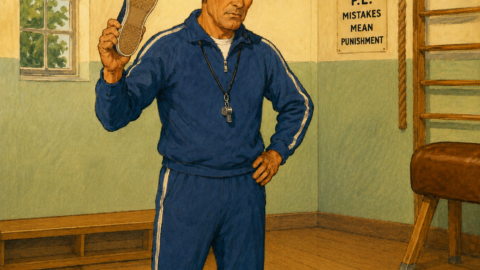
There’s a persistent myth that the music teacher was the only one who wielded the cane, but that’s simply not true. Most teachers had the authority to cane or slipper students, though some were more enthusiastic than others. Music was only taught in the first two years, and it was hardly a full-time subject. The music teacher doubled as the history teacher, and by the middle of the second year, we’d finished the basic syllabus. The class often became a quiet haven, a place to start homework while the teacher marked essays at his desk, the faint strains of a piano drifting through the open window.
(pause)
There were rumors, of course—whispers about romantic entanglements between teachers, secret glances in the staff room. But as far as I know, the popular Mam’selle was never involved in anything untoward during my time. Such relationships weren’t uncommon in the 1970s, but discretion was the rule. The staff maintained a careful distance, their private lives hidden behind a veil of professionalism.
(short pause)
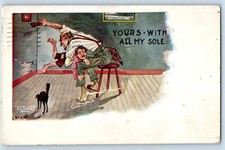
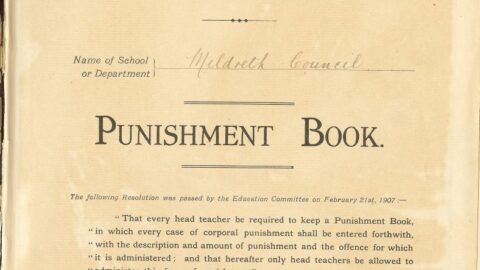
At home, the rules were different. It wasn’t common for parents to use a cane, but it did happen from time to time. I’m about ten years older than Richard, and I only remember hearing about it occasionally—usually whispered about in the playground, or mentioned in hushed tones at family gatherings. The cane was mainly a school punishment, prized for its efficiency. A few sharp strokes could be delivered in under a minute, leaving a stinging reminder for the rest of the day. Sometimes it happened in the classroom, sometimes in the head’s office. “Six of the best” was the usual maximum, but even fewer could leave you sore for days. I remember one Friday visit to the deputy head—my backside was tender all weekend, and the marks lingered long after the pain had faded.
Punishments at home varied wildly. I was spanked and occasionally slippered until I was about twelve, but I knew boys who were punished well into their teens. School rules about corporal punishment differed from one area to another, and even from one school to the next.
Girls weren’t immune, either. I remember my aunt, a formidable woman with a sharp tongue, warning her daughters about the consequences of misbehaving. But I never heard much about girls receiving corporal punishment at senior school. I attended a boys’ grammar school next to a girls’ school, and the two worlds rarely intersected.
I haven’t read Richard Madeley’s autobiography, so I can’t speak to his personal history, but I imagine his experiences were shaped by the same forces that shaped mine.
(pause)
I have a vague memory of a story about his father using a garden cane—not the polished, whippy kind favored by schools, but a rough bamboo stake from the shed. There was talk of a garden shed, of a mother’s fury, of a father forced to apologize and promise never to do it again. Richard mentioned it before, brushing it off, but later told the full story in his autobiography. It’s a reminder that even within families, attitudes could shift suddenly, shaped by anger, regret, and the changing tides of public opinion.
(short pause)
Parents who used a cane at home usually grabbed whatever was at hand—a bamboo garden cane, a slipper, a hairbrush, a belt. These were everyday objects, not instruments of punishment bought for the purpose. It would have seemed strange, even sinister, for a parent to purchase a cane just for spanking. I’ve heard of some items being set aside for discipline, but never bought specifically for that reason.
School canes were different—designed for punishment, both effective and, in their own way, “safe.” Plimsolls used for SCP were just ordinary shoes, like the slippers at home. A garden cane could sting, but it wasn’t as punishing as a real school cane.
I experienced them all: the slipper, the plimsoll, the proper school cane. They all hurt, but none left lasting scars—at least, not on the body. The memories, though, lingered.
(pause)
One story stands out in my mind—a case that made headlines and sparked debate across the country. A boy, just nine years old, was beaten by his stepfather with a tall bamboo garden stake, not once but repeatedly, over several days. The blows landed on his buttocks, calves, and thighs, leaving bruises that faded slowly. Now twelve, the boy took his case to the European Court of Human Rights, arguing that Britain’s corporal punishment laws—which allowed his stepfather to act with impunity—were in violation of European law.
(long pause)
These stories are not easy to tell, nor are they easy to hear. But they are part of our history, woven into the fabric of childhood memories—sometimes painful, sometimes bittersweet, always instructive. They remind us how far we’ve come, and how important it is to remember, even as we move forward, the lessons of the past.