A few more footballers caned at school:-
John Barnes caned at a strict Jesuits school in Jamaica, and Dwight Yorke in Tobago.
Also Viv Anderson, the first black footballer to play for England, ex Nottingham Forest, Man Utd, and Arsenal player, who went to Fairham Comprehensive in Nottingham. While he was still a Forest player, he visited his old school with a TV crew and some of the kids were able to ask him a few questions. One asked him if he was ever caned, and he replied “Yes, plenty of times”. This was shown on a Saturday lunchtime football show; I can’t remember its name.
(short pause)
Botham info from his autobiography. He is in favour of the slipper along the lines of “we got it, it hurt like hell but it kept us in line.”
Seem to remember hearing Glen Hoddle slippered by his Dad.
And Nick Faldo’s dad was a military policeman with a pretty foul temper! Says it all?
(pause)
A legendary cyclist from Texas who has won 5 Tour de France’s on the trot, and must be exceptionally fit, Lance Armstrong. His autobiography has recently been released, and he tells us that he was paddled by his stepfather fairly often and hard.
(short pause)
G. Boycott described a school caning he had for eating chips in the street. He said it was very painful and afterwards he sat in a washbasin full of cold water in the school toilets.
(pause)
The composer Britten is quoted on the subject of corporal punishment in his biography by Humphrey Carpenter. A few examples: “I can remember the first time that I heard a boy being beaten…and to find that it was sort of condoned and accepted was something that shocked me very much.”
(short pause)
“You got beaten on the slightest pretext, with a hell of a palaver. For really extra special beatings the whole school was assembled…We always said that Sewell liked beating boys, but we were much too frightened to complain.”
(pause)
He also wrote about his schooldays in the 3rd person in an essay, which includes: “He behaved fairly well…so that his contacts with the cane or the slipper were happily rare (although one nocturnal expedition to stalk ghosts left its marks behind).”
(short pause)
I also seem to remember reading the liberal use of slipper at Botham’s school, and how he thought it a good thing!
Incidentally, Nick Faldo on his website describes in his Early Years section how he was frequently “in trouble…” eg Boy was I in trouble but I never got the chance to explain my side of the story to Dad!” Given his Dad was a military policeman from the East End there’s little doubt that the slipper or probably the thick belt were in regular use in the Faldo household. Good thing, I reckon! He’s a stroppy lad and I’d personally pay good money to give him a bloody good seeing to!!!
(pause)
“Take down your trousers and we will cane your bare bottom. It really was like that in those days” Actor Patric McKnee describing Nivens'(and his own) school days in a recent television programme.
David Niven was born in 1910, McKnee must be about a dozen years younger, but they came from a similar social background and were friends and colleagues in adult life.
(short pause)
There’s a story about the cricketer Fred Trueman, who once said that the slipper was “as much a part of school as the blackboard and the bell.” He recalled being sent to the headmaster’s office for playing marbles in the corridor, and the headmaster, a tall man with a booming voice, would produce a size 12 gym shoe from his desk drawer. “Three whacks and you’d be hopping all the way back to class,” Trueman said, “but you never played marbles indoors again.”
(pause)
My uncle, who grew up in Yorkshire in the 1950s, used to tell us about his school’s infamous “slipper cupboard.” It was a battered old wardrobe in the staff room, filled with an assortment of plimsolls, each with a name painted on the sole. The teachers would select the slipper most suited to the offence—“the green one for talking, the red one for running in the corridor.” He swore the red one stung the most.
(short pause)
There’s a tale from a friend’s father, who attended a grammar school in Kent. He said the PE teacher, a former army sergeant, kept a collection of slippers hanging from a nail in the gym. “He’d make you choose your own punishment,” the man recalled. “Pick a slipper, bend over, and hope for the best. The worst was the one with the split sole—it made a noise like a gunshot and left a perfect print.”
(pause)
Even in the world of music, stories abound. The conductor Sir Simon Rattle once mentioned in an interview that his school’s music master was “a terror with the slipper.” Rattle said, “If you missed a note, you’d get a sharp reminder. But he also taught us discipline, and I suppose I owe him for that.”
(short pause)
In Scotland, the tawse was more common than the slipper, but the principle was the same. My mother remembers her own teacher, Miss MacLeod, who wielded a thick leather strap with a flourish. “She’d line us up and give us a warning look. If you so much as whispered, you’d feel the sting on your palm. We all respected her, though—she was fair, if fierce.”
(pause)
There’s a famous anecdote about the footballer Kevin Keegan, who once said in an interview that his school headmaster “could have played for England with the slipper.” Keegan joked, “He had a swing like Geoff Hurst and accuracy to match. I learned to duck pretty quickly.”
(short pause)
Even the world of literature isn’t immune. Roald Dahl, in his memoir “Boy,” describes the ritual of the cane and the slipper at his boarding school. He wrote, “The anticipation was often worse than the punishment itself. You’d hear the footsteps in the corridor, the door would open, and you’d know your fate.”
(pause)
My own father, who grew up in Lancashire, used to say that the slipper was “the great equalizer.” He’d tell us, “Didn’t matter if you were the cleverest or the cheekiest, everyone got it at some point. And somehow, we all survived.”
(short pause)
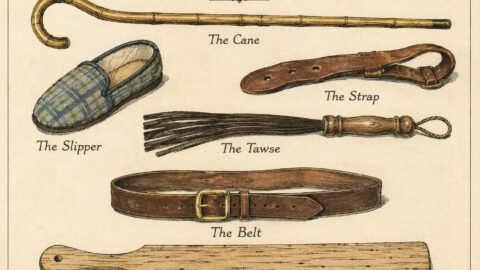
Looking back, these stories seem almost unbelievable now. But for generations, the slipper, the cane, and the tawse were as much a part of childhood as hopscotch and homework. They left their mark—sometimes literally—but also shaped the memories and the character of those who grew up in their shadow.
(long pause)