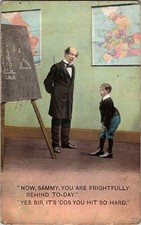
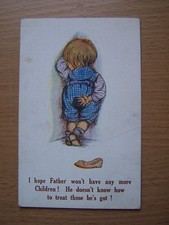
gap: 2s) Childhood in the late 1960s and early 70s, especially in places like Preston, Lancashire, was a tapestry woven from the ordinary and the extraordinary. The rows of pebble-dashed council houses, the scent of cut grass, and the ever-present hum of the radio formed the backdrop to a world where discipline was as much a part of daily life as the battered footballs and patched-up jumpers. (short pause) I seem to recall John Aldridge saying that his father told him not to let any teacher cane him! But I agree that a lot of footballers of that era, with the disciplinary records they had, must have got the cane or slipper at school.
(pause) I can e-mail you my source for the Teddy Sheringham details, and indeed I have one or two more names as well. It would be good if someone else could come up with some more. (short pause) The stories of discipline, both at home and at school, seem to echo through generations, shaping not just individuals but entire communities.
The comedian Max Miller (real name Thomas Henry Sargent) is quoted in Max Miller the Cheeky Chappie by John East, thus:
The teacher used to say, Come out, Sargent! Lie across that desk! Then I had the usual strokes. One afternoon the teacher called me out six times. After she had finished, I said, I think I’ll stay here.
Why? she asked.
I won’t be able to sit down now, I told her.
That time, she had to laugh too. It’s a funny thing, but forty years later, when I played the Brighton Hippodrome, she came to see me in my dressing room.
You used to be a dunce at school, she said. But you haven’t turned out to be much of a dunce after all.
Then she told me she’d never seen me on the stage. That was worse than any beating she gave me.
(pause) This fascination with earliest spankings is described in the autobiography of the late Sir Laurence Olivier. Much of the first part of the book contains descriptions of spankings and other corporal punishment at home and at school. Sir Laurence remarks that for so many people the first moment of awareness in childhood involves a spanking.
I haven’t read Laurence Olivier’s biography but in Ian Gibson’s book “The English Vice – Beating, Sex and Shame in Victorian England and After”, there is quoted a letter L.O. wrote to the Observer which reads:
‘The first time a schoolmaster ordered me to take my trousers down I knew it was not from any doubt that he could punish me efficiently enough with them up. The theatre is concerned, whether in the deepest tragedy or the lightest comedy, with the teaching of the human heart the knowledge of itself, and sometimes, when it is necessary – and we are obviously going through such a time – with the study, understanding and recognition of that most dreaded and dangerous eccentricity in the human design, the tripartite conspiracy between the sexual, the excretory and the cruel.’
He was writing in defence of Edward Bond’s play “Saved” in which a baby in a pram with a wet nappy is stoned to death.
Talking of Edward Bond, he has also translated Franz Wedekind’s play “Spring Awakening” set in Germany about 1900. Early on in this one of a group of schoolgirls describes to the others how her father strips and beats her and makes her stand outside the house in just her shift.
(pause) Mick Jagger got caned at Dartford Grammar School:
The late Brian Jones, also of the Rolling Stones, had “frequent canings” at school in Cheltenham.
“Sting” claims to have been caned 42 times in one year at school in Newcastle:
Sometime wannabe rock star Tony Blair, now prominent in a rather different line of business, got “six of the best” at age 17 at Fettes College.
Botham – slippered at school. Alec Stewart almost undoubtedly slippered/caned – went to my school! Chris Tarrant – caned in assembly / in front of whole school (on the backside).
(pause) But it wasn’t just the famous who felt the sting of discipline. Ordinary children, too, have their stories. My own uncle, for instance, used to recount how the headmaster at his primary school in Yorkshire kept a special cane, named “Old Faithful,” hanging on the wall. The mere sight of it was enough to silence a rowdy classroom. (short pause) He claimed he only felt its bite once, for sneaking out to play marbles behind the bike sheds, but the memory stayed with him for decades.
(pause) In Scotland, the tawse—a thick leather strap—was the instrument of choice. My mother, who grew up in Glasgow, remembered the ritual: hands outstretched, palms up, the sharp crack echoing in the corridor. She said it was less the pain and more the anticipation, the waiting in line, that made it unforgettable.
(pause) Across the country, discipline at home was often just as strict. The slipper, the wooden spoon, or even a quick smack were part of the parental toolkit. Yet, for all the sternness, there was a strange sense of security in those routines. The rules were clear, the boundaries firm, and the love—though sometimes hidden behind a stern face—was always there.
(pause) In the memoirs of Alan Bennett, he describes his mother’s gentle but unwavering discipline. “She never raised her voice,” he wrote, “but the look she gave could freeze a kettle mid-boil.” Bennett’s stories are filled with the small humiliations and quiet triumphs of childhood, the way a single word or gesture could linger for years.
(pause) Even in literature, the theme recurs. Roald Dahl, in “Boy,” recounts the terror of the cane at Repton School, wielded by the headmaster—none other than Geoffrey Fisher, who would later become Archbishop of Canterbury. Dahl’s vivid descriptions of trembling hands and stinging skin capture the mixture of fear and fascination that surrounded school discipline.
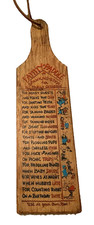
(pause) In the United States, corporal punishment took different forms. The paddle was common in Southern schools, and stories abound of principals who wielded it with theatrical flair. Yet, as in Britain, the memories are often tinged with nostalgia, a sense that those days, harsh as they were, belonged to a different, more ordered world.
(pause) Not all memories are about punishment, of course. There are recollections of laughter in the playground, secret clubs formed under the slide, and the thrill of sneaking a biscuit from the kitchen when no one was looking. But even these are shaped by the knowledge of what would happen if you were caught—a quick scolding, a wagging finger, or, in the worst cases, a trip to the headmaster’s office.
(pause) The slipper, the cane, the tawse—these objects have become symbols, not just of discipline, but of a certain kind of childhood. They remind us of the boundaries we tested, the lessons we learned, and the adults we became. For every story of pain, there is one of resilience, of laughter in the face of adversity, and of the quiet pride that comes from surviving the trials of youth.
(pause) Today, the world is different. Corporal punishment is rare, and many would say that’s for the best. But the memories linger, woven into the fabric of family stories and national history. They are reminders of a time when discipline was swift, consequences were clear, and childhood was a little rougher around the edges—but perhaps, in some ways, a little more vivid, too.
(long pause) If you have your own stories—of slippers, canes, or simply the small rebellions of youth—share them. They are the threads that connect us, across generations and across the years.