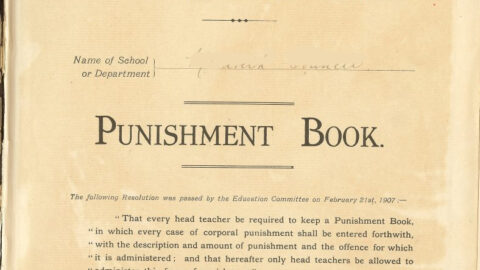
My experience of corporal punishment at school comes primarily from being on the receiving end of it throughout my education. During my secondary school years, I was punished by both male and female members of staff. The punishments I received included slipperings administered by teachers of both sexes and canings delivered by senior members of the school leadership, including the Headmistress and the Associate Headmaster.
Looking back, one observation stands out quite clearly. Although there were exceptions, female teachers generally tended to administer slipperings with greater force than their male counterparts. This was not merely my own impression. Many of the boys I knew at the time shared the same view, suggesting that it was not simply a matter of male teachers treating girls more leniently or boys perceiving punishments differently. Female staff often seemed more determined to make the punishment memorable, and their slipperings frequently had a reputation for being particularly painful.
When it came to caning, the distinction between punishments administered by the Headmistress and those given by the Associate Headmaster was less obvious. I was caned twice by the Associate Headmaster, although one occasion could only really be described as a token punishment, intended more as a formal disciplinary measure than a severe chastisement. Consequently, it is difficult to make a direct comparison between the two.
The most severe canings I received came from the Headmistress, and on one occasion from the Deputy Headmistress. Even so, I would hesitate to conclude that female senior staff necessarily delivered more painful canings than male staff. The severity of the punishment often depended more on the circumstances surrounding the offence and the individual administering it on that particular day than on their gender.
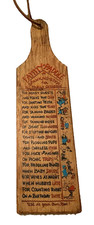
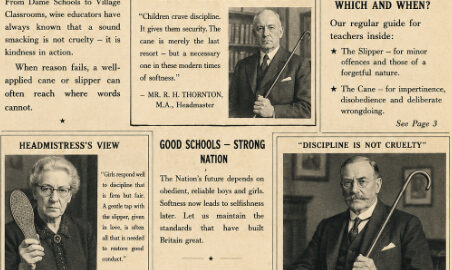
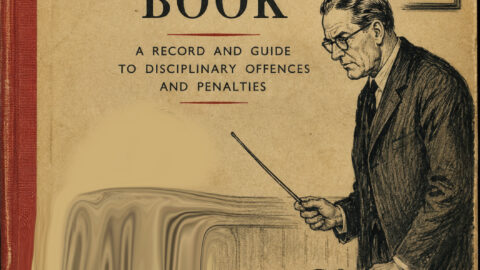
There was also an important distinction between the cane and the slipper as instruments of punishment. The cane was universally regarded as the more serious penalty. Being sentenced to the cane carried a greater sense of dread because it was reserved for more significant offences and often involved a degree of ceremony and formality. However, in practical terms, the assumption that the cane was always more painful than the slipper was not necessarily correct.
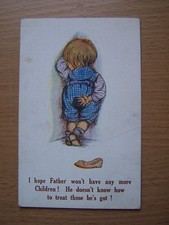
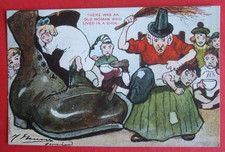
A severe slippering could be every bit as painful as a caning, particularly when administered by a physically strong or determined teacher. The gym mistress, for example, had a formidable reputation. Her slipperings could be exceptionally hard and were certainly capable of leaving a lasting impression. While the cane carried greater psychological weight as a disciplinary measure, the actual pain experienced could vary considerably depending on who was administering the punishment and how it was carried out.
My earliest opportunity to compare the two forms of punishment came during my primary school years. At that age, the cane unquestionably seemed more painful. One possible reason was that caning was usually administered on the hand, a particularly sensitive area, whereas slipperings were generally delivered to the seat of the trousers. Another factor may have been that younger children were not subjected to the full force of a slippering because of their age. Staff may have exercised a degree of restraint with junior pupils that was absent when dealing with older children.
I cannot make a direct comparison for my secondary school years because I attended a boys-only boarding school where the cane was the sole officially sanctioned form of corporal punishment. Slipperings simply did not form part of the disciplinary system there. As a result, I received a considerable number of canings during my time at the school. These punishments were typically administered in the dormitory rather than in a classroom or office, a practice that gave the proceedings a distinctly different atmosphere. The setting itself often added to the tension and anticipation surrounding the punishment.
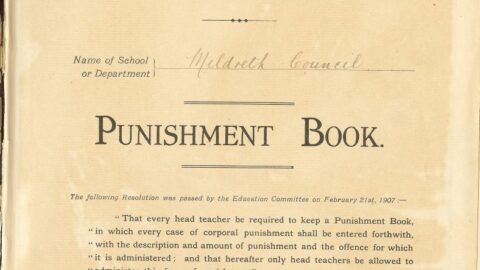
To understand these experiences properly, it is important to remember the historical context. During the 1950s, corporal punishment was an accepted and almost universal feature of life in English junior schools. Few parents, teachers, or pupils questioned its place within the educational system. It was regarded as a normal method of maintaining discipline and enforcing standards of behaviour. Consequently, children grew up expecting that physical punishment would be part of their school experience.
Having attended junior school during the early 1950s, I feel reasonably qualified to comment on accounts of school discipline from that era. The practices described by others generally accord with my own memories and observations. Indeed, among the many incidents I witnessed during those years, one punishment remains particularly vivid in my memory. It was undoubtedly the most painful school punishment I ever saw administered. Even after the passage of many decades, the details remain remarkably clear. The incident left a lasting impression not only because of its severity but also because it demonstrated just how firmly corporal punishment was embedded within the educational culture of the time.