(gap: 2s) In 1941, I was a solitary boy at a day school for boys in Oxford. My world was small, shaped by the absence of siblings and the shadow of war—my father had been killed in late 1939, a loss that left our home quieter, the air tinged with a sadness that never quite lifted. Many of the boys who lived nearby had also lost their fathers, and even more men were away fighting, their absence a constant ache in the community. Yet, in Oxford, there was a strange, almost guilty peace. Hitler’s vow to spare the ‘dreaming spires’ from the Blitz meant that, while the rest of England trembled under nightly bombardments, our city remained untouched, its ancient towers standing serene against the chaos beyond.
My school had broken up for Christmas just the day before, the corridors echoing with the shouts of boys released from lessons, their laughter a brief reprieve from the world’s troubles. Some schools, including the girls’ school nearby, remained open a little longer, but I was already home, my heart light with the promise of holiday freedom. Yet, as I stepped through the front door, the familiar scent of coal dust and boiled cabbage was joined by something new—a sense of intrusion. There, in the hallway, stood another woman, her presence both unexpected and unsettling.
She was Willow, a young, single woman with a gentle voice and eyes that seemed always on the verge of tears. She was one of my Mother’s friends, someone I’d met only in passing, but now she stood in our home, her suitcase battered and her coat dusted with London soot. My Mother, her face drawn with worry, took me aside and explained in hushed tones that Willow’s flat had been bombed in the Blitz. She had lost nearly everything. My Mother, ever practical and compassionate, had driven to London that morning—her job as an ambulance driver granting her rare access to petrol—to rescue Willow from the ruins. Willow would be staying with us, perhaps for the rest of the war. I tried to imagine what it would be like to lose all your possessions, to have your life reduced to a single suitcase and the kindness of friends. It should have been a comfort to have her with us, but the air in the house felt heavy, as if grief itself had taken up residence.
My Mother’s job meant she was often away, her uniform always smelling faintly of petrol and antiseptic. That morning, she had braved the bombed-out streets of London to bring Willow back, her hands gripping the steering wheel as she navigated the rubble and the silent, watchful faces of those left behind. She returned with Willow just as dusk was falling, the car’s headlights cutting through the winter gloom. Willow’s eyes were red-rimmed, her hands trembling as she clutched her bag. My Mother tried to reassure her, offering tea and gentle words, but Willow seemed adrift, her gaze fixed on some distant memory of home.
The next day, they would have to return to London to see about the few possessions that had been salvaged from the wreckage. Looters had already taken most of Willow’s things, but the police had managed to gather up what little remained. The police station, my Mother explained, was overflowing with the belongings of those killed in the bombing—suitcases, photographs, trinkets—waiting for relatives who might never come. The officers could not guarantee that Willow’s things would be safe if not collected by 10am the next day. The urgency in my Mother’s voice made me shiver; the war, usually so distant, suddenly felt very close.
Willow herself was unharmed, at least physically, but she moved through the house like a ghost, her face pale and drawn. Nothing seemed to comfort her—not the warmth of the fire, nor the gentle murmur of the radio, nor my Mother’s careful attempts at conversation. In the end, my Mother pressed a bottle of sleeping pills into Willow’s hand, instructing her to take two and try to rest. Willow nodded mutely and disappeared upstairs, her footsteps barely audible on the creaking stairs.
That evening, I nursed a secret hope that I might be allowed to go to London with them, to see the city I’d only heard about in stories and news reports. But my Mother, ever practical, informed me that she had made arrangements for me to stay with Miss Matthews, a neighbour down the road, for the day. My heart sank, but I tried not to show it.
Miss Matthews was, in my young eyes, the very picture of elegance and mystery. She had four daughters, three of them older than I was, all day pupils at the local girls’ school. Her hair was always perfectly set, her voice low and musical, and she carried herself with a quiet dignity that made her seem both approachable and distant. She had divorced her husband the year before, a scandal whispered about in the neighbourhood, and had taken up her maiden name again. I found her fascinating, and the prospect of spending a day in her company—without her daughters, at least until lunchtime—was almost as thrilling as a trip to London.
The next morning dawned grey and cold, the sky heavy with the promise of snow. My Mother was a whirlwind of activity, bustling about the house as she packed for the journey. Willow had not yet appeared, and my Mother, her patience fraying, sent me upstairs to rouse her. The door to the spare room was ajar, a thin sliver of light spilling into the hallway. I knocked softly, but there was no answer. A strange unease prickled at the back of my neck.
I pushed the door open a little further and saw Willow lying on her side, her back to the door, her hair spread across the pillow like a dark halo. The room was cold, the air tinged with the scent of lavender and something sharper—medicine, perhaps. I crept around to the other side of the bed, my heart pounding. On the nightstand, the bottle of sleeping pills sat half-empty. Willow must have taken more than the recommended dose, seeking oblivion in the depths of sleep.
I stood there for a moment, watching her breathe, her face peaceful in repose. In that moment, I was struck by how beautiful she looked, her features softened by sleep, the lines of worry smoothed away. I had never kissed a girl or a woman other than my Mother, and a strange longing welled up inside me—a desire to offer comfort, to bridge the gap between loneliness and connection. My Mother always woke me with a kiss; surely it would be harmless to do the same for Willow.
Kneeling beside the bed, I leaned in and pressed my lips gently to Willow’s cheek, just at the corner of her mouth. Her skin was cool, her breath slow and even. For a moment, I felt a rush of tenderness, a childish hope that my gesture might somehow ease her pain.
But before I could retreat, the sound of footsteps on the stairs shattered the stillness. My Mother appeared in the doorway, her eyes widening as she took in the scene—me kneeling by the bed, the covers pulled back, Willow oblivious to it all. Her face darkened with anger, her voice sharp as she ordered me downstairs at once.
I stumbled down the stairs, my cheeks burning with shame and fear. Above me, I could hear my Mother’s voice, urgent and low, as she tried to rouse Willow and get her dressed. Willow’s voice, when it came, was muffled and despondent. She insisted she couldn’t eat, her words heavy with exhaustion and sorrow. I hovered at the bottom of the stairs, my heart thudding in my chest, dreading what would come next.
When my Mother finally came down, her expression was thunderous. She demanded to know if I had done anything else before she arrived. Terrified, I blurted out a confession—I had kissed Willow three times, one of them on the lips, though in truth my memory was already muddled by guilt and fear. My Mother’s anger flared anew, but there was no time for punishment. She bundled Willow and me into the car, her movements brisk and efficient, and drove us to Miss Matthews’ house, the engine growling as we sped through the quiet streets.
At Miss Matthews’ door, my Mother wasted no time. She asked, in a voice that brooked no argument, whether Miss Matthews had much experience spanking children. In those days, corporal punishment was as common as rain, and Miss Matthews replied with a wry smile that her daughters were no strangers to sore bottoms, though she preferred to use her hand rather than a hairbrush or slipper. She had never spanked a boy before, she admitted, her eyes twinkling with a mixture of amusement and curiosity.
My Mother explained, in front of me, that she and Willow had to leave for London immediately, but that I needed a very sound spanking for my misbehaviour. To my horror, Miss Matthews agreed, her smile broadening as she assured my Mother that she would see to it. My Mother fixed me with a stern look and said, “Timothy will tell you what he did before you give him his spanking. And mind you, my lad, I will check with Miss Matthews that you have told her the truth. We’ll be back later.”
Suddenly I was alone with Miss Matthews. Fortunately, her daughters had all gone to school. She lost no time in getting down to business, as it were, She sat down on the settee.
Miss Matthews glanced briefly at my pants and bare legs, then looked me in the face and said: “Tell me what you did, then?” I squirmed a bit and stammered out only that I’d kissed Willow while she slept.
Miss Matthews was cross, of course. She scolded me and snarled that doing so was very naughty, that doing anything to a woman who couldn’t tell me not to was dreadful, although adding– and this made my heart sink even lower – ‘at least that wasn’t the worst thing you could have done.’
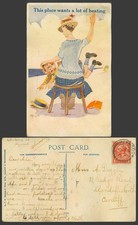
She then ordered me over her lap, from her right because she was right-handed. I put myself there as best as I could, and she moved me so my bottom was directly over her right thigh. Although I knew I was going to be walloped, I was at least comfortable in that position.
Miss Matthews then asked me if I deserved what was coming, and I couldn’t say anything but a very quiet ‘yes’.
“Ready?” Miss Matthews asked. I managed to say I was. Then she raised her hand and began spanking me, hard, making my bottom hotter and sorer with each smack.
Finally, Miss Matthews gave me a very solid ‘one for luck’ smack, telling me first that the harder it was, the more luck I’d have. Then I heard her saying I could now get up, but all I could do was to move myself backwards toward the right side of the settee, and try to cuddle her.
Fortunately she cuddled back. It was a lovely moment, ameliorating my soreness on both sides