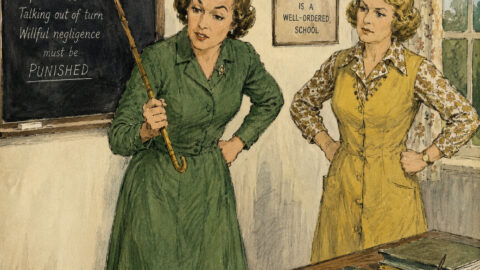
I do have one question. We hear so much about the “Evils” of males smacking females at school. How about the reverse? I know one of my grandsons in about 1965, when he was six was sent to the headmistress and she put him over her knee and smacked his bare bottom.
I know of a case in 1974 (Middle school) where a female came into the boys changing room as the master was required urgently. She stayed and supervised the boys while showering, and put the slipper across a few bottoms (Auriol Middle School) Nobody complained and the view was that the female teacher had boys of her own and was not improper that she should see the boys in such a way.
However, I recall, a few months later, I could look up the cutting, that a male teacher (a father with two daughters) did the same thing but did not hit the girls causing outrage from parents.
It seems that its wrong for a male to see girls undressed, and does lead to complaints if bottoms are smacked or hit. Yet, for females to see boys and to hand smack them over their knee or slipper their bottoms seem acceptable.
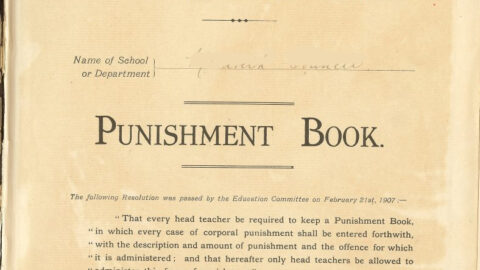
The auction details describe the Punishment Book columns as being:
2 Name of pupil
3 The offence
4 Date of offence
5 Punishment awarded
6 Date of punishment
7 Remarks
8 Initials of manager, clerk, or inspector</div>
It is not absolutely clear from the description if 7 & 8 are in fact just one column.
The first of the three ‘page’ pictures is identified as showing columns 1, 2, & 3. The ‘identification number’ in column 1 seems to be year based, we see that there were 27 entries for 1916 and numbering then starts from 1 again for the first punishment of 1917.
The second ‘page’ picture appears to show columns 2, 3 & 4.
The third ‘page’ picture seems to be columns 5, 6 & 7 (or possibly 7/8 if they are one and the same)
I initially presumed that the names in the last picture, in column 7 (or 7/8) are supposed to be the names of the teacher administering the punishment, in lieu of remarks about the punishment. There would seem to be little point in entering the name of the punished pupil in columns 2 and 7. However, you may be correct that they are in fact the pupils’ names written by them. One would not expect teachers to use the given name and surname format as some of these entries do.
Curiously, in the previous picture, we see that when Maria Viola was punished for truancy someone has written her initial and surname (misspelt) in column 3 in a very shaky hand. I suppose a pupil might misspell their name immediately after being caned, and write it in the wrong column by mistake. Maybe, but a little strange! The convention used to be, I believe, to cane on the non-writing hand. But as you note the pupils could have endorsed the book before they were caned, or they could have been caned other than on the hand. Sadly the book doesn’t seem to have a column for ‘caned on’.
Clearly children had a hard time in those days. 10 strokes for playing cards at school or for Misbehaving to girls (I think we can assume misbehaving is a euphemism for molesting) may be reasonable, but what is so serious about playing bandy, which seems to be a form of ice hockey, that it also merits 10 strokes? And why is drinking spiritous liquors at school (8 strokes) less serious than playing cards? There are no less than 5 offences which involve children not bowing at the right time, the majority of which attract 4 strokes. However not addressing a teacher correctly only attracts 2 strokes.