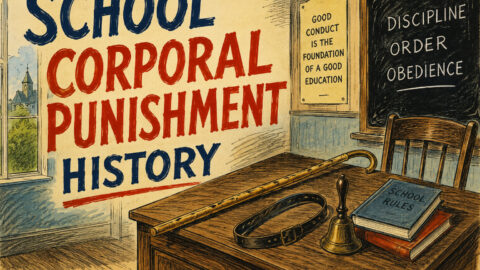
School Corporal Punishment is purported to serve seven main purposes.
The first purpose, and arguably the most important, is that it is meant to deter.
It is very difficult for ethical and practical reasons to study SCP scientifically but we can consider whether pain deters other activities, such as cycling.
The maximum penalty or cycling is quadriplegia for life.
Lesser penalties include slow death by mutilation and severe “road rash” and broken bones. Minor punishments include saddle soreness, excess fatigue, bruises and grazes.
Despite these very harsh penalties cyclists persist in cycling. We must conclude that neither death nor pain are effective deterrents.
No wonder the paddle, slipper, strap and cane all failed at school.
On the contrary, withstanding the pain of Corporal Punishment was often seen as a challenge.
Many children saw getting the cane as a rite of passage.
That’s one reason some men deny girls got it, if a “mere” girl could survive being caned it couldn’t be much of an ordeal.
For others, less concerned with “proving” their masculinity, it allowed them to accept girls and women as equals.
For women, the transition to motherhood is also a rite of passage in many ways.
Of course, you are correct about the “rite of passage”. In fact this is just one of many factors that differentiate the infliction of SCP by another as a procedure to deter an act vs. the intentional self-infliction of pain for entirely different purposes.
Where you say, “if a “mere” girl could survive being caned” … going back to my comments regarding birth: ironically, the truth may be the opposite! Having witnessed childbirth myself I can tell you this is the truest rite of passage, and even the severest of canings would probably not compare to the pain that ordeal entails. I wonder how many men could “survive” that?
Alas, this is something I will simply never know.
Once, when I was about 9, I was rough-housing with a group of children in the schoolyard. Whilst I was on the ground, they toppled on top of me … breaking both the bones in my left forearm, about 1/3 way up from the wrist. Purely accidental but there it was; and the most intense pain I can assure you. I was screaming profusely! I was eventually taken to the hospital, where after X-raying, they had to “set” the fracture, just as in your case. I don’t recall any anesthetic being administered, just a quick warning that “this might hurt a little
Corporal Punishment is clearly an unnecessary and avoidable pain IF … behaving in a certain way with the foreknowledge that it would otherwise be evoked.
From this standpoint, SCP is self-inflicted pain, as a conscious decision is usually made to act in a way that has the expectation of being applied.
However, putting that aside it is a pain clearly inflicted by someone else in a position to do so and differs from the self-inflicted pains from cycling, for example.
Pain is a very personal experience. We can’t describe any sensation in purely objective terms nor do we have any common frame of reference. Even if you (HH) could experience childbirth, you would only know what you felt, not what another person feels going through the same experience. I can’t reliably describe the sensations involved even to another mother.
There has been some discussion about whether girls feel pain more than boys. There is no way to know. We can measure the response (brain activity and endorphin production for example) but that tells us nothing about what the subject feels. High levels of endorphins might indicate a high sensitivity to pain but they induce analgesia. High sensitivity to pain could equate to not feeling pain as much as one with a low sensitivity to it. Those who, initially, felt pain more might have developed better coping mechanisms too.