I saw boys from a lot of schools – but of those in my daily experience, only those of Scotch seemed to have the same strength of feeling, the same types of attitudes I saw at my old school.
I’m also a bit of a snob – I was very proud of going to Xavier because it was one of the six ‘great schools’ of Victoria (the youngest of the six). I’m interested in the history of the other five (Scotch College, Geelong Grammar, Geelong College, Melbourne Grammar, and Wesley College), so I want to read their histories anyway – and as Scotch was the first established, it seems a good place to start. The others all have histories available to me as well, and I will look at those in time. No idea if they will contain information of interest to this group, though.
Thirdly, I know there’s at least one Scotchie on the list – so I thought he might be interested in seeing this.
A couple of definitions – The Hill refers to the area of the school traditionally occupied by boarders. Satura is a student newspaper/magazine.
And now for the quotes:
“Various models were available to 19th-century teachers. The Enlightenment influenced Scotch’s insistence that its teaching was systematic. The Bible’s first example of teaching is that Adam and Eve were told a rule, failed to learn it, and were expelled. Pedagogically this has two aspects, the use of punishment and the use of explanation.”
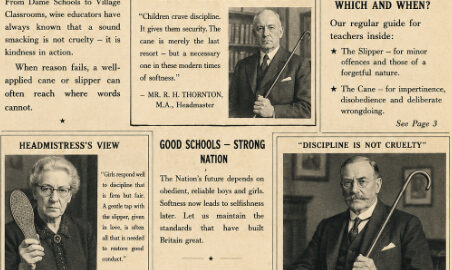
“Punishment for failing to learn a lesson has several intensities and purposes. It can be done as an example. Adam and Eve received no chance to learn from their mistake. The learning opportunity was for others. It is not by chance that such strong, pre-emptive discipline occurs near the start of the Bible, and many masters have adopted the same strategy of beginning as fearsomely as possible. Men with military training had already used this technique in the armed forces. As late as the 1970s, Bond began the year with a thunderous entry to the classroom.
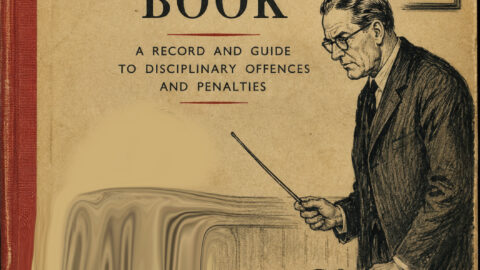
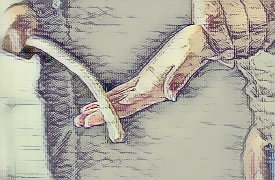
A long ruler whacked down hard on a desk, and a manner that brooked no weakness, set the tone from the start. With a solid frame established, some mellowing would be possible, and learning could proceed. The military model of learning is said to be that ‘when you fear the instructor more than the task, learning will take place’. By century’s end, however, Rob McLaren (1973, staff 1987-) writes that ‘it is only when a student feels comfortable and safe in his immediate environment that any real learning can take place’.
In the 1920s Edmunds taught writing to the Junior School with ‘a bunch of keys with which he chastized children’. In the 1930s Charles ‘Chassa’ Pawsey (1908, staff 1922-43) – fearsome in appearance and attitude, unsmiling and overbearing – used a ‘rubber hose to chastise for smallest infringement i.e. not knowing the answer to questions one did not understand’. In the 1960s ‘there was one master who would extract information from students by pinching tightly a small patch of their hair and slowly screwing it around until the correct answer was provided’. Another master is described by Old Boys decades apart as ‘sadistic’ and one who ‘enjoyed beating boys’ (1951, 1972).
A more flexible model of punishment allowed for the possibility that he who is punished might learn. Thus Pharaoh underwent increasingly severe punishments until he achieved the desired behaviour which had been explicitly stipulated from the outset – for learning is greatly helped when pupils are given clear targets. The educational model employed is that a mistake is best followed quickly by a rebuke or punishment. This was how Morrison taught Latin.
He put ‘the boys through conjugating verbs and declining nouns and those who failed too ignominiously received a few strokes with the taws on their open hands. There was no newfangled nonsense about old Dr Morrison.’ The taws was a Scottish leather strap slit at the ends. Gordon ‘Gunner’ Owen (staff 1946-74) ended a boy’s spelling mistakes by threatening to cane him.”
“Much of the physical punishment seems to have been considered unexceptional. Lyne later became friends with Adams, and together they ran Scotch’s branch of the Australian Student Christian Movement (ASCM). Another Old Boy recently extolled the virtues of Littlejohn, several times expressing his admiration of the man, and concluding with a final emphasis that, after all, ‘I knew him quite well for he often caned me’.
‘They say corporal punishment scars a boy – which is a lot of cock! We treated it as a great joke – those bloody detentions really hurt!’ Morrison concurred: a public rebuke ‘was more stinging than a flogging’.’
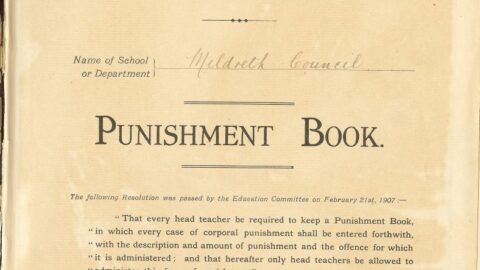
For boarders, caning was common. One in 1929 was caned 24 times in one term; once the cane broke. Otherwise, officially only the Principal could administer corporal punishment, so conceptually caning seems to have been regarded as different from the routine physical intimidation that occurred in the classroom.
It was an era that accepted a level of physical violence between teacher and pupil. A good deal of whacking and pummeling had no reason other than the doing of it. When the school later moved to Hawthorn, the buildings were not ready and two grades were in marquees. Littlejohn would walk outside the tents thwacking at any boy whose shape made a bump in the side of a tent, and he roared with laughter as he did so
Unabashed by post-Freudian anxieties about physical contact, the old propensity to hit boys was part of a broader enthusiasm for touching which let many masters throw a comradely arm round boys’ shoulders. In primary school boys learnt the ABC from Miss Hay (staff 1862-70) literally sitting on her knew. As late as the 1940s. Gilray could hug a boy. David Grounds (1946), although aiming for Medicine still wanted to study English Literature, evoking a spontaneous embrace from Gilray in the middle of the quadrangle.