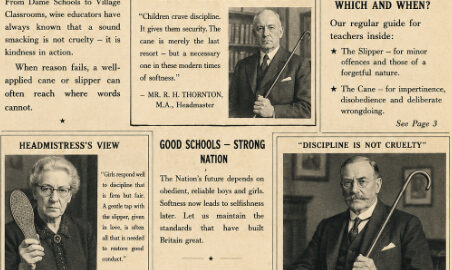
The prefects’ claim to rule boys’ lives outside school, and their savage punishment of ordinary social behaviour like smoking, began in the 1960s to be questioned. Doug Eager (Captain 1963) increasingly caned boys for disrespect to school officers. A letter in Satura, entitled ‘Pres and Queues’, mocked school officers’ privilege in the tuckshop to go to the head of the line. Charles Ream (1964), an American, told a Prefects’ Meeting ‘he disagreed with the prefect system anyway’.
A thoughtful Captain like David Mason (1966) believed that the Prefects’ Meeting would be accepted if ‘it functions with the right intentions and in the right spirit’/ The prefects must be dignified, and refrain from sarcasm or jokes in the presence of the offender. Nor should they take ‘any delight in the actual infliction of the corporal punishment [which] itself is not the most important thing; it is the interrogation and reprimanding before the punishment that often has the most effect; and in some case, it is not necessary to use the cane at all’.
Among the prefects, doubts grew. John McCaughey (1964) refused to be party to a caning, and Hamish Ewing (1967), present at one, was horrified. Finlay Macrae (Captain 1967) feels he caned ‘rather gingerly’. Andy Mackay’s boarding house captain ‘was trying to hit my backside but I bet he couldn’t hit a par 3 to save himself. I have cuts at the back of my knees and along my back by the time he finished. Captains, John Field and Graeme Blanch, caned no-one but, but caning resumed in 1970 and 1971.
Caning by staff ended in 1988 with the departure of Campbell Stewart (Year 8 Group Master 1984-88). On the Hill, caning ceased around 1990. Long before, the Prefects’ Meeting had expired. There was non in 1973 or 1974, for ‘All smokers and the like were dealt with by the School Captain and the prefect(s) concerned’. The last meetin, in 1975, dealt with a culprit who had disobeyed a prefect and thrown a dead pigeon in his face. He ‘pleaded guilty… but said he did not aim at the prefect’s face. This was thought to be not very important.’ He received a Saturday detention.
During the 1960s new ideas crept into the thinking even of the prefects. They punished boys for crimes not previously recorded, like setting a poor example to younger boys. They caned boys for having too many detentions. They punished boys for insolence to masters (one boy shouted ‘Bill’ through a ventilator into a classroom). Previously masters had looked after themselves. In 1967 a boy was caned for ‘Using foul and obscene language to St. Kevin’s boys over Gardiner’s Creek’. He denied his swearing was obscene, and in any case it happened ‘under provocation from St. Kevin’s boys. Stated that he was trying to stand up for Scotch. Attitude throughout meeting was somewhat impertinent.’: 4 strokes.
From 1961 the prefects discerned a new crime: General Attitude, or GA. In Australian law, a state of mind is not usually in itself an offence, and though Prefects’ Meetings punished boys for GA, they usually spelt out its manifestations in the culprit’s dress (about which rules did exist) or apathy in activities like sport or choir, or lack of respect. In this way the prefects addressed both the behaviour and its meaning. In this way the prefects walked alongside Healey, whose obsession about apparently petty details can be understood as defending not those details but what they stood for.
In 1964 prefects had caned less harshly (the only boys who received more than three stroke had hitch-hiked or brought firearms or explosives to school), and only 13 cases came before a Prefects’ Meeting, compared to 49 in 1963. Instead, alternative punishments were tried. Rowan McIndoe (1964), for example, set an essay. In the following years, however, John ‘Mon’ Thomson and Mason (both boarders) tightly enforced dress and discipline ‘right from the beginning of the year; this makes it far easier to maintain a high standard through the year. The number of charges rose again.
Scotch saw itself as training leaders. The disappearance of prefects’ power to impose caning was part of a wider shift in perceptions of leadership, away from leadership imposed by fear and punishment, and towards a leadership of persuasion and example, leadership modes that Scotch boys might eventually exercise out in industry or commerce or the professions, where caning is often not employed.”
“So the prefects in 1966 caned a boy for ‘wearing school uniform improperly in a public place, and thereby lowering the name of the school.’”
“Alan Hartman (1970) tried to organise an anti-Vietnam War protest group at the school in 1968, and ‘was caned for some other minor disciplinary infraction at the same time… the first and only time I was caned in my entire 6 years at Scotch’.
“Railway enthusiasts formed a club in the 1950s, averaging about 50 members a year. Under Dr Mendel, it held weekly meetings, films and excursions. They built a model railway layout in a hut near the rowing pool, and rebuilt it in 1965. In 1966 a boy was caned for damaging it.”
“The prefects’ response to bullying was mild. In 1966 a bully’s punishment was only a one-hour detention, whilst smoking and uniform infractions brought the cane.”
“Other things neither rise nor oscillate, but become a sequence of items that are connected but separate, like a symphony’s movements. For example, Scotch has had successive perceptions of leadership, starting with no formal leaders at all, to having only a small number of god-like prefects (natural leaders), to having a general leadership spread widely within Year 12 (and trained).
In a different, parallel sequence of changes, leadership by example has been a constant but it has moved from being bolstered by the power to punish through to largely relying on persuasion, whilst the power to punish has shrunk as caning ceased.”
“‘Here was a centuries-old state of mind, starting with prayers and then through the cane to other corporal punishments.’”