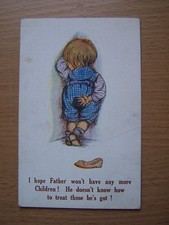
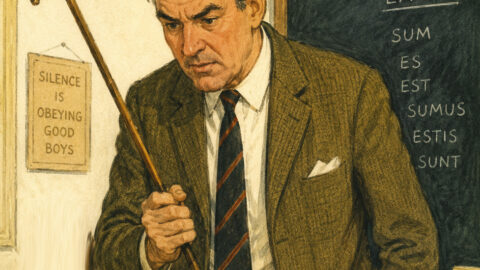
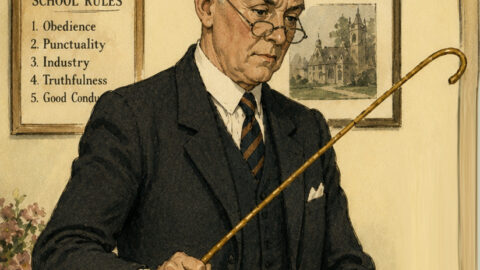
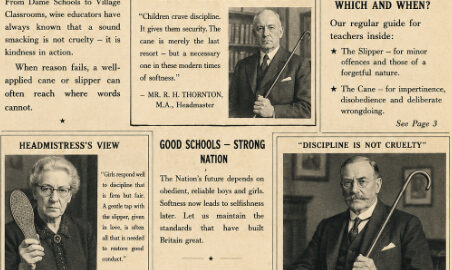
Roger Daltrey from The Who recently wrote in his book that, at age 15, he received six strokes of the cane from his headmaster. The punishment was so severe that he was caned on his bare backside, and then immediately expelled. At least, he joked, he was spared any more canings after that! Gary Lineker also admits in his biography that he was caned at school.
I believe at least one of the Beatles was caned during their school days. Unless they attended private school, any UK youngster who was caned at school would now be over 42 years old, since very few junior schools used the cane. I’m pretty sure Cilla Black once said she was caned at school as well.
In the past, corporal punishment—both at school and at home—was widely accepted as the proper way to discipline children. I’ve read in several places that Cilla Black, known as Priscilla White back then, was caned at school, and I have no doubt it happened. Liverpool, like many big cities, had some tough neighborhoods. In the 1950s and 60s, many 14- and 15-year-old girls weren’t interested in academics; most just wanted to leave school and get a job. School felt boring to them, but they had no choice but to attend. Some of these girls, understandably, acted out.
Liverpool has always been a predominantly Catholic city, with many Catholic schools where school corporal punishment was more common. Maybe Cilla was one of those bored girls. However, none of the reports I’ve read say whether she was caned on her hands or her bottom.
When it comes to girls being caned at school, the number of strokes was usually even—two, four, or six—which meant the cane was used on the hands. At my boys’ school in that era, the headmaster usually gave three or six strokes across the bottom. I know that some UK girls did receive canings on the bottom, but it was much less common than hand canings. Plenty of boys were caned on the hands too.
I was pretty naïve about girls’ schools—and girls in general until I was 14 or 15!—but I did hear that some girls’ schools used the cane on hands, usually only for serious offences. I never heard of girls being slippered in local schools back then. I understood that if a hand caning involved more than one stroke, it was given to both hands—one stroke on each. Sometimes, it was described as “one, two, or three on each,” which explains the even numbers. Some schools might have given “three on the non-writing hand.”
I know that school corporal punishment varied a lot from area to area, and even from school to school. For example, in Walsall in the West Midlands, schools used a leather tawse. Unlike in Scotland, where the tawse was only used on hands for both boys and girls, Walsall schools used it on boys’ bottoms and on girls’ hands. I’ve seen old newspaper reports about this.
If I only relied on my own schooldays and local area, I’d probably assume there was much more corporal punishment of schoolgirls nationally than there actually was. Sometimes, I get the impression that your experience might lead you to the opposite conclusion. Maybe it’s better to underestimate than overestimate in such a sensitive topic.
Paul McCartney and George Harrison were both caned at school too. Many people have said that school corporal punishment was accepted by both pupils and parents, and that was true for some. But not for Harrison’s father—he was from the “Dane school” of thought about corporal punishment. He actually confronted the teacher the next day.
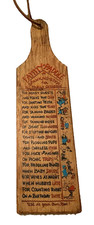
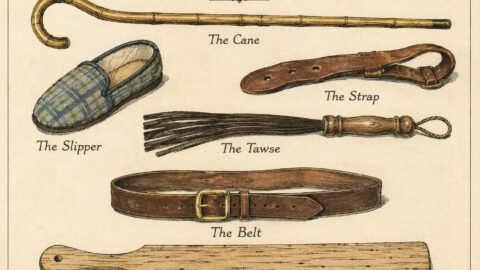
The cane, of course, wasn’t the only implement used. In some schools, especially in Scotland, the leather tawse was the instrument of choice. The tawse was a thick leather strap, split at the end, and it was used almost exclusively on the hands. I remember reading about how, in Scottish schools, both boys and girls would line up to receive “the belt,” as it was called. The ritual was almost as memorable as the punishment itself.
Anecdotes from the time often mention the fear and anticipation more than the pain. One former pupil from Glasgow recalled how the sound of the tawse striking a desk would silence an entire classroom. Another, from Birmingham, described the embarrassment of being called out in front of peers, the walk to the front of the class feeling longer than the punishment itself.
It’s interesting to note that some teachers were notorious for their severity, while others were known for their reluctance to use corporal punishment. There were even stories of teachers who would “pull” their strokes, delivering a token tap rather than a real blow. But there were also those who seemed to relish the authority the cane gave them.
The slipper was another common tool, especially in secondary modern schools. I’ve heard stories from friends who attended such schools in the 1960s and 70s. The gym shoe, or plimsoll, was often used for minor infractions—talking in class, forgetting homework, or being late. Some boys would even boast about how many “slipperings” they’d received, as if it were a badge of honor.
Not all parents approved of corporal punishment, even in those days. My own parents, for example, were divided. My mother thought it was a necessary evil, while my father believed it was outdated and cruel. I remember overhearing heated discussions at home after a neighbor’s son came home with red hands from school.
Some notable figures have spoken out about their experiences. John Lennon, for instance, mentioned in interviews that he was caned at Quarry Bank High School. He described it as “part of the system,” something everyone expected. Yet, he also admitted it left a lasting impression—one that shaped his views on authority.
Even Margaret Thatcher, before she became Prime Minister, was a schoolgirl in Grantham. While there’s no record of her being caned, she later defended the right of teachers to use corporal punishment, arguing it maintained discipline. Her stance was controversial, especially as attitudes began to shift in the 1970s and 80s.
The debate over corporal punishment was fierce. By the late 1970s, campaigners like Mary Whitehouse and organizations such as the National Union of Teachers were calling for reform. Some argued that physical punishment was a violation of children’s rights, while others insisted it was necessary to maintain order.
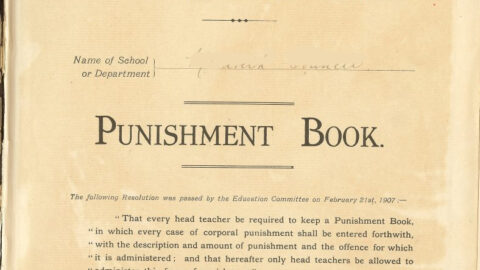
I remember the gradual change in atmosphere as the 1980s approached. Stories of canings became less frequent, and new teachers seemed less inclined to use the cane. Detentions, lines, and extra homework began to replace physical punishment. By 1987, corporal punishment was banned in state schools in England and Wales, and later in Scotland and Northern Ireland.
Looking back, it’s clear that corporal punishment left its mark—sometimes literally—on generations of British schoolchildren. For some, it was a rite of passage; for others, a source of trauma. I sometimes wonder how different things might have been if other forms of discipline had been used.
Today, the idea of caning a child at school seems almost unthinkable. Yet, for those of us who grew up in that era, the memory lingers. It’s a reminder of how much society has changed—and how our attitudes toward children and discipline have evolved.
I’d be curious to hear more stories from others who experienced school in those days. Did the cane teach respect, or just fear? Was it a necessary part of growing up, or an outdated relic? Perhaps the answer lies somewhere in between.
In any case, the stories of Roger Daltrey, Gary Lineker, the Beatles, and countless others remind us that the past is never far away. Their memories—and ours—are a testament to a time when discipline was delivered with a stick, and childhood was shaped by the sound of the cane.