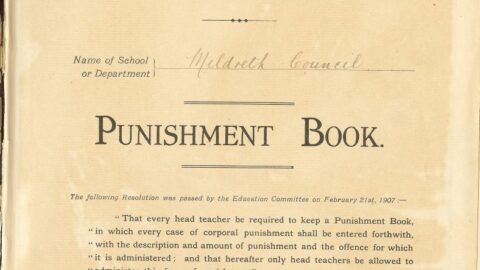
The 1980s saw the beginning of a completely new approach to discipline. Peter Hawkins and Malcolm Joseph drew up the Kostka Hall School Rules in 1986, with the aim of setting specific goals for boys’ behaviour and focusing on acceptable boundaries. The rules covered behaviour in such areas as travelling to school, classrooms, lunch breaks, the library, sport and examinations. In the same period, the school introduced the ‘strap book,’ through which staff became more accountable for their disciplinary techniques by having to record each use of the strap. The culture of discipline was changing in the wider community, and well before the final entry in the strap book (in 1990), use of the strap had rapidly diminished.’
‘Once outside for play and lunch breaks, boys saw more of those who had special responsibilities in the play area. Brother McDonald, for example, “was the disciplinarian with the strap in the school yard. You really weren’t a Kostka boy, it used to be said, unless you’d been strapped by Brother McDonald. But he didn’t really hurt or hit hard. Everybody was aware of his voice and his strap. His favourite expression was “Hey, you boy! Here, you boy!”, and you jumped if you were a boy.”‘
COMMENTS: I left this school in 1988 at age 13 – so towards the end of the time they still used the strap. I have to say if its use had rapidly declined at that time, it must have been used an awful lot in the past. There were sixty boys in my year level – and I’d say three were strapped in any given week. I was strapped by three of the teachers mentioned above – by Brother McDonald, by Peter Hawkins (who was my form master when I was 12) and by Malcolm Joseph (form master in my final year).
I guess it’s true that Brother McD didn’t hit that hard – but it was still easily hard enough to make an impression on a ten year old. Back when I was ten, he used to carry a strap in his pocket in the playground as he had for many years. But he stopped doing that fairly soon after – maybe the changes meant he wasn’t allowed to. It did not however stop him disciplining boys. When I was 13, I dared to backchat him after he had mildly reprimanded me at recess. His hand just swung out and – well, he smacked my bottom.
I don’t think it hurt at all. But I was 13 – I was one of the oldest boys in the school, I had a really high opinion of myself and thought I was very grown up. And this happened in public – dozens of people saw it. I disintegrated into tears. I was totally mortified, utterly embarassed. Looking back on it, it was probably a very good thing considering my attitude. In a second, that man completely reminded me that no matter what I thought of myself, I was still a child, and he was the one in charge, and I could not get away with defying him in any shape or form.
I see a lot of tough kids in schools today, getting into deep, deep trouble – and I wonder if they’d have learned the same lesson
Xavier College, Kew, Victoria, Australia. I attended this school from 1989-1992 (having attended one of its two junior schools, Kostka Hall, from 1985-1988 – the other junior school is Burke Hall, mentioned in the quotes). I never experienced corporal punishment at the senior school – was threatened with it a couple of times.
The books I will quote later relate to schools I did not attend – just to make that clear. Kostka and Xavier are the only ones I will be quoting about that I have direct personal experience of. The others – well, I’m reading their histories because I find them interesting for a number of reasons.
These quotes come from ‘Xavier Portraits’ by Greg Dening and Doug Kennedy, published in 1993. Much of that book is a copy of ‘Xavier: A Centenary Portrait’ published in 1978.
“Rumours of what was put into straps to make them heavy were rife. Some were tan, some were black. Some were carried everywhere, some were locked away let they be taken as trophies.”
Mr. Cornelius Hartnett, S.J (First Division Prefect).: “When one of the boys left the bicycle sports at the Friendly Society Gardens and got drunk, he recorded the appropriate punishment: an apology from the boy on his knees in the Study Hall and dismissal from the Sodality. He next had to stripe two boys for ‘excessive animal sports in the dormitory.’”
“When the boys remember the Prefects, they remember their flogging ways and the guerilla war that gets created between the high regulators and the highly regulated.”
“Rectors and Prefects of Studies were more distant figures, their respective rooms more awe-filled places. A Rector on the whole, however was seen as kindlier and more fatherly than the Prefect of Studies. The latter’s office was at the entrance to the Study Hall, a sort of customs house on the edge of a silent land.
Its heavy door never quite masked the sound of summary justice being administered within. Merely opening it whipped up waves of suspense in boys’ minds as they prepared to proffer an excuse or present the note from their class-master which gave the reason for their execution. It was not a room for sitting or quiet counsel.”
“The dormitories were also places of high discipline. Until the 1920’s they provided some small privacy: each bed was curtained off. But even that small privacy was lost with a change to long, open lines of beds and lockers which the division Prefects could see at a glance. Breaches of silence which in the study could earn ‘penals’ or detention, here would earn a strapping.”
“There were, of course, other scandals and other problems. There was the case of the boy expelled from school for display of ‘French letters not of the epistolary kind’ on the Kew tram. There were mothers who fretted about draughts in dormitories and holes in shoes. There was detective work in the unraveling of schoolboy plots to run away. There were thefts, occasional drunkenness, truancies, late returns from vacation. If one parent saw lack of discipline as a symbol of a general decadence in the school, another promised court action for excessive zeal in strapping.”