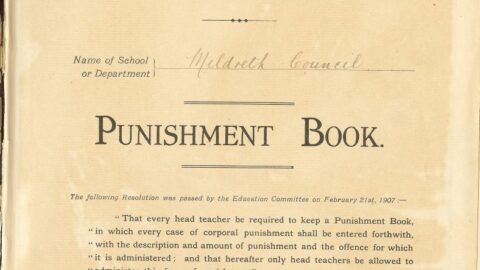
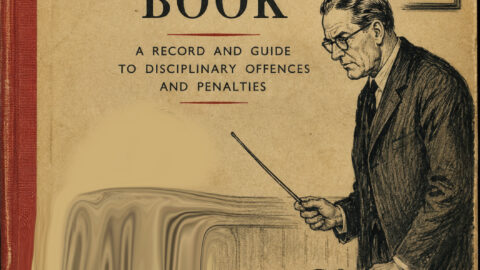
It is difficult to believe that every instance of corporal punishment was formally entered into an official record, at least in many state schools. Although regulations often required such records to be kept, compliance was by no means universal. Schools that employed corporal punishment only rarely may have adhered closely to the rules, but institutions in which it was more frequently administered often reserved the punishment book for formal canings carried out by senior staff.
One can scarcely imagine a junior mistress diligently completing official entries during her luncheon interval after spending the morning administering slaps to younger pupils. Nor is it likely that a physical education master, after a long day in the gymnasium during which several boys had received the slipper, would devote much attention to clerical formalities.
The principal distinction lay between caning and the other, generally less severe, forms of corporal punishment. Surviving punishment books from various schools suggest that only a comparatively small number of canings were officially recorded each year, despite the widespread understanding that corporal punishment was employed far more frequently in practice. The documentary evidence therefore appears to represent only a fraction of the true extent of such discipline.
It is not entirely clear that any Act of Parliament or Statutory Instrument imposed a direct legal obligation upon schools to maintain punishment books. Matters of regulation, however, are somewhat different. Various Education Acts empowered Local Education Authorities to establish rules governing the operation of their schools, and many authorities introduced regulations concerning corporal punishment and the maintenance of punishment records. Breaching such regulations was not equivalent to committing a criminal offence. A teacher could face disciplinary consequences, including dismissal or the withholding of references, but not prosecution before the courts.
Nevertheless, many governing bodies appear to have required headmasters to maintain disciplinary records and make them available for inspection. Schools could, and still can, face criticism during inspections if proper disciplinary documentation is unavailable. Failures relating to safeguarding and discipline have always been treated more seriously than comparatively minor deviations from curriculum guidance.
Parliamentary discussions recorded in Hansard during April 1985 reveal growing concern regarding the administration of corporal punishment. Particular attention was given to the issue of parental rights to exempt children from such punishments. While parents possessed this right, many regarded the resulting situation as inequitable, especially when one pupil received corporal punishment for misconduct while another, guilty of the same offence, escaped it owing to parental objection.
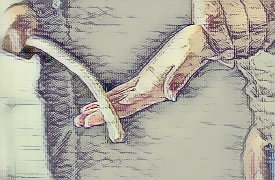
The methods by which punishments were recorded appear, in general, to have been imprecise. Entries in punishment books were often vague and frequently omitted important details, such as whether the punishment had been administered across the hands or the buttocks. Although many authorities specified the use of an “approved cane,” no practical means existed of recording the severity with which it had been applied. A light stroke differed greatly from a forceful one, yet official records seldom reflected such distinctions.
By the mid-1980s, the doctrine of in loco parentis already appeared somewhat outdated. Few parents at that time would themselves have contemplated caning their children. During the 1950s and 1960s, some parents still employed spanking or the slipper as domestic discipline, but by 1985 such practices had declined considerably throughout Britain.
The proposal advanced during that period for a two-tier disciplinary system — whereby one pupil might remain liable to corporal punishment while another was exempt — was unlikely ever to succeed. In practice, many schools had already begun consulting parents individually whenever corporal punishment was under consideration. This approach was both practical and prudent, as few headmasters wished to invite disputes or legal proceedings from dissatisfied parents. It was ultimately undermined less by practical difficulties than by a lack of political enthusiasm for compromise.
The legal principle of in loco parentis has since diminished considerably in significance. It was effectively superseded by later child welfare legislation, which placed greater emphasis upon the rights and welfare of the child. Teachers nevertheless continue to bear responsibilities akin to those of a “reasonable parent” in matters concerning pupil safety and welfare, particularly during school excursions or emergencies, even though their disciplinary powers have been substantially reduced.
An interesting contribution to the parliamentary debate came from Clement Freud, who once recounted an incident from his own schooldays during a late-night political discussion programme. He described being summoned for caning and instructed to remove his trousers and undergarments. Owing to his grandfather’s well-known opposition to corporal punishment, the headmaster reportedly refrained from carrying out the sentence. Freud later recounted the episode with characteristic wit and irony.
The Hansard extract itself may also have been somewhat misleading. One Member of Parliament asserted that schools practising corporal punishment possessed a statutory duty to record every instance in the punishment book. Yet another speaker later clarified that punishment books were maintained under the provisions of a Department of Education memorandum issued in May 1956. Such memoranda constituted administrative guidance rather than statutory law. The distinction is important: guidance may influence professional practice, but it does not possess the binding force of legislation.
The parliamentary exchanges therefore suggest that the intention in 1985 may have been to place the keeping of punishment records upon a firmer legal footing. They also serve as a reminder that statements made in Parliament should not automatically be assumed to represent definitive interpretations of the law.
For many former pupils educated during the 1950s and 1960s, punishment books were more familiar as objects of rumour than direct experience. Boys often considered themselves experts in school discipline despite the fact that many schools possessed remarkably few written rules. One former pupil recalled appearing before his headmaster, together with two companions, for an act of collective mischief. After a stern reprimand, the headmaster entered details into a large book and confirmed the boys’ names, ages and forms before administering three strokes of the cane to each in turn. Subsequent punishments, however, were not always visibly recorded, leading to the suspicion that entries may often have been made either before or after the event.
There are also accounts of boys being instructed to collect both the cane and the punishment book from the school secretary before disciplinary proceedings took place. One is left to wonder what opinions such secretaries privately held regarding corporal punishment, though many likely regarded the matter simply as part of their professional duties.
The principle of in loco parentis always possessed practical limitations. Teachers and youth leaders could make minor decisions on behalf of parents, but not major medical decisions concerning children in their care. In cases requiring urgent medical treatment, authority rested with medical professionals rather than school staff.
Many parents who accepted mild domestic discipline nevertheless regarded school caning differently. A spanking or slippering administered at home by a parent was considered by some to be far removed from a formal caning inflicted by a comparative stranger and capable of leaving marks for several days. Even among those who accepted corporal punishment within the family, there was often unease regarding its use within schools.