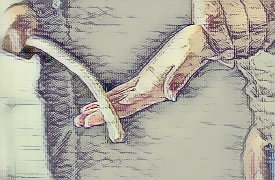
School canes have varied considerably between institutions and across different periods. An 8 mm diameter cane seems rather thin from my recollection, although childhood memories are not always reliable. I remember a woodwork teacher improvising with a three-foot length of 3/8-inch dowel, approximately 10 mm in diameter. While the thickness seemed about right, the wood itself was far too fragile for the purpose.
The physical build of the recipient plays an important role in determining the effect of the cane. A thin adolescent boy often had very little flesh covering his bones, particularly when bent over in the traditional touch-the-toes position, making the experience especially intense.
I was never spanked as a girl, either at home or at school, yet I developed a strong fascination with such punishments during my early teens. I frequently asked friends whether they had ever been smacked. Corporal punishment had long since disappeared from my girls’ high school, but a few of my friends were occasionally punished by their mothers, usually with a hairbrush or a leather strap applied to the bare bottom.
My interest continued to grow over the years. In my early thirties, I met a woman who shared the same curiosity. We openly discussed our thoughts and interests, and before long we began experimenting by spanking one another.
I vividly remember the excitement of having my knickers lowered and receiving a bare-handed spanking for the first time. Soon, however, our experiments progressed to using a hairbrush and a strap with increasing enthusiasm. One day my friend returned from London carrying what she described as a genuine punishment cane.
I was fascinated by it. It felt surprisingly light and harmless in my hands, yet it produced a distinctive swishing sound when swung through the air. Curious about the experience, we agreed to give each other four hard strokes on our bare bottoms and not stop until the punishment was complete.
I volunteered to go first and bent over the arm of the settee. As my skirt was raised and my knickers lowered, anticipation quickly gave way to shock when the first stroke landed. I had never experienced such pain and immediately cried out. Despite the intensity, the experience did nothing to diminish my fascination.
The pain produced by a rattan cane across the buttocks is unlike any other sensation. It is difficult to compare with other forms of physical discomfort. Yet experiences such as these often reveal something about resilience and endurance.
It seems to be part of human nature that surviving a difficult ordeal through courage, determination, and self-control can leave a person feeling stronger. Many boys—and occasionally girls—looked back on visits to the headmaster’s office with a sense of pride or satisfaction. Other demanding experiences, such as exhausting cross-country races, can be deeply unpleasant in the moment yet become valued memories later. Some individuals even find that life-changing hardships ultimately shape them in positive ways.
Of course, challenges always carry risks. Failure can be deeply damaging, and experiences intended as tests of character do not always produce positive outcomes. Whether the challenge is a demanding confidence course or a painful punishment, outcomes vary enormously from person to person.
Responses to caning certainly differed between individuals. Some recipients emerged from the headmaster’s study visibly distressed and unwilling to discuss what had happened. Others, despite obvious discomfort, were surprisingly willing to compare marks and recount the experience only hours later.
Several factors seem to influence how a person copes. Acceptance often helps. Certain events are unavoidable, and resisting the inevitable may only increase anxiety. Sharing the experience with others can also make a significant difference. Talking about a difficult experience often helps place it in perspective.
Minor hardships can also serve as preparation for greater challenges later in life. If a caning represented a boy’s first serious trauma, it was often harder to endure. Yet there was sometimes comfort in facing it collectively. Waiting in line outside the headmaster’s study alongside other boys could lessen feelings of isolation. Observing others emerge apparently composed suggested that the ordeal, while unpleasant, was survivable.
For some, the emotional impact was complex. The initial shock could be intense, particularly when successive strokes landed before the pain of the first had fully registered. Yet surviving the experience could create a sense of achievement, belonging, or relief once it was over.
One incident from boarding school illustrates how such experiences could have unexpected effects. During my first year, when I was twelve, the final morning before the summer holidays was filled with excitement. The dormitory was noisy with horseplay, and someone balanced a waste bin full of water above the door.
When a prefect entered to investigate the commotion, the entire contents of the bin fell on him. I happened to be out of bed at the time and was immediately assumed to be responsible. He grabbed me by the neck and marched me back to his study.
Ordinarily I would have received the slipper, but the prefect had apparently already packed his gym shoes. Instead, he reached for the nearest substitute—his leather trouser belt—and administered a rapid dozen strokes across the seat of my thin pyjamas. Although it did not hurt nearly as much as I expected, the sound was extraordinary, echoing down the corridor and back to the dormitory where my astonished friends could hear every stroke.