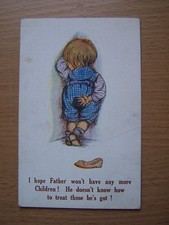
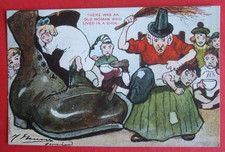
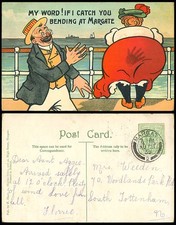
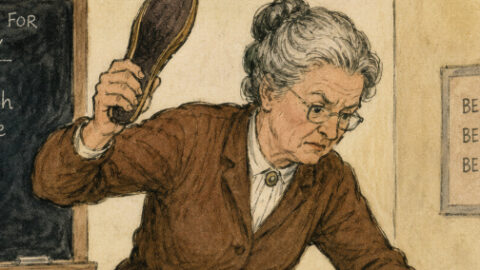
Until recently, I had never really stopped to consider where the teachers at my primary school obtained the slippers they used for punishment. As a child, it was not something that crossed my mind. When you were standing in front of an angry teacher and watched them pull a plimsoll from a desk drawer, practical questions about its origin seemed completely irrelevant. In that moment, the object took on an almost mythical quality. What was, in reality, an ordinary gym shoe suddenly appeared enormous and intimidating.
Looking back, I am fairly certain that most of the slippers were adult-sized. What has always puzzled me is where they came from. The teachers certainly did not wear them themselves. In fact, none of my teachers ever changed into sports clothing for physical education lessons. They remained in their ordinary attire, standing at the side of the gymnasium barking instructions while the pupils exercised. I doubt many of the plimsolls used for punishment had ever been worn by the teachers who wielded them. It seems more likely that they were acquired specifically for disciplinary purposes.
Among the staff, the threat was always referred to as “the slipper.” Among the pupils, however, we used the more familiar expression of “getting the pump.” The terminology may have differed, but the meaning was perfectly clear to everyone involved.
I was the youngest member of my family to attend the school. There was a considerable age gap between myself and my older siblings, which provided an interesting comparison of how discipline changed over time. My eldest sibling does not recall teachers regularly using slippers in the classroom. Physical punishment certainly existed, but it was more likely to involve a smack from a teacher’s hand or a trip to the headmaster’s office. By the time I attended the school, many of the same teachers were still there, yet their methods seemed to have evolved. Classroom punishments were used more frequently, while referrals to the headmaster appeared less common. The slipper had become an established and convenient disciplinary tool that allowed teachers to deal with matters themselves.
For me, the school slipper provided my first introduction to corporal punishment. It also sparked an interest that has remained with me for more than three decades. One particular incident stands out vividly in my memory. I was twelve years old when I witnessed three boys being slippered outdoors while an entire class of girls looked on. The scene had a strangely powerful effect on me, one that I did not fully understand at the time. Even now, I can remember that day with remarkable clarity.
Although I personally received corporal punishment only once during my five years at the school, I was frequently exposed to it as an observer. Punishments occurred regularly enough that they became part of the everyday atmosphere of school life. The distinctive sound of a slipper striking its target was instantly recognisable and often echoed through the corridors. In the gymnasium, where acoustics amplified every noise, the sound could reverberate around the building for many seconds after the punishment itself had ended.
Over the years I witnessed corporal punishment administered in a variety of circumstances. Sometimes it was delivered over the thin shorts worn for games lessons, occasionally with little or no additional clothing underneath. On rare occasions it was administered immediately before or after showers, resulting in even more severe forms of punishment. Such events left a lasting impression on those who witnessed them.
In an odd way, the school slipper became intertwined with my later interest in corporal punishment. What began as childhood observation gradually developed into a lifelong fascination. Whether that fascination should be regarded as a hobby, an interest, or an obsession is perhaps open to debate, but there is no question that those early experiences played a significant role in shaping it.
When considering where the teachers acquired their slippers, lost property seems the most likely explanation. The school itself was extremely old and had accumulated decades’ worth of forgotten possessions. It is easy to imagine generations of abandoned plimsolls gathering dust in cupboards and storage rooms until some enterprising teacher discovered their disciplinary potential.
The image of teachers searching through lost property to find the most suitable and effective slipper is strangely amusing. Yet there may well be some truth in it. Teachers who wished to keep a slipper readily available could not rely upon pupils bringing one to school. Wearing pumps outside of physical education lessons was generally discouraged, and most children only brought their PE kit on designated sports days. Had a teacher demanded a slipper from the class, they might easily have found none available.
This raises another interesting question: what happened to these disciplinary slippers when they were eventually no longer needed? Were they thrown away, returned to lost property, or simply left forgotten in some desk drawer? Given the longevity of many school institutions, I suspect some of them may have remained hidden away for decades.
Years after leaving school, I returned there while undertaking a college placement. I had little enthusiasm for revisiting the place, but its proximity to my home made it a convenient option. One day, while searching through a classroom cupboard for teaching materials, I made an intriguing discovery. Hidden among the clutter was a small cane.
At the time, school corporal punishment was still technically legal, although classroom caning had long since disappeared from the school. Finding that cane immediately made me wonder how long it had been there.
My father had attended the same school many years earlier. In his day, some teachers employed a remarkable disciplinary method. Rather than administering the punishment themselves, they would hand a small cane to the offending pupil and order them to cane themselves. If the cane I discovered was indeed the same one used during my father’s schooldays, it had been sitting forgotten in that cupboard for approximately half a century. If a cane could survive unnoticed for fifty years, it seems entirely plausible that some of the slippers from my own era might still be hidden somewhere within the building.
According to my father, pupils were not usually told exactly how many strokes they were required to administer. The important thing was that the effort appeared genuine. If the teacher felt the child was holding back, they would simply be instructed to strike themselves harder.
My father, being naturally left-handed, encountered an additional complication. During his school years, left-handedness was actively discouraged. On one occasion, a teacher automatically placed the cane in his right hand and instructed him to strike his left hand. Although he could write reasonably well with either hand, his left remained his stronger side. Consequently, his attempts at self-punishment appeared insufficient to the teacher, who ordered him to repeat the process until a satisfactory level of force was demonstrated.
The school was co-educational, and my aunts attended alongside the boys. Interestingly, girls were subjected to the same disciplinary practices. Throughout the school’s history, methods of punishment appear to have changed repeatedly, but one constant remained: both boys and girls were disciplined under the same system.
For my father, the school represented his entire formal education. He left at fourteen, having attended no other institution. He recalls at least one female infant teacher, although his memories of those early years are vague. Most of his recollections involve a single male teacher who taught him throughout what would now be considered the junior years, roughly from the ages of eight to fourteen.
The self-caning usually took place within the classroom itself. My father was never entirely clear about whether pupils were required to stand before the class, but his descriptions suggest the teacher approached children while they remained seated at their desks, cane in hand, and issued the instruction there and then.
The headmaster employed rather more traditional methods. He personally administered canings, and these punishments were often carried out in front of an audience. My father and his friends, a group known for their colourful nicknames and mischievous behaviour, sometimes treated these occasions as opportunities for entertainment.
When summoned for punishment, they would deliberately attempt to provoke the headmaster by acting uncooperatively. Their goal was to make him so angry that his eyes would bulge dramatically. Among the boys, a running challenge developed: who could be the one to make the headmaster’s eyes actually pop out?
Naturally, such antics only resulted in harsher punishments. According to my father, they often received a severe thrashing as a consequence. Yet in their eyes, the spectacle was worth the price, particularly when fellow pupils were watching. The resulting laughter and admiration from their peers more than compensated for the increased severity of the caning.
Although the boys never succeeded in achieving their impossible objective, my father always maintained that the attempt itself was half the fun. Even many years later, he occasionally remarked that one of his few lingering disappointments from school was that he never quite managed to see those famous eyes finally pop out.