Corporal punishment was a normal part of school life during my school years, and like most boys of my generation, I accumulated more than my fair share of encounters with the slipper and, on occasion, the cane. Looking back now, some incidents stand out not only because of the punishment itself but because of the unusual circumstances surrounding them.
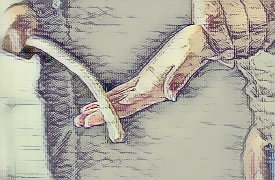
One particularly strange episode occurred during my time at junior school. A teacher summoned two boys to the front of the classroom and ordered them out of their seats. Expecting the usual caning, the class fell silent as he produced his cane. What happened next, however, was something none of us had ever witnessed before.
Instead of administering the punishment himself, the teacher instructed one of the boys to bend over. He then handed the cane to the second boy and told him to carry out the punishment. The unfortunate boy holding the cane looked thoroughly uncomfortable with the task. Reluctantly, he delivered two very weak, hesitant strokes that barely seemed to qualify as punishment at all. The entire affair felt awkward and ineffective. The recipient hardly reacted, and within moments both boys were told to return to their desks.
It was a remarkable incident precisely because it never happened again. The teacher evidently concluded that delegating punishment to pupils was neither practical nor satisfactory, and from then on he returned to administering canings himself whenever he felt they were required.
The Slipper at Secondary School
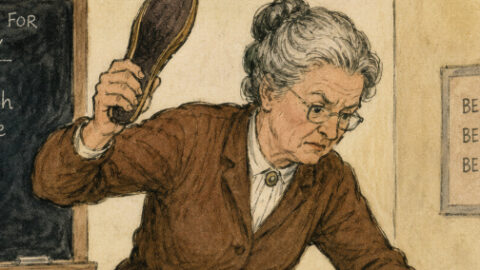
By the time I reached secondary school in the 1960s, the slipper had become the preferred instrument of discipline for many teachers. Some used it frequently, while others reserved it for more serious offences. The physical education teacher, however, was undoubtedly its greatest enthusiast.
Curiously, despite slippering boys on what seemed like a daily basis, he did not possess a favourite slipper of his own. Rather than keeping a dedicated shoe for disciplinary purposes, he simply used whatever happened to be available. Sometimes it came from the lost property box; at other times a nearby pupil might be instructed to lend a plimsoll for immediate use. There seemed to be an element of chance involved, both for the teacher and for the unfortunate recipient.
I found myself on the receiving end of his slipper many times. Punishments were often administered in front of the class, creating an atmosphere that was equal parts discipline and spectacle. A line of boys would be summoned to the front, each awaiting his turn while trying desperately to appear unaffected.
The audience inevitably played its part. The girls seated near the front always appeared particularly fascinated by these proceedings, watching closely as the boys attempted to maintain their dignity. Among the boys, there was often a mixture of sympathy, relief that it was someone else, and curiosity about how severe the punishment would be.
Most of the other male teachers were more occasional users of the slipper. Unlike the PE teacher, many of them kept a preferred shoe specifically for punishment. Some had used the same slipper for years, and a few had even bestowed nicknames upon them, as though the implements had become established characters within the school.
An Unfair Slippering
Of all the punishments I received, one remains memorable not because it was particularly severe but because it felt profoundly unjust.
During my school years I was subjected to a considerable amount of bullying. It was not simply a matter of a couple of dominant boys making life difficult. The behaviour spread through the class. Once the strongest bullies realised they could get away with intimidating weaker pupils, others followed their example. Boys who might not normally have behaved aggressively began copying those above them in the pecking order.
As one of the less physically confident pupils, I often found myself a target. The choice frequently seemed to be either to fight back or accept being pushed around. More often than not, I chose the latter, hoping to avoid trouble.
One day, however, circumstances pushed me beyond my limit.
As we left a woodwork lesson, two boys who regularly gave me a hard time were once again shoving and harassing me. Nearby stood a class of younger pupils waiting to enter the workshop. One of these younger boys witnessed the incident.
Later that day, during break time, he sought me out in the playground. Although he was a year younger and considerably smaller than me, he apparently decided that if others could push me around, then so could he.
At that moment I realised something had to change. If I allowed even younger pupils to treat me as an easy target, I feared I would become a laughing stock throughout the school. For the first time, I decided to stand my ground.
I told him firmly to leave me alone. When he continued pushing, I pushed back. The confrontation escalated quickly, and I eventually punched him. The blow knocked him flat onto his back.
Within seconds, before he had even stood up, a teacher appeared on the scene.
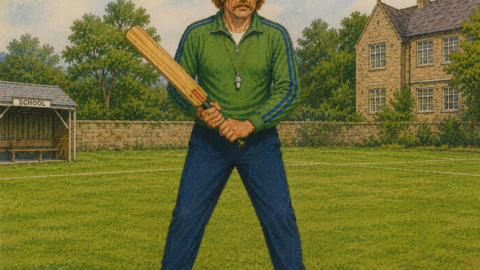
I recognised him by sight but had never been taught by him. He was a tall, thin man with a reputation for taking discipline seriously.
“I can’t stand bullying,” he announced sternly as he took in the scene before him.
“Neither can I, sir,” I replied truthfully.
Unfortunately, from his perspective the situation seemed obvious. He saw an older, larger boy standing over a younger pupil lying on the ground. The notion that the younger boy might have been the instigator simply seemed implausible to him.
He ordered me to his classroom to await punishment.
The Giant Slipper
Upon arriving at the classroom, my thoughts immediately turned to what form that punishment would take.
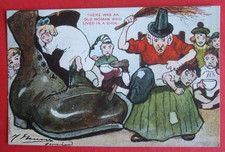
I searched the room for the inevitable slipper but found nothing obvious. My curiosity got the better of me, and I discreetly looked around the cupboards. There I discovered what appeared to be a pair of gigantic gym shoes.
These things were enormous—perhaps size twelve or even larger—with exceptionally thick soles. Each seemed to weigh several pounds.
Surely, I thought, he cannot intend to use those.
Convinced there must be another slipper hidden somewhere, I continued looking but found nothing else. The giant gym shoes appeared to be the only candidates.
About ten minutes later the teacher arrived. He delivered a lengthy lecture about bullying, ignoring my attempts to explain the situation. To be fair, the evidence before him had pointed strongly in one direction.
When the lecture ended, he opened the cupboard and produced exactly the shoe I had feared.
My heart sank.
As I bent over, I imagined the enormous slipper would knock me off my feet.
The first stroke landed with a tremendous thud.
To my surprise, however, it was not nearly as painful as I had expected. The sheer size and weight of the shoe created a heavy impact, but it lacked the sharp sting of the smaller, more flexible plimsolls commonly used for punishment.
Four strokes followed in total.
Although they certainly hurt, the sensation was different. Instead of the intense burning sting produced by lighter slippers, the giant shoe delivered a deeper, heavier impact that left my backside glowing for the remainder of the afternoon.
I was then dismissed and sent back to class.
Looking back, it remains the most unfair punishment I received. Not because it was especially severe, but because it was imposed for standing up to bullying after years of enduring it.
Different Teachers, Different Slippers
My own experiences of the slipper were largely confined to primary school, where I received it on numerous occasions. By secondary school, despite the widespread use of corporal punishment, I somehow avoided further slipperings outside the incidents already described.
One thing I learned was that not all slippers were created equal.
At my school, the PE master possessed enormous size 14 feet and kept one of his old gym shoes specifically for disciplinary purposes. It was a fearsome implement and among the most painful slippers in regular use.
Other teachers relied on footwear obtained from lost property. As a result, the severity varied enormously depending on whose office or classroom you happened to visit.
My very first teacher possessed a tiny, rather worn slipper that could not have been much larger than a child’s size one. While receiving it was never pleasant, its effect was relatively modest.
At the opposite end of the scale was my final teacher at the school. His chosen slipper was a size nine gym shoe apparently abandoned by a particularly large pupil from years gone by. It packed considerably more punch and commanded far greater respect.
Such details may seem trivial now, but to schoolboys of that era they mattered enormously. We became surprisingly knowledgeable about which teachers used what implements, who delivered the hardest punishments, and which classrooms were best avoided when trouble loomed.
For better or worse, these experiences formed part of everyday school life in those days. While attitudes toward discipline have changed dramatically since then, the memories remain vivid—sometimes amusing, sometimes frustrating, and occasionally tinged with a sense of injustice that has never quite faded.