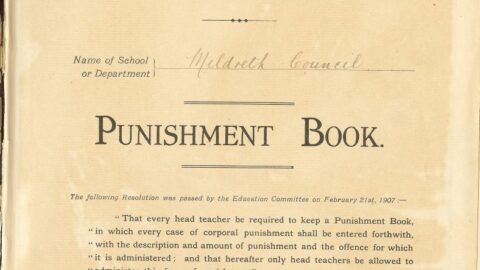
Boys found guilty of serious misdemeanours or repeated offences could expect to be sent before the Headmaster for a swishing. This dreaded summons was known throughout the school simply as being sent to “the Beak.”
The Headmaster, Mr Henry Cloak, was an imposing figure in every sense of the word. A large, stern, humourless man, he carried himself with the gravity and authority of a High Court judge. His thick white hair, worn in loose curls, and his flowing black academic gown only reinforced the impression. Indeed, there was something distinctly judicial about the way he conducted discipline. Unlike masters who dispensed punishment quickly and with little ceremony, Mr Cloak took great pride in carefully considering each case before deciding upon a sentence. His favourite maxim was, “Let the punishment fit the crime,” and he applied it with unwavering conviction.
The nickname “the Beak” suited him perfectly. In old slang, appearing before “the beak” meant standing before a magistrate or judge, and no one embodied that role more completely than Mr Cloak. Yet the nickname also reflected his appearance. Dominating his face was a large, sharply curved nose which gave his profile a distinctly birdlike quality. Seen from across the assembly hall, silhouetted against the stage lights, he resembled a watchful vulture surveying its domain.
To be sent to the Headmaster’s study was regarded as one of the gravest experiences a boy could face. Stories circulated endlessly among the pupils concerning his formidable skill with the cane. Older boys spoke in hushed tones of punishments so severe that the resulting bruises remained visible for weeks afterwards. Whether every tale was true hardly mattered. The stories alone were enough to inspire awe and fear in new arrivals.
Mr Cloak’s reputation was enhanced by his physical presence. An Oxford history graduate, he had distinguished himself in sport during his university years. He had played both rugby and cricket at a high level and had even rowed in the famous Oxford and Cambridge Boat Race. Now in his mid-forties, he retained much of the strength and athleticism of his youth. Tall and broad-shouldered, he stood head and shoulders above most of the teaching staff. During morning assembly, as he stood on the stage flanked by his senior masters, he seemed almost larger than life. His white hair and commanding stature gave him the appearance of some modern-day Samson, a man entirely capable of enforcing discipline through sheer force of will if not physical strength.
Each morning assembly concluded with a ritual that many boys dreaded more than any lesson or examination. Mr Cloak would produce a list and begin reading aloud the names of those required to report to his study immediately afterwards.
The atmosphere in the hall would change instantly.
Every boy listened anxiously, hoping not to hear his own name. Those who were called often turned pale. Some stared fixedly at the floor while others sat rigidly in their seats, scarcely daring to breathe. A summons did not automatically mean punishment; there were occasions when a boy was merely questioned or reprimanded. Nevertheless, nobody ever assumed the best. Experience had taught us that being called before the Headmaster usually meant trouble.
It was about five weeks into my first term when my own moment arrived.
The assembly was drawing to a close. Mr Cloak had already read several names when I heard the words that caused my stomach to lurch.
“…and B. Spockings of Form 1A.”
The sound of my name echoing through the hall seemed unnaturally loud.
To be honest, I could not claim complete surprise. The previous afternoon, while travelling home on the bus, I had become involved in an incident that was almost certainly the reason for my summons.
Two boys from the local secondary modern school had begun teasing me shortly after I boarded. They mocked my school uniform, which they clearly regarded as ridiculous. Unlike us, they did not have to wear one. Their amusement soon escalated into harassment when one of them snatched my school cap from my head. The pair proceeded to throw it back and forth between themselves, forcing me to chase after it while they laughed. To the other passengers it may have appeared little more than childish horseplay, but to me it was humiliating.
For several minutes I endured their taunts, trying unsuccessfully to retrieve my cap. Then something inside me snapped.
Seeing red, I launched myself at the nearer boy. I struck him with my fists and attempted to wrestle him to the floor. What had begun as a prank instantly descended into chaos. The second boy joined the fight from behind, grabbing and punching at me. Within moments the three of us were engaged in a full-scale brawl. Schoolbags flew, passengers shouted, and other children crowded around us, cheering and urging us on.
Eventually the bus driver brought the vehicle to an abrupt halt and stormed down the aisle to separate us. With considerable effort he pulled us apart and demanded our names and schools. After recording the details, he ordered all three of us off the bus.
At the time, I had hoped that would be the end of the matter.
Clearly it was not.
Someone had informed the school, and now the consequences awaited me.
Leaving the assembly hall, I began the long walk towards the Headmaster’s study. The school itself was a curious blend of old and new architecture. At its heart stood the original Victorian building, a sprawling structure of dark brick and stone. It housed the sixth-form classrooms, the prefects’ common room, the senior masters’ offices, the administration block, the library, and, most importantly, the Headmaster’s study.
Around this older building newer additions had gradually appeared over the years: the science block, the gymnasium, and the modern auditorium where assembly was held each morning. The route from the auditorium to the old building seemed unusually long that day. Every step gave me more time to consider what awaited me at the journey’s end.
The corridors were quiet as boys dispersed to their lessons. My footsteps echoed on the polished floors while my mind raced through every possible outcome. Would I merely receive a stern lecture? Would there be a note sent home to my parents? Or would Mr Cloak decide that fighting, regardless of the provocation, warranted a far more painful lesson?
Ordinarily, the prospect of corporal punishment occupied a strange and complicated place in my imagination. On this occasion, however, there was nothing remotely appealing about it. As I approached the Headmaster’s study and contemplated facing the most feared man in the school, any such thoughts vanished entirely.
For the first time since arriving at the school, I felt only apprehension.
And with every step closer to the door marked “Headmaster,” that apprehension grew.