In many British schools during the twentieth century, the slipper occupied a unique place among disciplinary measures. Unlike the cane, which was usually a formally regulated punishment requiring authorization and record-keeping, the slipper was often employed as a more informal corrective measure. By the late twentieth century its use had generally declined, but in many schools it remained in use long after the cane had disappeared.
The frequency with which the slipper was administered varied greatly over time. In some boarding schools during the 1970s it might have been used almost daily, whereas by the late 1980s its use had fallen dramatically, perhaps occurring only a handful of times each term. Nevertheless, the slipper survived the abolition of the cane in many establishments. Supporters of the practice often argued that it allowed a teacher to make a firm disciplinary point without inflicting the more severe pain or lasting effects associated with caning. A slippering could be sharp and memorable while generally avoiding the level of injury, resentment, or prolonged discomfort that a caning might produce.
One common misconception concerned the type of slipper used. It was sometimes claimed that smooth-soled slippers were preferred because they were gentler or “fairer” on the recipient. In reality, the opposite was often true. Teachers frequently preferred smooth leather soles because a larger surface area came into contact with the buttocks during impact. This increased the sting by distributing the force across a broader area. The absence of tread was not primarily intended to reduce marking, since rubber tread patterns rarely left significant impressions compared with the overall effect of the blow.
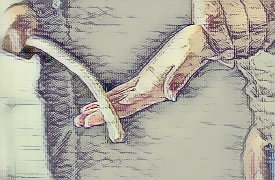
Unlike the cane, whose dimensions and specifications were often regulated by school authorities, the slipper existed in a remarkable variety of forms. Because it was generally an unofficial implement, there were few restrictions regarding the type of footwear that could be used. House slippers, gym shoes, plimsolls, and occasionally other forms of footwear all found their way into service as disciplinary tools.
Some school heads and senior staff maintained a dedicated slipper specifically for disciplinary use. A typical example might have been an old leather-soled house slipper dating from the early decades of the twentieth century. These older slippers often possessed thick yet flexible leather soles that produced a sharp sting without causing significant injury. In many cases, only one or two strokes delivered across a boy’s trousers were considered sufficient to deal with minor offences that warranted more than a verbal reprimand but less than a caning.
The slipper occupied an intermediate position within the hierarchy of punishments. Teachers frequently regarded it as suitable for offences that did not justify severe disciplinary action but nevertheless required an immediate and memorable consequence. It was often considered more effective than detention, extra work, or lines, while remaining less serious than corporal punishments administered with the cane.
School practices varied considerably regarding whether the punishment was administered over clothing or directly to the skin. In many schools slipperings were normally delivered across trousers or shorts. Elsewhere, particularly in certain boarding schools or under particular members of staff, boys might be required to lower their trousers before receiving the punishment. Such variations reflected local custom rather than any universal standard.
There were numerous stories illustrating the assumptions pupils carried from one school to another. A boy transferring from a school where the slipper was always applied over trousers might prepare himself accordingly, only to discover that the disciplinary practices at his new school were quite different. Such misunderstandings occasionally resulted in embarrassment as much as punishment, particularly when staff interpreted attempts at self-protection as further misconduct.
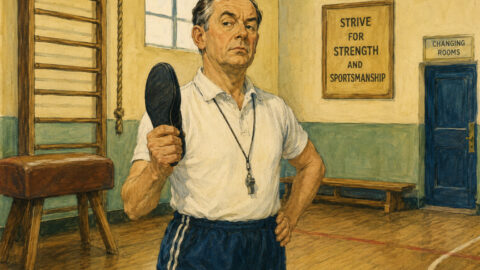
Physical education departments developed their own traditions regarding the use of the slipper. PE staff were often regarded as the most frequent users of this form of punishment. Rather than keeping a dedicated slipper for disciplinary purposes, they commonly relied upon whatever footwear happened to be available, including lost-property gym shoes or plimsolls borrowed from another pupil. Because younger pupils required different treatment from older boys, the size of the shoe used often varied considerably.
In junior schools, smaller gym shoes were frequently employed. A shoe in the region of a child’s size four or five was often considered more appropriate than a larger adult slipper. The reasoning was practical: a smaller implement covered most of a younger child’s buttocks while reducing the risk of bruising that might result from a heavier shoe. Teachers were generally conscious of avoiding injuries that could lead to complaints from parents.
Opinions differed regarding the effectiveness of different sizes of slipper. Some teachers believed that a larger slipper, striking both buttocks simultaneously, provided a more uniform punishment. Others maintained that a smaller shoe concentrating its impact on a single buttock at a time produced a sharper and more memorable sting. Such preferences varied widely between individual staff members and schools.
Most teachers who used the slipper regularly selected footwear that they believed was suitable for the purpose. Nevertheless, experimentation occasionally occurred. Certain schools briefly saw the use of heavier plimsolls with thick rubber soles, such as Green Flash shoes. These were generally unpopular among both pupils and staff because their weight increased the likelihood of bruising and visible marks.
Within classrooms, teachers who relied upon the slipper often kept a designated example in a desk or cupboard. Such slippers frequently acquired nicknames, becoming almost legendary among pupils. Names such as “Charlie,” “Fred,” or “Mr Sting” were sometimes attached to these implements, contributing to their reputation as symbols of discipline and authority.
The circumstances surrounding punishment in PE departments differed from those found elsewhere in the school. Because boys were often dressed only in shorts during games lessons, any slippering administered at that time tended to be felt more intensely. In many schools underwear was not worn beneath games shorts, meaning there was little protection between the shoe and the skin. As a result, even relatively light blows could produce a sharp and immediate sting.
Some PE teachers deliberately chose moments before or after showers to deal with disciplinary matters. From a practical standpoint this allowed punishment to be administered quickly without interrupting lessons. It also reflected the more informal disciplinary culture that often existed in gymnasiums and changing rooms compared with ordinary classrooms.
The slipper’s effectiveness as a deterrent was frequently cited by those who supported its use. Beyond the physical discomfort, there was often a psychological element. The prospect of receiving a slippering in front of peers, particularly in the environment of a changing room, could have a powerful influence on behaviour. Whether this represented effective discipline or unnecessary humiliation remains a matter of historical debate.
Stories occasionally circulated about exceptionally large slippers or shoes being used for punishment. Claims involving oversized footwear, such as adult size-thirteen slippers, should probably be treated with caution. Such shoes would have been cumbersome to wield effectively and, because of their greater weight, more likely to cause bruising. Practical considerations alone suggest that most teachers preferred implements that were manageable in the hand and capable of delivering a controlled, rather than excessive, punishment.
Looking back, the slipper represents a distinctive chapter in the history of school discipline. Its widespread use reflected educational attitudes that were once commonplace but are now largely confined to history. The considerable variation in how it was employed—from school to school, teacher to teacher, and decade to decade—illustrates the informal nature of the practice and the absence of any single standard governing its use.