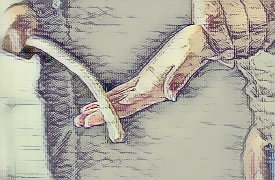
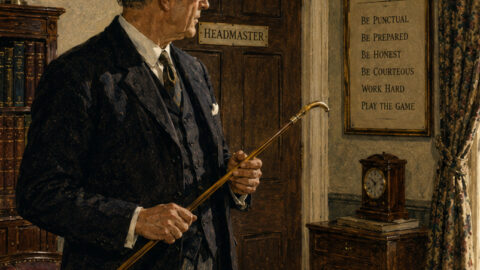
As I mentioned previously, their private convent school employed no corporal punishment during the 1960s. Around 1968, her younger sister transferred to the local grammar school, largely because many of her friends attended there and because the family anticipated a substantial move. A transfer from one grammar school to another therefore appeared sensible. The middle sister subsequently moved to the sixth form of the new grammar school as well, much to the satisfaction of their father, who until then had been responsible for paying fees for three daughters simultaneously.
The youngest sister’s first grammar school was co-educational, and she was somewhat shocked when a boy she knew was caned. She remained there only briefly before the family relocated to another part of the country. The new grammar school was for girls only, a circumstance that greatly pleased their mother.
Although the implication is that caning of the hand was widespread, it is noteworthy that at some schools both the hand and the buttocks were considered permissible targets for punishment.
The reported use of a hairbrush at Walton-le-Dale is also striking, as such an implement was not generally approved by educational authorities. It was capable of causing considerable bruising.
I also observed that the only corporal punishment mentioned at Walshaw Secondary School occurred during school camps. It has often been remarked that school camps sometimes gave rise to disciplinary practices not ordinarily encountered during the school term.
The use of the hairbrush at Walton-le-Dale is both unusual and surprising. One imagines it was employed only infrequently, though doubtless effectively. I should have thought the most common method of administering such punishment would have involved the pupil being bent over the knee, as I have seldom heard of a hairbrush, bath brush, or clothes brush being used in any other manner.
I was pleased to note the references to pupils punished both at school and again at home, which were evidently included with deliberate intent.
One former pupil at Pleckgate recalled:
“I only ever received the cane on the hand. I was relieved, because my stepfather had already left my backside bruised and cut with his belt.”
In another recollection she added:
“I received three strokes of the cane on each hand, and the following week I had to return for another six. My father was furious with the teacher.”
It is interesting to consider that, while her father objected strongly to corporal punishment administered by a male teacher, he apparently accepted far harsher punishment carried out at home by her stepfather.
A former pupil at Shadsworth remembered being taken to school by her father after some misconduct. The headmaster administered several strokes of the cane with the father’s approval. It is reasonable to assume that this punishment was delivered across the hand.
I fear I may previously have misrepresented an account concerning St Gabriel’s Preparatory School. The former pupil in question actually stated:
“I attended a severe Catholic preparatory school run by nuns. We were forced to eat dreadful meals, and at the age of six I received six strokes on my backside for drawing on my desk. I was badly bruised.”
Although I had initially assumed the punishment had been administered on the bare skin, this was not stated. Nevertheless, the punishment described was undoubtedly severe, particularly for a child of such a young age.
With regard to Ribbleton Hall, there appears to have been no single established disciplinary practice. It would be interesting to know what the local education authority’s policy was during the period concerned.
Several former pupils of Walton-le-Dale recalled punishments administered by a senior mistress named Miss Ovenden. One remembered being struck with a hairbrush for wearing a skirt above the permitted length, while another stated that she “was forever getting the hairbrush.” A third recalled Miss Ovenden using the brush on pupils’ backsides. There is also evidence that the implement was sometimes used across the hand.
The discussion of Helston Grammar School raises more serious issues. A former pupil recently objected strongly when references to a controversial former headmaster were removed from public discussion. He argued that suppressing such matters distorted the historical record and prevented acknowledgment of behaviour that had caused genuine suffering. He further suggested that silence surrounding such incidents had often enabled abuses of authority to continue unchecked.
His argument is compelling. It is important that unpleasant aspects of educational history should not be ignored merely because they are uncomfortable to discuss.
Returning to the subject of school camps, the accounts from Walshaw School concerned punishments administered at Hestbank Holiday Camp in Morecambe. One former pupil recalled dormitories containing approximately twenty-five beds, supervised from adjoining quarters occupied by teachers. She remarked that the slipper was used “most nights.” Another remembered receiving the “plimsoll” punishment for smoking in the lavatories.
These accounts appear characteristic of the doctrine of in loco parentis, under which teachers were expected to exercise parental authority while supervising children away from home. At the time, such punishments were generally regarded as socially acceptable.
Some years later, during my own first school camp in the North Yorkshire Moors, no corporal punishment was administered, though I do recall one mischievous incident involving a girl from the school.
There is considerable evidence that the incident at Helston was far from isolated. The comments made by former pupils may have referred to schoolgirls more generally rather than solely to pupils at Helston, but the moderator’s explanation for deleting discussion — namely, the wish to avoid reviving painful memories — strongly suggests that the matter remained deeply troubling for many involved.
Regarding the punishments at camp, the remark that “we received the slipper most nights” suggests the punishment was probably administered over nightclothes. The description of the dormitories is familiar: in many schools boys and girls slept in separate sections, with teachers accommodated between them. One assumes punishments were usually administered by a teacher of the same sex, though this was certainly not always the case.
My own class teacher during my final year at junior school used a wooden T-square to punish boys. The more troublesome pupils would be required to bend over a table at the front of the classroom before receiving what was usually three firm strokes. Ours was a mixed class, and the girls witnessed these punishments. Girls rarely misbehaved, but when they did they were generally sent to the senior mistress, who slapped the backs of their legs in private.
I was considered a conscientious pupil and served as class monitor. One afternoon, however, I was detained after school and reprimanded for “getting too big for my boots.” To my alarm, the teacher removed the T-square from the blackboard. Having seen it used many times before, I knew immediately what was expected when he instructed me to bend over. I received three strokes. They stung considerably, though they were not especially severe. I had never previously been punished at school, although occasional smacking at home was not uncommon. I remained class monitor afterwards, though I became more careful not to draw attention to myself.
Such T-squares were approximately three feet long. My classroom teacher kept neither cane nor slipper, though the headmaster and deputy head occasionally caned or slippered particularly unruly boys. Girls were spared these punishments, although some of the more difficult ones reportedly received slaps to the backs of their legs from the senior mistress.
The T-square was not used excessively. This was a period when many parents still employed corporal punishment at home, and few boys appeared genuinely frightened of it. The punishment stung sharply, but it was accepted as part of school life at the time.
Schools, of course, differed greatly. At mine, T-squares were never used on classroom blackboards, which had raised rims that made such use impossible. They were confined to technical drawing lessons, where the boards had no rim and straight lines could be drawn properly. Only the technical drawing master used the instrument for corporal punishment.
I recall one such occasion at secondary school. A technical drawing teacher, who normally preferred written punishments, assigned a boy two hundred lines to complete that evening. The boy protested that his father would not permit him to do lines at home, which struck me as highly unusual. After a brief pause, the teacher offered an alternative: three strokes across the buttocks with a T-square. The boy accepted immediately. We watched as he bent over and received the punishment, which clearly caused discomfort though not great distress.
I knew nothing of the boy’s home circumstances, but I wondered whether corporal punishment at home may have influenced his willingness to accept the alternative. In any case, I do not recall that teacher ever again administering physical punishment.
—